 flip
flipHerb Omelette from the Studio, Ardèche Style
Herb Omelette from the Studio, Ardèche Style
Why this dish? From 1937 to 1940, Carrington lived with Max Ernst in a farmhouse at Saint-Martin-d'Ardèche, which they decorated with sculptures. Far from English luxury, they ate simply and locally: eggs, garden herbs, olive oil — the frugal and luminous cooking of two painters who turned their home into a work of art.
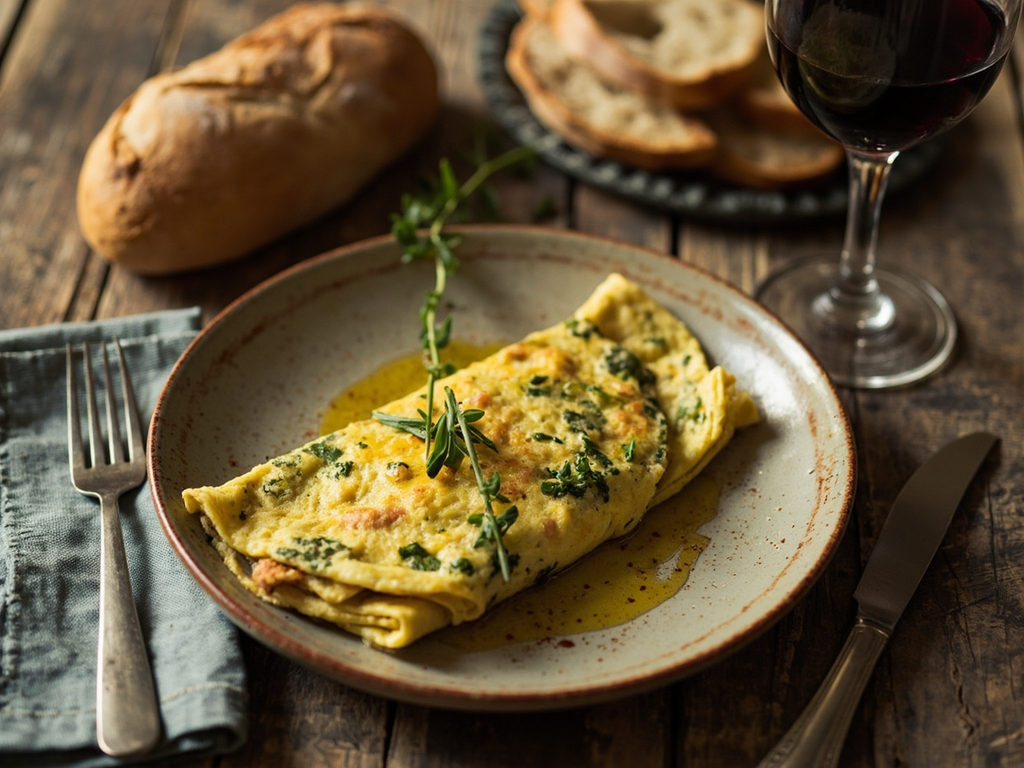
A runny omelette folded over fresh garden herbs and a little melted onion, drizzled with olive oil. The quick meal between painting sessions, but cooked with care — the humble transmuted, as always with her.
Here, at Saint-Martin, we have neither servants nor silverware — and what a relief! The hens give us the eggs, the garden the herbs, and Max sculpts monsters on the walls while I crack three eggs into the pan. The secret is the high heat and not overcooking: the omelette must stay tender, almost alive, folded over a cloud of fine herbs. We eat it outside, right off the board, with bread and local wine — and it is a king's feast disguised as a peasant's meal.
- •Fresh farm eggs — three per person (base)
- •Fine garden herbs (parsley, chervil, chives, tarragon) — a good handful (flavor)
- •Spring onion — one small (sweet base)
- •Olive oil — a drizzle (cooking, flavor binder)
- •Salt, pepper — to taste (seasoning)
Herb Omelette from the Studio, Ardèche Style
A runny omelette folded over fresh garden herbs and a little melted onion, drizzled with olive oil. The quick meal between painting sessions, but cooked with care — the humble transmuted, as always with her.
Why this dish? From 1937 to 1940, Carrington lived with Max Ernst in a farmhouse at Saint-Martin-d'Ardèche, which they decorated with sculptures. Far from English luxury, they ate simply and locally: eggs, garden herbs, olive oil — the frugal and luminous cooking of two painters who turned their home into a work of art.
Here, at Saint-Martin, we have neither servants nor silverware — and what a relief! The hens give us the eggs, the garden the herbs, and Max sculpts monsters on the walls while I crack three eggs into the pan. The secret is the high heat and not overcooking: the omelette must stay tender, almost alive, folded over a cloud of fine herbs. We eat it outside, right off the board, with bread and local wine — and it is a king's feast disguised as a peasant's meal.
Ingredients (period version)
- Fresh farm eggs — three per person (base)
- Fine garden herbs (parsley, chervil, chives, tarragon) — a good handful (flavor)
- Spring onion — one small (sweet base)
- Olive oil — a drizzle (cooking, flavor binder)
- Salt, pepper — to taste (seasoning)
Ingredients
- Eggs — 6 (for 2) (base)
- Mixed chopped parsley, chervil, chives, tarragon — 4 tbsp (flavor)
- Sliced spring onion — 1 (sweet base)
- Olive oil — 2 tbsp (cooking)
- Salt, freshly ground pepper — to taste (seasoning)
Method
- Beat the eggs just enough, season with salt and pepper, add half the herbs.
- Gently cook the spring onion in olive oil over low heat, without browning.
- Increase the heat, pour in the eggs, and use a spatula to draw the edges toward the center for soft folds.
- When the bottom is set but the top is still creamy, sprinkle with the remaining herbs.
- Fold the omelette in two or three, slide onto a plate, drizzle with olive oil, and serve immediately with bread.
How it was made : In pre-war rural France, the herb omelette was a resourceful dish: eggs from the henhouse, herbs foraged, oil or lard. It was cooked in a cast-iron pan over a wood fire, often firmer than today. No costly garnish — the richness came from the freshness of the eggs and garden.
The contemporary twist : Plate the omelette barely folded, still glossy, with a few edible garden flowers (nasturtium, borage) — a nod to the vegetal bestiary of Carrington's paintings.
Leonora Carrington · Charactorium