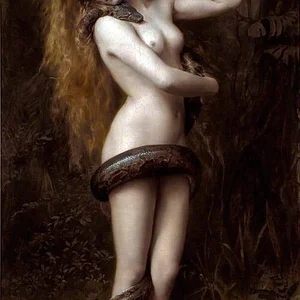

A demonic figure rooted in Mesopotamian mythology (Lilitu), Lilith was incorporated into Jewish tradition as Adam's first wife, before Eve. Refusing to submit, she leaves the Garden of Eden and becomes a nocturnal demon threatening newborns and sleeping men.
Lilith
Lilith
9 min read
Frequently asked questions
Key Facts
- Origins c. 3000 BCE: the Mesopotamian Lilitu is a demon of wind and night in Sumerian and Akkadian culture
- Mentioned in the Hebrew Bible (Isaiah 34:14) as "Lilith" or a "creature of the night"
- Incorporated into the Babylonian Talmud (4th–5th century CE) as a demonic figure
- Developed in the Middle Ages in the Alphabet of Ben Sira (9th–10th century CE) as Adam's first wife
- Reinterpreted from the 19th century onward as a feminist symbol of rebellion against patriarchal authority
Works & Achievements
Liturgical texts from the Qumran community mentioning Lilith among the demonic spirits to be warded off. The first explicit mention of Lilith in a non-biblical Hebrew text, attesting to her integration into Jewish demonology.
A series of eight cuneiform tablets forming the great collection of Babylonian exorcisms. It contains numerous incantations against the Lilitu, demonic ancestors of Lilith, reflecting the age-old fear of these nocturnal spirits.
The encyclopedic compilation of Jewish law and tradition composed in Babylonia. Several passages (Eruvin, Niddah, Shabbat) describe Lilith as a winged demon with long hair, establishing her canonical appearance in the rabbinic tradition.
An anonymous satirical and didactic text in Hebrew and Aramaic. It contains the most complete account of Lilith as Adam's first wife, laying the foundation for all later tradition around her refusal to submit and her subsequent exile.
The foundational text of Kabbalah, attributed to Moses de León. It develops a complex theology of Lilith as queen of darkness and consort of Samael, representing the feminine pole of evil in kabbalistic metaphysics.
A collection of hundreds of ceramic bowls inscribed with Aramaic exorcism formulas against Lilith, excavated at Nippur in Mesopotamia. A major archaeological source attesting to the reality of popular protective practices against this demon.
Anecdotes
The name Lilith is likely derived from the Sumerian word 'lil', meaning 'wind' or 'air', which explains why she is associated with storm spirits in Mesopotamian demonology. The Babylonians feared the Lilitu, feminine wind demons who prowled at night to attack helpless men and newborns.
In the Babylonian Talmud (Eruvin 100b and Niddah 24b), Lilith is described as having long hair and wings. This description influenced generations of medieval artists and scribes who depicted her as a creature half-woman, half-night bird, blending beauty and terror.
The only possible mention of Lilith in the Hebrew Bible appears in Isaiah 34:14, where the Hebrew text uses the word 'lilit' to refer to a nocturnal creature dwelling among the ruins of devastated Edom. Translations vary: the Jerusalem Bible renders it as 'night hag', while others use 'screech owl' or 'night creature'.
The Alphabet of Ben Sira, a medieval Jewish text dating from the 9th–10th centuries, is the first source to tell in detail the story of Lilith as Adam's first wife. She refuses to submit to him because both were created from the same earth, speaks the ineffable name of God, and flees to the Red Sea, becoming the mother of demons.
To protect newborns from Lilith, medieval Jewish families placed amulets bearing the names of three angels — Sanvai, Sansanvai, and Semangelaf — believed to have been sent by God to restrain her. These apotropaic practices are attested in numerous manuscripts and archaeological artifacts from across the Middle East and Europe.
Primary Sources
Wild cats shall meet with hyenas, the goat shall call to his fellow; there too Lilith shall repose, and find a place to rest.
I proclaim the greatness of his splendor to frighten and terrify all the spirits of the ravaging angels and the spirits of the bastards, the demons, Lilith, the howlers and the yelpers...
Rabbi Hanina said: One must not sleep alone in a house, for whoever sleeps alone in a house is seized by Lilith.
God created Adam and Lilith at the same time. Adam said: 'You must lie beneath me.' Lilith replied: 'Why should I lie beneath you? We are equals, for we were both created from the earth.'
I exorcise you, O Lilith who appears to men and women, who attacks children of flesh, you the fever-bringer and the striker... be bound and sealed.
Key Places
Sumerian city where the demonology of the Lilitu is among the best documented. Priests at the temple of Inanna performed exorcism rituals against nocturnal spirits, including the ancestors of Lilith.
Site where the Dead Sea Scrolls were discovered, including the Songs of the Sage (4Q510-511), which names Lilith among the demons to be conjured away — attesting to her presence in Jewish demonology as early as the 1st century BCE.
Capital of the Babylonian Empire and a major intellectual center; Babylonian scribes and Jewish communities in exile (6th century BCE) helped merge Mesopotamian demonology with Hebrew traditions, giving rise to Lilith as she is known today.
According to the Alphabet of Ben Sira, Lilith flees the Garden of Eden to the Red Sea, where she dwells and gives birth to thousands of demons. This symbolic location anchors her myth within a familiar biblical geography.
An important center of the medieval Sephardic Jewish diaspora, where the use of anti-Lilith amulets was widespread. Kabbalistic texts and practices related to Lilith were copied there and disseminated throughout Europe.
Typical Objects

These ceramic bowls, found by the thousands in Mesopotamia, bore magical formulas written in a spiral intended to trap and neutralize Lilith. They were buried beneath the thresholds of homes to protect the occupants, especially pregnant women and newborns.

A small metal plate or parchment inscribed with the names of the angels Sanvai, Sansanvai, and Semangelaf, believed to bind Lilith. Placed in birthing chambers and cradles, this amulet was widely used in medieval Jewish communities.

Babylonian exorcist-priests (ashipu) used clay tablets engraved with ritual formulas to ward off the Lilitu. These texts were part of the great Mesopotamian magical corpus known as the Maqlu.

The quintessential creature of the night, the owl is Lilith's emblematic attribute in Near Eastern iconography. The famous 'Queen of the Night,' a Babylonian relief plaque (c. 1800 BCE), depicts a winged goddess with raptor feet flanked by owls.

In Talmudic tradition, Lilith was believed to hide inside walnuts. Some rabbinic literature forbade leaving walnuts out on the night of Rosh Hashanah so as not to attract her.

Babylonian protective rituals against the Lilitu demons involved symbolic bindings: a knotted cord tied around a bed or cradle was believed to imprison the demon and prevent it from approaching the sleeping victim.
School Curriculum
Vocabulary & Tags
Key Vocabulary
Tags
Daily Life
Morning
In the mythologies that shape her, Lilith has no day in any human sense — she is a creature of the threshold, active in the in-between. At dawn, according to Babylonian incantation texts, she retreats to desolate places — ruins, deserts, riverbanks — to escape the sunlight that strips her of her power.
Afternoon
During the daylight hours, Lilith exists in the minds of the living through rituals of avoidance: mothers recite protective spells, priests carve exorcism tablets, craftsmen prepare amulets bearing the names of the three angels. She is present in everyone's thoughts without ever being seen.
Evening
At dusk, her reign begins. Talmudic and Babylonian texts agree: it is at night that she prowls, slipping into homes through windows and unguarded doorways. She seeks sleeping men alone and newborns unprotected by amulets, embodying the terror of nights without artificial light that haunted the ancient world.
Food
As a demonic being, Lilith feeds on the life force of the living rather than on physical food. Mesopotamian texts describe the Lilitu demons 'drinking the milk' of sleeping infants — a metaphor for the vital energy stolen from them — and 'consuming' the masculine essence of men during sleep.
Clothing
Babylonian iconography, most notably the 'Queen of the Night' relief, depicts Lilith dressed in a robe of scales or feathers reminiscent of birds of prey. In medieval Hebrew texts, her long, loose black hair symbolizes her permanent state of rebellion against the established order — a woman with disheveled hair being a sign of disorder or mourning.
Housing
Lilith dwells in 'empty places': ruins, deserts, seashores (the Red Sea, according to the Alphabet of Ben Sira), and places abandoned by humans. These liminal spaces — neither fully part of the civilized world nor entirely wild — are, in many cultures, the domain of spirits and demons. The Talmud also lists latrines among her haunts.
Historical Timeline
Period Vocabulary
Visual Style
Un style mêlant les reliefs babyloniens et les enluminures de manuscrits hébreux médiévaux : figure féminine ailée et spectrale dans des ruines du désert, sous une lune rouge, entourée de hiboux et d'inscriptions cunéiformes.
Sound Ambience
Une ambiance nocturne et inquiétante évoquant les déserts de Mésopotamie, entre rituels d'exorcisme, vents des ruines et présences invisibles. Sons typiques des nuits de l'Antiquité proche-orientale, à la frontière du monde humain et démoniaque.
Liens externes & ressources
Références
Œuvres
Manuscrits de la mer Morte — Cantique des Sages (4Q510-511)
Ier siècle av. J.-C.
Corpus Maqlu (Mésopotamie)
VIIe siècle av. J.-C. (compilation)
Talmud de Babylone
Ve-VIe siècle apr. J.-C.
L'Alphabet de Ben Sira
IXe-Xe siècle apr. J.-C.
Le Zohar (Livre de la Splendeur)
XIIIe siècle apr. J.-C.
Bols incantatoires de Nippur (collection de l'Université de Pennsylvanie)
Ve-VIIe siècle apr. J.-C.