 flip
flipPoi (pounded taro paste)
Poi (pounded taro paste)
Why this dish? Poi was present at every meal of Liliuokalani, from ʻIolani Palace to her residence at Washington Place: queen or commoner, no Hawaiian dines without poi. It is the food that connects the sovereign to her people.
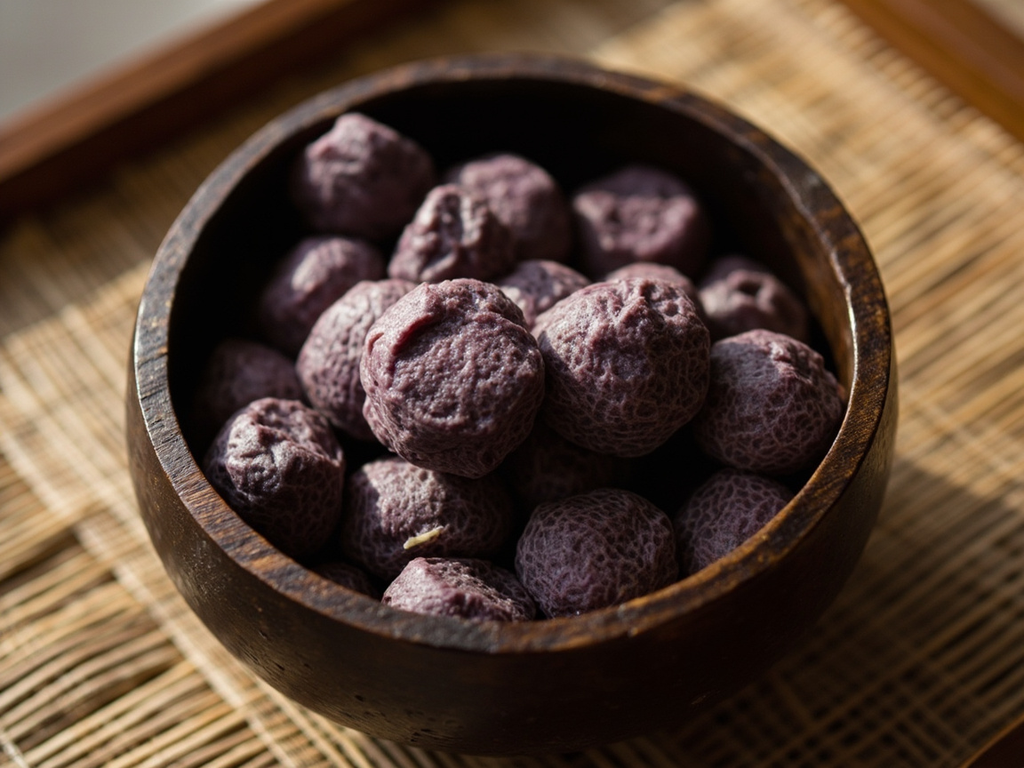
Smooth paste obtained by pounding cooked taro with a little water, then left to sour for one to three days. It is eaten with the fingertips, its consistency measured as 'one finger', 'two fingers', or 'three fingers' depending on thickness.
Come, and let me offer you poi, that which nourishes my people since the first morning of the world. At my table as in the humblest home, one dips a single finger into the ʻumeke and brings to the mouth this paste of kalo, fresh on the day or slightly sour the next. My people pounded the cooked taro on the wooden board until it became smooth as silk, adding water drop by drop. Believe me: without poi, no Hawaiian meal is truly a meal.
- •Taro corms (kalo) — a large calabash (starchy base)
- •Spring water — as needed (adjust consistency)
Poi (pounded taro paste)
Smooth paste obtained by pounding cooked taro with a little water, then left to sour for one to three days. It is eaten with the fingertips, its consistency measured as 'one finger', 'two fingers', or 'three fingers' depending on thickness.
Why this dish? Poi was present at every meal of Liliuokalani, from ʻIolani Palace to her residence at Washington Place: queen or commoner, no Hawaiian dines without poi. It is the food that connects the sovereign to her people.
Come, and let me offer you poi, that which nourishes my people since the first morning of the world. At my table as in the humblest home, one dips a single finger into the ʻumeke and brings to the mouth this paste of kalo, fresh on the day or slightly sour the next. My people pounded the cooked taro on the wooden board until it became smooth as silk, adding water drop by drop. Believe me: without poi, no Hawaiian meal is truly a meal.
Ingredients (period version)
- Taro corms (kalo) — a large calabash (starchy base)
- Spring water — as needed (adjust consistency)
Ingredients
- Fresh taro roots — 1 kg (starchy base)
- Water — 20–30 cl (thin the paste)
Method
- Scrub and steam or boil the taro until very tender (45–60 min).
- Peel the hot roots (wear gloves: raw taro irritates the skin).
- Mash with a pestle or in a food processor, adding water gradually, until smooth and homogeneous.
- Cover and leave at room temperature for 1 to 3 days to develop the typical sourness ('sour poi'). Serve chilled.
How it was made : The taro was cooked in the imu, then pounded by hand with a stone pestle (pōhaku kuʻi ʻai) on a wooden board (papa kuʻi ʻai) — a long, rhythmic task, often communal. The natural fermentation, due to wild yeasts, gave poi its appreciated tangy edge.
The contemporary twist : Served as a quenelle in a dark wooden bowl, with a dollop of lomi salmon on the side for a 'surf & taro' twist.
Sources : Rachel Laudan, The Food of Paradise: Exploring Hawaii's Culinary Heritage, University of Hawaiʻi Press, 1996 · Mary Kawena Pukui & Samuel H. Elbert, Hawaiian Dictionary
Liliuokalani · Charactorium