 flip
flipNán-o-panír — Morning Bread, Cheese and Herbs
Nán-o-panír — Morning Bread, Cheese and Herbs
Why this dish? During his long years of captivity and exile, from Baghdad to 'Akká, Bahá'u'lláh lived with great frugality. Bread, white cheese, and a few fresh herbs were the everyday fare of both the humble and prisoners: a meal that requires neither fire nor cooking, and is shared at the sofreh.
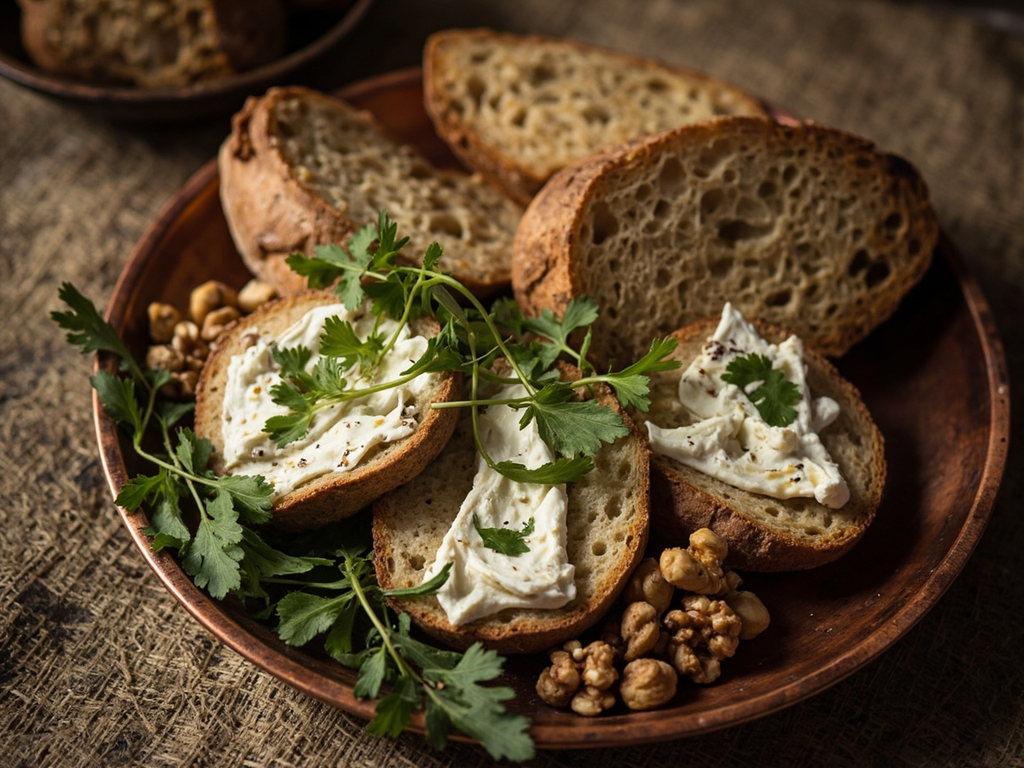
The simplest and most universal Persian lunch: warm flatbread, a piece of salty white cheese, a handful of perennial herbs (mint, basil, tarragon), and a few walnuts. Nothing is cooked, everything is broken and shared by hand.
Draw near, friend, and let us break this bread together. See how God's table is generous even in destitution: a little bread, this cheese that the shepherd curdled, these herbs that the earth gives without being asked. In the days of chain and prison, this was my entire meal, and yet the soul found its sufficiency. Eat slowly, and give thanks — frugality of the body is the wealth of the spirit.
- •Flatbread (nán sangak or barbari) — a few rounds (base of the meal, broken by hand)
- •Salty white cheese (panír, ewe's milk type) — a good piece (main protein)
- •Fresh herbs (mint, basil, tarragon, scallion) — a mixed handful (freshness and green bitterness)
- •Fresh walnuts — a handful (richness, satiety)
Nán-o-panír — Morning Bread, Cheese and Herbs
The simplest and most universal Persian lunch: warm flatbread, a piece of salty white cheese, a handful of perennial herbs (mint, basil, tarragon), and a few walnuts. Nothing is cooked, everything is broken and shared by hand.
Why this dish? During his long years of captivity and exile, from Baghdad to 'Akká, Bahá'u'lláh lived with great frugality. Bread, white cheese, and a few fresh herbs were the everyday fare of both the humble and prisoners: a meal that requires neither fire nor cooking, and is shared at the sofreh.
Draw near, friend, and let us break this bread together. See how God's table is generous even in destitution: a little bread, this cheese that the shepherd curdled, these herbs that the earth gives without being asked. In the days of chain and prison, this was my entire meal, and yet the soul found its sufficiency. Eat slowly, and give thanks — frugality of the body is the wealth of the spirit.
Ingredients (period version)
- Flatbread (nán sangak or barbari) — a few rounds (base of the meal, broken by hand)
- Salty white cheese (panír, ewe's milk type) — a good piece (main protein)
- Fresh herbs (mint, basil, tarragon, scallion) — a mixed handful (freshness and green bitterness)
- Fresh walnuts — a handful (richness, satiety)
Ingredients
- Flatbread like lavash, sangak or pita — 2 rounds (base)
- Ewe's milk feta or salty white cheese — 150 g (protein)
- Fresh mint, basil, tarragon, scallion — 1 large mixed bunch (freshness)
- Walnut halves — 50 g (crunch)
- Radishes and cucumber (optional) — a few (freshness)
Method
- Briefly warm the flatbread in a dry pan or oven to make it pliable.
- Wash and dry the herbs, arrange them in a bunch on the sofreh (or a large platter).
- Cut the cheese into generous pieces and place the walnuts alongside.
- Serve without individual plates: each person breaks bread, tucks in cheese, herbs, and walnuts, and rolls up the bite.
- Accompany with a glass of hot tea (see chái recipe).
How it was made : Nán-o-panír-o-sabzí (bread-cheese-herbs) has been the emblematic Persian lunch for centuries, from peasant to notable. Cheese was preserved in brine in jars, and herbs (sabzí khordan) picked from the garden. It is a cold meal, ideal where fuel is scarce — thus perfect for prison and exile.
The contemporary twist : Present it as a convivial "modern sofreh" board with a drizzle of honey and dried rose petals on the cheese, meze-style to share.
Sources : Najmieh Batmanglij, Food of Life: Ancient Persian and Modern Iranian Cooking · Margaret Shaida, The Legendary Cuisine of Persia
Bahá'u'lláh · Charactorium