 flip
flipSour Cabbage Shchi
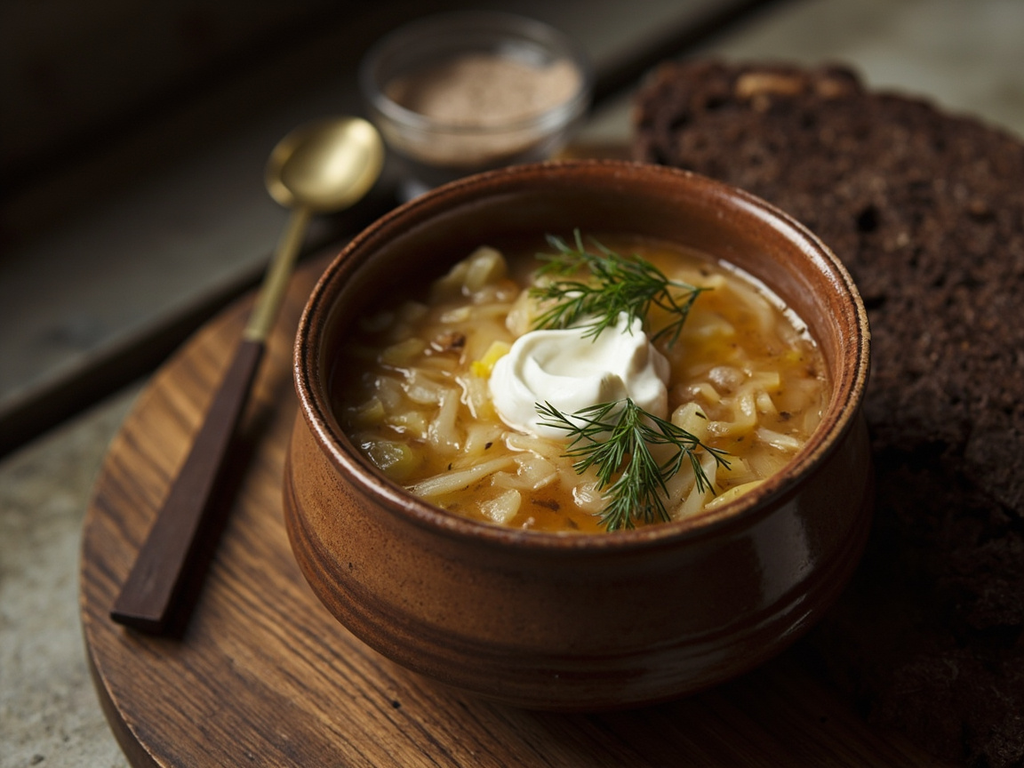
Sour Cabbage Shchi
Why this dish? It is reported that Mendeleev contented himself with simple Russian meals — soup, black bread, fish — which he dispatched quickly to return to his notes. Sour cabbage shchi is THE everyday Russian soup par excellence, served in every home from St. Petersburg to Tobolsk.
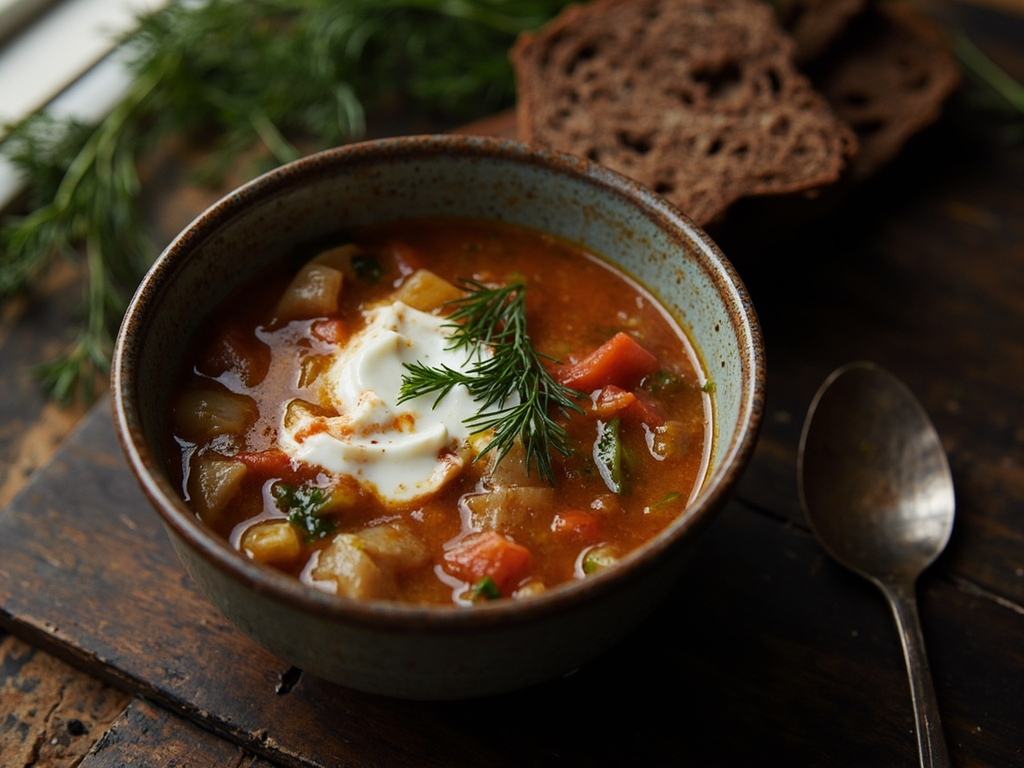
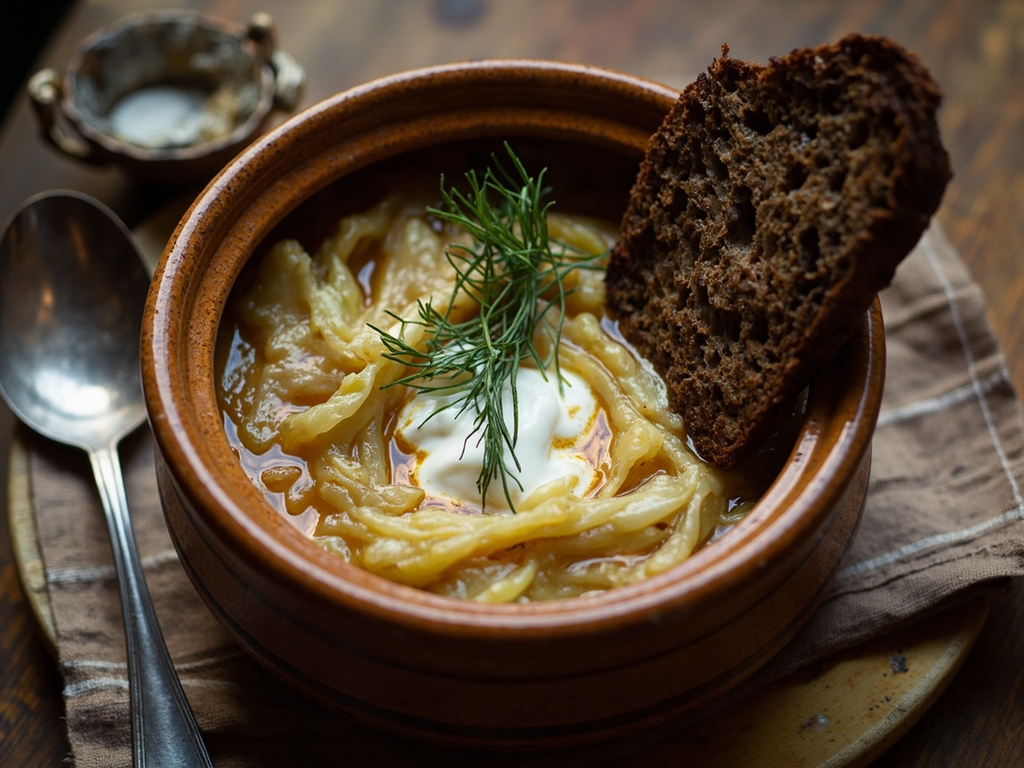
A peasant soup of fermented cabbage, long-simmered with a piece of meat, scented with dill and finished with a spoonful of smetana. Its lively acidity awakens and warms — the comfort of long Russian winters.
You see, I never wasted time at table: a bowl of sharp shchi, a slice of rye bread, and the mind stays clear for work. My mother, who managed the glass factory in Tobolsk, fermented cabbage in barrels every autumn, and it is from that brine that the soup draws all its strength. Let it simmer without haste — like a reaction you do not rush — then pour in a spoonful of sour cream, and you hold the true taste of Russia.
- •Fermented cabbage (kvachenaya kapusta) — a good bowlful (sour and fermented base)
- •Beef brisket or shank — one piece (stock foundation)
- •Onion — one (aromatic)
- •Carrot and parsley root — a few (stock sweetness)
- •Dill and bay leaf — a bunch (fragrance)
- •Sour cream (smetana) — at serving (creamy binder)
- •Black rye bread — as desired (accompaniment)
Sour Cabbage Shchi
A peasant soup of fermented cabbage, long-simmered with a piece of meat, scented with dill and finished with a spoonful of smetana. Its lively acidity awakens and warms — the comfort of long Russian winters.
Why this dish? It is reported that Mendeleev contented himself with simple Russian meals — soup, black bread, fish — which he dispatched quickly to return to his notes. Sour cabbage shchi is THE everyday Russian soup par excellence, served in every home from St. Petersburg to Tobolsk.
You see, I never wasted time at table: a bowl of sharp shchi, a slice of rye bread, and the mind stays clear for work. My mother, who managed the glass factory in Tobolsk, fermented cabbage in barrels every autumn, and it is from that brine that the soup draws all its strength. Let it simmer without haste — like a reaction you do not rush — then pour in a spoonful of sour cream, and you hold the true taste of Russia.
Ingredients (period version)
- Fermented cabbage (kvachenaya kapusta) — a good bowlful (sour and fermented base)
- Beef brisket or shank — one piece (stock foundation)
- Onion — one (aromatic)
- Carrot and parsley root — a few (stock sweetness)
- Dill and bay leaf — a bunch (fragrance)
- Sour cream (smetana) — at serving (creamy binder)
- Black rye bread — as desired (accompaniment)
Ingredients
- Raw sauerkraut (plain, not cooked in wine) — 400 g, rinsed and squeezed (sour and fermented base)
- Beef shank or brisket — 500 g (stock foundation)
- Onion — 1 large (aromatic)
- Carrot — 1 (sweetness)
- Bay leaves + peppercorns — 2 leaves, 5 grains (fragrance)
- Fresh dill — 1/2 bunch (final fragrance)
- Thick crème fraîche — 4 tbsp (binder at serving)
- Rye bread — as desired (accompaniment)
Method
- Cover the meat with cold water, bring to a simmer, skim, then cook for 1.5 hours with the whole onion, carrot, and bay leaves.
- Remove the meat, dice it, strain the stock if you want a clear soup.
- Add the rinsed sauerkraut to the stock and simmer gently for 40 minutes, until the cabbage is tender.
- Return the meat, adjust salt and pepper.
- Off the heat, sprinkle with dill. Serve very hot with a spoonful of crème fraîche in each bowl and rye bread.
How it was made : Shchi was made in the Russian oven (pech), where the soup stayed for hours in the residual heat, which softened the cabbage. Families fermented cabbage in large barrels in autumn to last all winter — fermentation was preservation. A proverb said: 'Shchi and kasha, that is our food.'
The contemporary twist : A 'chemist's shchi': served in a clear glass to show the clear stratification of broth and cabbage, a sprig of dill standing straight like a column in the table.
Dmitri Mendeleev · Charactorium