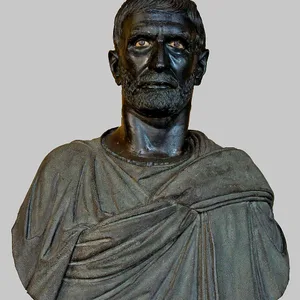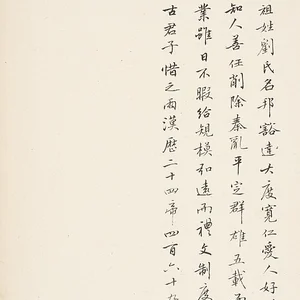

Liu Bang, of peasant origin, led the revolt against the Qin dynasty and then triumphed over Xiang Yu during the Chu–Han Contention. In 202 BC he founded the Han dynasty, one of the longest-lasting in Chinese history, and reigned under the name Gaozu.
Liu Bang
Liu Bang (Emperor Gaozu of Han)
7 min read
Frequently asked questions
Key Facts
- Born around 256 BC in the region of Pei, of modest peasant origin
- Takes part in the uprising against the Qin dynasty from 209 BC
- Receives the title of King of Han in 206 BC after the fall of the Qin
- Defeats his rival Xiang Yu at the Battle of Gaixia in 202 BC
- Founds the Han dynasty in 202 BC and reigns as Emperor Gaozu until his death in 195 BC
Works & Achievements
Establishment of one of China's longest-lasting dynasties (more than four centuries), which gave its name to China's majority ethnic group (the Han).
Triumph over Xiang Yu at the end of a long civil war, lastingly reunifying the empire after the collapse of the Qin.
A radical simplification of the draconian Qin penal code down to three articles, a gesture that won over the population and founded his reputation for clemency.
A combination of commanderies administered by the state and kingdoms entrusted to close allies, a fragile balance between Qin centralization and ancient feudalism.
The choice of a strategic capital in the Guanzhong plain, which shaped Han power for centuries.
After the military failure at Baideng, the establishment of a diplomacy of marriage alliances and gifts to pacify the northern frontier.
A reduction of the tax burden and the demobilization of soldier-farmers, fostering economic reconstruction after decades of war.
Anecdotes
Before becoming emperor, Liu Bang was a humble local official tasked with escorting prisoners to Mount Li. Along the way, several of them escaped. Realizing he would be sentenced to death for this failure, he freed all the others and took to the wilderness himself with a handful of men: this was the beginning of his career as a rebel.
According to the legend recorded by the historian Sima Qian, Liu Bang is said to have one day cut in two a gigantic white serpent that blocked the road. An old woman then appeared, weeping, claiming that the serpent was the son of the White Emperor, slain by the son of the Red Emperor — an omen foretelling his imperial destiny.
Liu Bang had little fondness for Confucian scholars and, it is said, once urinated in the cap of one of them to humiliate them. Yet once he became emperor, he eventually came to recognize the usefulness of rites and learned advisers, declaring that one could conquer an empire on horseback but not govern it on horseback.
At a famous banquet, the “Banquet at Hong Gate,” his rival Xiang Yu had the opportunity to have him assassinated. Liu Bang owed his survival solely to cunning and slipped away discreetly on the pretext of going to the latrines, thus escaping an almost certain death.
Born of the peasantry, Liu Bang was the first Chinese emperor of common origin. Once on the throne, he invited his aging father to a banquet and asked him, not without mischief, which of his sons had ultimately been the most successful — he who had once been judged less deserving than his hardworking brothers.
Primary Sources
"Emperor Gaozu was a native of the village of Feng, in the district of Pei. His family name was Liu. (...) As a man, he had a prominent nose and the forehead of a dragon."
"You conquered the empire on horseback, but can you govern it on horseback?" — a rebuke attributed to the advisor Lu Jia, cited to justify relying on scholars.
The Hanshu takes up and expands the account of the founding of the Han dynasty, portraying Liu Bang as a magnanimous ruler skilled at winning talented men to his side.
Key Places
Liu Bang's native town, where he served as a minor official before raising the banner of revolt. His nickname “Duke of Pei” comes from this place.
Capital of the Qin dynasty, near present-day Xi'an. Liu Bang was the first to enter it in 206 BC, sealing the fall of the Qin.
A mountainous region granted to Liu Bang as the Kingdom of Han by Xiang Yu. It gave the dynasty its name and served as the base for his reconquest.
Site of the decisive battle of 202 BC where Xiang Yu was encircled and defeated, paving the way for the founding of the Han.
Capital established by Gaozu near present-day Xi'an, which became one of the largest cities in the ancient world under the Han.
The place where Gaozu was besieged by Xiongnu cavalry in 200 BC, narrowly escaping capture. The episode led to the policy of marriage alliance (heqin).
Typical Objects

Emblematic weapon of the warlords at the end of the Qin era, blending ancient bronze techniques with the new use of iron. Liu Bang, as a rebel leader, is traditionally depicted sword in hand.

A bronze weapon with a mechanical trigger, fearsome and accurate, widely used in the armies of the Chu-Han war. It allowed poorly trained foot soldiers to pierce armor.

A seal of jade or bronze used to authenticate edicts and appointments. Possession of the seal symbolized the legitimacy of the Mandate of Heaven passed to the new sovereign.

Thin strips of bamboo bound together with cords, used as a writing surface before paper came into common use. Han laws, registers, and administrative correspondence were recorded on them.

A horse-drawn chariot used for command and display more than for mass combat at this time. It signaled the general's rank on the battlefield.

A loose, wide-sleeved garment crossed over at the front, reserved for the elite and the sovereign. Silk, a luxury Chinese product, marked Gaozu's imperial status.

A round bronze coin pierced with a square hole, inherited from the Qin and retained in the early Han. It facilitated trade and the payment of taxes throughout the unified empire.
School Curriculum
Vocabulary & Tags
Key Vocabulary
Daily Life
Morning
Once he became emperor, Gaozu began the day with audiences at the court of Chang'an, receiving ministers and generals. The Confucian scholars, such as Shusun Tong, had established a strict ceremonial that imposed order and reverence, far removed from the rustic manners of his early days.
Afternoon
The afternoon was devoted to affairs of state: appointing officials, managing the kingdoms and commanderies, and receiving administrative reports inscribed on bamboo strips. He surrounded himself with advisers such as Zhang Liang and Xiao He to settle important matters.
Evening
In the evening, banquets brought together comrades-in-arms and dignitaries, accompanied by music and sometimes songs composed by the emperor himself. It was at one of these that he is said to have improvised the famous “Song of the Great Wind.”
Food
The diet was based on millet and rice, the foundation of Chinese meals, supplemented with vegetables, soybeans, pork, and poultry. At court, roasted meats, grain liquor, and refined dishes marked one's rank; Liu Bang, of peasant origin, kept a taste for simple foods and for drink.
Clothing
As sovereign, he wore crossed silk robes with wide sleeves in solemn colors, fastened with a sash marking his rank. The wearing of the cap and of insignia distinguished the degrees of the court hierarchy.
Housing
Gaozu resided in the Weiyang Palace at Chang'an, a vast complex of wood-and-earth halls raised upon terraces. His adviser Xiao He had a grandiose palace built, which the emperor at first deemed too extravagant before acknowledging its symbolic value.
Historical Timeline
Period Vocabulary
Liens externes & ressources
Références
Œuvres
Fondation de la dynastie Han
202 av. J.-C.
Victoire de la guerre Chu-Han
206-202 av. J.-C.
Les « Trois articles de loi » (yue fa san zhang)
206 av. J.-C.
Système politique mixte (junguo)
202 av. J.-C.
Établissement de la capitale à Chang'an
vers 200 av. J.-C.
Politique heqin avec les Xiongnu
vers 198 av. J.-C.
Allègement des impôts et des corvées
après 202 av. J.-C.