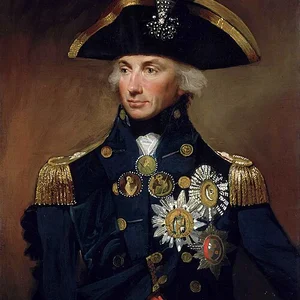

Horatio Nelson (1758-1805) was a British admiral and hero of the Napoleonic Wars. His decisive victory at Trafalgar in 1805, where he was killed, secured the United Kingdom's naval supremacy for more than a century.
Lord Nelson(1758 — 1805)
Horatio Nelson
Royaume-Uni de Grande-Bretagne et d'Irlande
6 min read
Frequently asked questions
Famous Quotes
« England expects that every man will do his duty»
Key Facts
- Born on 29 September 1758 in Burnham Thorpe (Norfolk)
- Won the Battle of the Nile (Aboukir) against the French fleet in 1798
- Lost his right arm during the attack on Santa Cruz de Tenerife in 1797
- Won the Battle of Trafalgar on 21 October 1805 against the Franco-Spanish fleet
- Killed in action at Trafalgar on 21 October 1805, struck down by a French marksman
Works & Achievements
Nelson disobeyed formation orders to intercept the Spanish fleet, helping secure a major British victory and earning his knighthood.
The near-total destruction of the French fleet at anchor, which stranded Bonaparte's army in Egypt and restored British naval prestige.
A victory over the Danish fleet that broke the League of Armed Neutrality, which favoured France.
Nelson drove his ships perpendicular to the enemy line in two columns, a bold manoeuvre that threw the Franco-Spanish fleet into disorder.
The annihilation of the Franco-Spanish fleet without the loss of a single British ship, securing the United Kingdom's command of the seas for a century.
The nickname given to his command style, built on the initiative left to his captains and tactical daring, which became a model in the Royal Navy.
Anecdotes
At 14, the young Nelson signed on as a cabin boy aboard a ship sent to explore the Arctic. During that expedition, he reportedly confronted a polar bear out on the ice, hoping to bring back its fur to his father, before the ship's cannon scared the animal away.
Nelson lost the sight in his right eye during a siege in Corsica in 1794, then lost his right arm in 1797 at Tenerife. Despite these handicaps, he continued to command fleets: it is said that at the Battle of Copenhagen in 1801, he raised his telescope to his blind eye so that he could claim he did not see his superior's signal to retreat.
Before Trafalgar, Nelson had a famous flag signal hoisted: “England expects that every man will do his duty.” This message, relayed to the whole fleet, became one of the most famous phrases in British naval history.
Mortally wounded by a French marksman stationed in the rigging of the Redoutable at Trafalgar, Nelson lay dying for several hours in the hold of the Victory. He is said to have murmured “Thank God I have done my duty” before he died, having learned that the battle was won.
To preserve his body until the return to England, Nelson's remains were placed in a cask filled with brandy and secured on the deck of the Victory. Sailors' legend, almost certainly apocryphal, claims that some of them drank from this liquor — hence the expression “tapping the Admiral.”
Primary Sources
England expects that every man will do his duty.
Thank God I have done my duty.
Victory is not a name strong enough for such a scene.
May the great God, whom I worship, grant to my Country, and for the benefit of Europe in general, a great and glorious Victory.
Key Places
Village in England where Nelson was born in 1758, in the rectory where his father was a parson.
Site of the Battle of the Nile in 1798, where Nelson destroyed the French fleet and cut off Bonaparte's army from France.
Off this Andalusian cape, the Battle of Trafalgar took place on 21 October 1805, a decisive victory in which Nelson lost his life.
Nelson's flagship at Trafalgar, aboard which he died. The ship is now preserved in dry dock at Portsmouth.
Site of Nelson's state funeral in 1806 and of his tomb, in the crypt of the building.
During the failed assault of 1797, Nelson was severely wounded here in his right arm, which had to be amputated.
Typical Objects

Two-pointed hat worn sideways, the distinctive mark of senior Royal Navy officers. Nelson's had a green eyeshade to protect his good eye from the sun.

Optical instrument used to observe enemy ships and signals from a distance. Nelson famously raised it to his blind eye at Copenhagen.

A sabre carried by officers, at once a close-combat weapon and a symbol of command and honour.

A set of coloured flags used to send coded orders between ships. Popham's system was used to hoist the famous message at Trafalgar.

Artillery piece mounted aboard ships of the line, arranged in batteries across several decks. Firepower decided the outcome of fleet engagements.

Embroidered insignia and medals sewn onto Nelson's uniform, attesting to his titles and victories. Their brightness is said to have made him an easy target for the enemy marksman at Trafalgar.
School Curriculum
Vocabulary & Tags
Key Vocabulary
Tags
Daily Life
Morning
Aboard a warship, the admiral's day began early: inspecting the deck, reading dispatches, and scanning the horizon through a spyglass. Nelson, often unwell and prone to seasickness, oversaw the crew's gunnery drills.
Afternoon
The afternoon was divided between writing orders and letters, studying charts, and holding conferences with his captains. Nelson liked to set out his battle plans in person to make sure everyone understood his intentions.
Evening
In the evening, the admiral frequently hosted his officers for dinner in the great stern cabin of the ship. These meals were a chance to strengthen the trust and camaraderie he shared with what he called his “band of brothers.”
Food
Standard navy fare consisted of ship's biscuit, salted beef and pork, cheese, and a daily ration of grog (rum cut with water). To fight scurvy, lemon or lime juice was handed out, and the admiral's table was better stocked than that of the ordinary sailors.
Clothing
Nelson wore the navy-blue uniform with gold facings and buttons of Royal Navy officers, adorned with his embroidered decorations. Having lost an arm, he had his empty right sleeve pinned up and wore a bicorne hat with a green eyeshade.
Housing
On campaign, he lived in the admiral's quarters at the rear of the flagship—relatively spacious rooms furnished with a hanging cot, a writing table, and stern windows. Ashore, he resided at Merton Place, near London.
Historical Timeline
Period Vocabulary
Liens externes & ressources
Références
Œuvres
Bataille du cap Saint-Vincent
1797
Bataille du Nil (Aboukir)
1798
Bataille de Copenhague
1801
Tactique de rupture de ligne à Trafalgar
1805
Victoire de Trafalgar
1805
Le « Nelson Touch »
1805