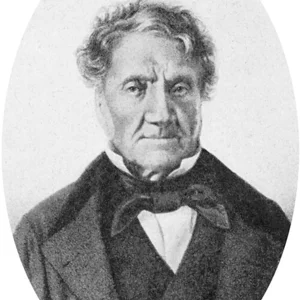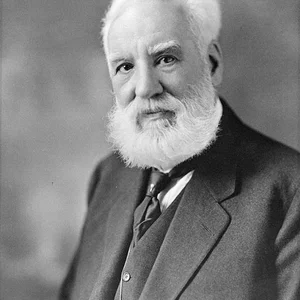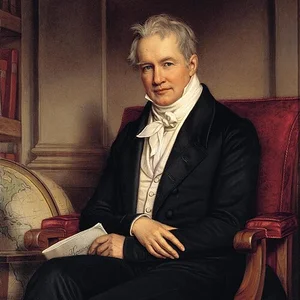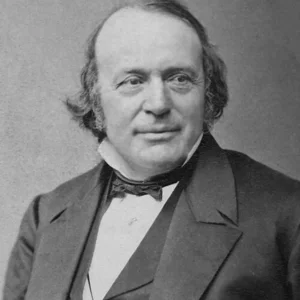

American naturalist of Swiss origin, zoologist, ichthyologist and geologist. A pioneer in the study of fossil fish and a theorist of the great ice ages, he was also a famous opponent of Darwin's theory of evolution.
Louis Agassiz(1807 — 1873)
Louis Agassiz
États-Unis, Suisse
6 min read
Frequently asked questions
Key Facts
- Born in 1807 in Môtier (Switzerland), died in 1873 in Cambridge (Massachusetts)
- Published his 'Researches on Fossil Fish' between 1833 and 1843, a major reference work in ichthyology
- Formulated in 1837 his theory of a great glacial period (Eiszeit) that had covered Europe
- Emigrated to the United States in 1846 and became a professor at Harvard University
- Founded the Museum of Comparative Zoology at Harvard in 1859
Works & Achievements
A five-volume work describing hundreds of species of extinct fishes. It founded the scientific study of fossil fishes.
Book in which Agassiz defends the existence of a great glacial period (an “ice age”) that once covered Europe. A revolutionary idea for its time.
An extension of his research on glaciers, the fruit of his observations on the Aar glacier. In it he refines his theory of the movement of ice.
Essay in which Agassiz lays out his vision of a nature ordered by a divine plan, in opposition to the ideas of evolution.
A great research museum that he created and directed, still today one of the richest collections of specimens in the world.
A major expedition he led on the Amazon to collect and study the freshwater fishes of South America.
The first American school to teach biology through direct observation in the field. A model for the future marine stations.
Anecdotes
When he taught at Harvard, Agassiz would place a fish preserved in alcohol in front of a new student and let him observe it for hours, sometimes several days, with no instruction other than “Look at your fish.” This method, which became famous, was meant to teach students to see details for themselves before reading books.
In 1837, Agassiz astonished his colleagues by claiming that immense glaciers had once covered Europe. To prove it, he had a hut built on the Aar Glacier in the Alps and drove stakes into it to measure its movement, demonstrating that the ice flowed like a slow river.
Having emigrated to the United States in 1846, Agassiz became a star of the public lecture circuit: his talks on fish and glaciers drew enormous crowds. His fame was such that his name was given to Lake Agassiz, a gigantic vanished glacial lake of North America, as well as to a peak and a lunar crater.
Throughout his life, Agassiz refused to accept Darwin's theory of evolution, published in 1859. To him, each species was a “thought of God” created separately, and he remained one of the last great scientists to fight against evolution, even as many of his own students embraced it.
In 1873, shortly before his death, he opened a summer school of marine biology with his students on Penikese Island, off the coast of Massachusetts. Nature was studied directly in the field there, a pioneering idea that later inspired many marine research stations.
Primary Sources
The surface of Europe, adorned before with a tropical vegetation and inhabited by herds of great elephants, found itself suddenly buried beneath a vast mantle of ice covering plains, lakes, seas and plateaus alike.
The study of fossil fishes opens an entirely new field, where each layer of the Earth yields up to us the species that lived in its age, like so many pages of a history written in stone.
Every species exists as a thought of the Creator, and the order we discover in nature is but the translation of that divine plan into matter.
I give my students neither books nor explanations: I place before them an object of nature and ask them to observe it, again and again, until they see what they had not seen at first.
Key Places
Village on the shores of Lake Morat where Louis Agassiz was born in 1807, the son of a Protestant pastor.
City where Agassiz became a professor in 1832 and where he carried out his research on fossil fish and glaciers.
Glacier where Agassiz set up an observation hut and planted stakes to study the movement of the ice.
Capital where the young Agassiz came to work alongside the famous naturalist Georges Cuvier in the early 1830s.
American university where Agassiz taught from 1848 and founded the Museum of Comparative Zoology in 1859.
Small island where Agassiz opened a pioneering summer school of marine biology in 1873, shortly before his death.
Typical Objects

A glass container filled with alcohol used to preserve fish and animals for study. It was the central tool of his famous method, “Look at your fish.”

A magnifying optical instrument for examining the tiny details of animals and their structures. Indispensable to the nineteenth-century naturalist.

A hammer with a flat head and a pointed end used to break rock and extract fossils. Agassiz used it to free fossil fish trapped in stone.

A notebook in which the scholar drew fish, fossils and glacier structures with precision. Drawing then took the place of photography to record observations.

Rows of stakes driven into the ice of the Aar Glacier to measure its movement over the months. They proved that ice flows slowly like a river.

A small magnifying lens easy to carry into the field or the classroom. It allowed close examination of fish scales, teeth and bones.
School Curriculum
Vocabulary & Tags
Key Vocabulary
Tags
Daily Life
Morning
Agassiz started early, often in his museum or laboratory, surrounded by jars of specimens and fossils. He devoted his mornings to examining his collections and directing the work of his many assistants and students.
Afternoon
The afternoon was dedicated to teaching and writing his books. He also received scientific correspondence from all over the world and welcomed visitors curious about his discoveries.
Evening
In the evening, he prepared his famous public lectures or discussed science with his wife Elizabeth, herself an educator. He read and sorted the notes accumulated during the day.
Food
Like the well-off scholars of nineteenth-century New England, he ate simply but regularly: bread, meats, fish, vegetables, and coffee. During his expeditions, he shared the rustic fare of the explorers.
Clothing
He wore the dark, serious attire of the nineteenth-century professor: frock coat, waistcoat, high-collared shirt, and tie. In the field, he adopted more rugged clothing for the mountains or the boat.
Housing
After his arrival in the United States, he lived in Cambridge, near Harvard, in a house close to his museum. His home was a meeting place for students and scholars.
Historical Timeline
Period Vocabulary
Liens externes & ressources
Références
Œuvres
Recherches sur les poissons fossiles
1833-1843
Études sur les glaciers
1840
Système glaciaire (Système glaciaire)
1847
Essay on Classification
1857
Fondation du Muséum de zoologie comparée de Harvard
1859
Expédition scientifique au Brésil (voyage Thayer)
1865-1866
École d'été de l'île de Penikese
1873