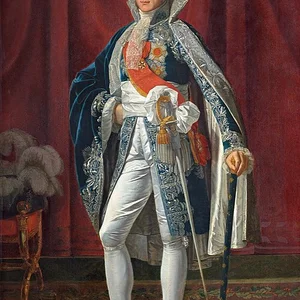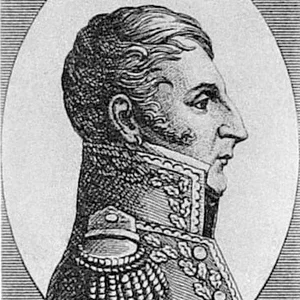

A French divisional general of the Napoleonic era, Saint-Hilaire distinguished himself in several major campaigns including Austerlitz. He was mortally wounded at the Battle of Essling in 1809.
Louis Charles Vincent Le Blond de Saint-Hilaire(1766 — 1809)
Louis Charles Vincent Le Blond de Saint-Hilaire
France
7 min read
Frequently asked questions
Key Facts
- Appointed divisional general during the Napoleonic Wars
- Distinguished himself at the Battle of Austerlitz in 1805
- Mortally wounded at the Battle of Essling (21–22 May 1809)
- Died of wounds sustained at Essling in 1809
- One of the emblematic generals of Napoleon's Grande Armée
Works & Achievements
Saint-Hilaire commanded the division tasked with seizing the Pratzen Heights, the centerpiece of Napoleon's plan at Austerlitz. His decisive action earned him praise from Napoleon and contributed to the Grande Armée's greatest victory.
Saint-Hilaire took part in the campaigns that established French dominance over northern Europe under Bonaparte. These operations were his school of war, forging him into a senior officer capable of independent command.
Taking part in the campaigns of Jena and Eylau, Saint-Hilaire built extensive experience commanding large-scale operations under extreme climatic and logistical conditions, first in Prussia and then across the Polish plains.
During Napoleon's first major tactical defeat, Saint-Hilaire covered the Grande Armée's withdrawal to the right bank of the Danube until a cannonball put him out of action. His sacrifice allowed his troops to fall back in good order.
Anecdotes
At the Battle of Austerlitz on **December 2, 1805**, Saint-Hilaire's division received the perilous order to seize the Pratzen Heights, held by the Austro-Russian army. Climbing the hill under heavy fire, his soldiers broke through the enemy center and played a decisive role in Napoleon's greatest victory. The Emperor himself named Saint-Hilaire among the heroes of the day in the *Bulletins de la Grande Armée*.
During the Battle of Essling on **May 21–22, 1809**, Saint-Hilaire was commanding a division covering the French retreat across the Danube. Struck in the foot by a cannonball while inspecting his lines on horseback, he was carried away on a stretcher and underwent emergency amputation. The wounds were too severe: he died on **June 5, 1809**, taken by gangrene at the age of forty-two.
Saint-Hilaire was known throughout the Grande Armée for his exceptional calm under enemy fire. He made a habit of inspecting his regiments on horseback during combat, exposed to bullets and cannonballs, in order to show his soldiers that a general shared their dangers. This quiet courage earned him the unwavering loyalty of his men.
When Napoleon learned of Saint-Hilaire's death after Essling, he declared that he had lost one of his finest divisional generals. Saint-Hilaire had been raised to the rank of Count of the Empire in recognition of his service, a testament to the esteem in which the Emperor held him. His name is engraved today on the **Arc de Triomphe** in Paris, among the generals who served France.
Primary Sources
General Saint-Hilaire's division stormed the heights of Pratzen with remarkable impetus; the enemy's center was overthrown and the heights seized, deciding the outcome of the day.
General Saint-Hilaire has rendered eminent services during this campaign; you will convey to him my particular satisfaction and have him cited in the order of the army for his conduct under fire.
Saint-Hilaire commanded his division with remarkable intelligence and composure; his men admired him for the serenity he maintained under the most violent fire, and he fully deserved the confidence the Emperor placed in him.
Divisional General Saint-Hilaire, mortally wounded by a cannonball that carried away his foot during the crossing of the Danube, was transported to Vienna where he died of his wounds on 5 June 1809. In him the army loses an intrepid and seasoned commander.
Key Places
A key strategic position at the Battle of Austerlitz on 2 December 1805, which Saint-Hilaire's division was tasked with storming. This victory on the heights shattered the Austro-Russian center and decided the outcome of Napoleon's greatest battle.
A village near Vienna where the Battle of Aspern-Essling was fought on 21–22 May 1809. It was here that Saint-Hilaire was struck by a cannonball that shattered his foot — a wound from which he died on 5 June 1809 in Vienna.
The famous Parisian monument on which Saint-Hilaire's name is engraved among the generals and marshals of the Grande Armée. This permanent memorial, commissioned by Napoleon, honors for all time those who served France.
The theater of Saint-Hilaire's first great campaigns, where he built his reputation between 1796 and 1800 alongside Bonaparte, taking part in the victories of the young French Republic against the European coalitions.
Typical Objects

Curved forged-steel saber carried by generals of the Grande Armée as a symbol of command and personal weapon. Saint-Hilaire wore it during inspections and close-quarters combat.

Two-cornered black felt hat, insignia of the rank of general, worn facing forward (en sautoir) so troops could recognize their commander from a distance on the battlefield. It symbolized visible leadership and courage.

Brass optical instrument used to observe the terrain and track enemy movements at long range. An essential tool for a division general coordinating his brigades across a vast battlefield such as Austerlitz.

Handwritten or engraved topographic map of the theater of operations, annotated to plan battles and marches. An essential tool of Napoleonic strategy, which relied on speed and mastery of the terrain.

Blue coat with scarlet lapels and gold-embroidered facings, two-star epaulettes with gold fringe, required wear while on duty. The uniform distinguished rank, commanded the respect of the troops, and kept the general visible under fire.

Official communiqué drafted after each battle and read aloud to the troops, recounting victories and naming deserving officers. Saint-Hilaire was singled out after Austerlitz, the kind of recognition that built a general's legend.
School Curriculum
Vocabulary & Tags
Key Vocabulary
Daily Life
Morning
Up before dawn during campaigns, Saint-Hilaire began his day with a review of his regiments to check the condition of the men, horses, and equipment. He then received reports from his colonels and studied orders from Marshal Soult or the imperial general staff, often delivered at first light by dispatch riders.
Afternoon
The afternoon of a campaign day was devoted to mounted reconnaissance of the terrain, accompanied by his aides-de-camp. Saint-Hilaire inspected positions, prepared march or battle formations for the following day, and corresponded with other divisions through messages carried at full speed by orderlies.
Evening
In the evening, when the army bivouacked, the general shared a frugal meal with his staff around a campfire. He wrote up his daily reports, planned the next day's movements, and took a few moments for officers who came to him with requests for reinforcements, leave, or clarification of orders.
Food
On campaign, a Napoleonic general's diet was simple but more reliable than that of ordinary soldiers: bread, soup, boiled or roasted meat, dried legumes, a little wine mixed with water. In occupied towns, being billeted with local notables or in requisitioned inns allowed for more substantial meals.
Clothing
On duty, Saint-Hilaire wore the regulation uniform of a divisional general: a blue coat with scarlet lapels and cuffs embroidered in gold, epaulettes with gold fringe, a white sash, and a bicorne hat. On campaign, for practicality, he might throw a grey overcoat over his uniform — following the example of Napoleon himself.
Housing
In the field, the general lodged in his headquarters tent or, during halts in towns, in a requisitioned notable's house. His setup was spartan: a camp bed, a table for maps and correspondence, and a few chests for personal equipment and divisional records.
Historical Timeline
Period Vocabulary
Liens externes & ressources
Références
Œuvres
Commandement de la 1re division du IVe Corps à Austerlitz
2 décembre 1805
Campagne de Prusse et de Pologne
1806-1807
Couverture défensive à la bataille d'Aspern-Essling
21-22 mai 1809