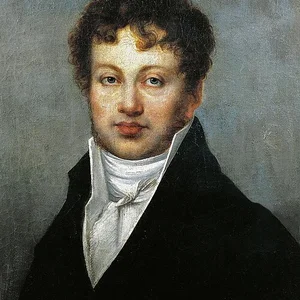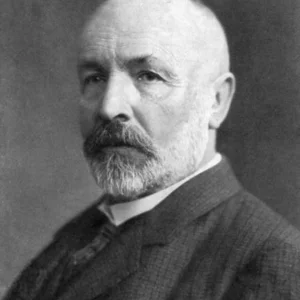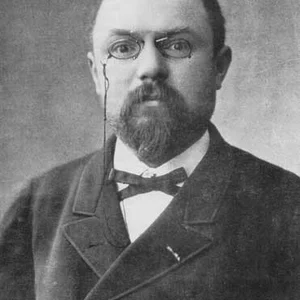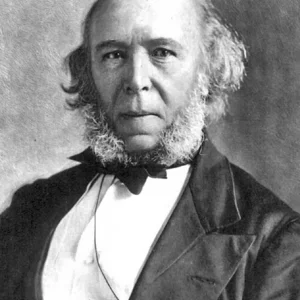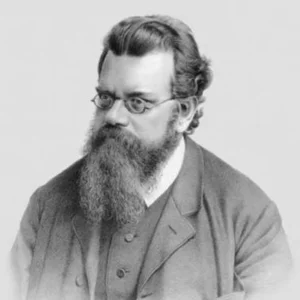

Austrian physicist (1844–1906), founder of statistical mechanics. He demonstrated that the laws of thermodynamics arise from the statistical behavior of atoms, laying the foundations of modern physics.
Ludwig Boltzmann(1844 — 1906)
Ludwig Boltzmann
Autriche-Hongrie
9 min read
Frequently asked questions
Famous Quotes
« If you are too lazy to think, work; if you are too tired to work, think.»
« The entropy of the universe tends toward a maximum.»
Key Facts
- 1844: Born in Vienna, Austria
- 1872: Formulation of the Boltzmann equation on the distribution of velocities of gas molecules
- 1877: Statement of the relation S = k·ln(W) linking entropy and probability
- 1900: Max Planck uses the Boltzmann constant to formulate the law of black-body radiation
- 1906: Suicide in Duino, Italy, after years of controversy over the existence of atoms
Works & Achievements
In this paper, Boltzmann mathematically demonstrates that the entropy of an isolated system tends to increase, linking classical mechanics and thermodynamics through probability theory for the first time. The Boltzmann equation, describing the evolution of the molecular velocity distribution, remains a cornerstone of theoretical physics.
This revolutionary formula defines entropy as proportional to the logarithm of the number of possible microstates of a system. It forms the foundation of statistical mechanics and was later inscribed on Boltzmann's tomb in the Vienna Central Cemetery.
Building on the work of James Clerk Maxwell, Boltzmann established the law governing the distribution of molecular speeds in a gas at thermal equilibrium. This distribution, which bears both their names, is fundamental to statistical physics and gas chemistry.
In two volumes, Boltzmann synthesizes twenty years of research on the kinetic theory of gases, presenting the molecular velocity distribution, the H-theorem, and the statistical foundations of the second law of thermodynamics. It is the masterwork of his scientific career.
This collection of philosophical essays reveals the humanist dimension of Boltzmann, who defends the reality of atoms, critiques Mach's positivism, and reflects on the relationship between science and philosophy. It bears witness to a thinker as much at home with ideas as with equations.
Anecdotes
The formula S = k log W, which Boltzmann used to relate entropy to the number of possible microscopic configurations of a system, is engraved on his tomb in the Central Cemetery of Vienna. This equation, one of the most profound in all of physics, was not fully recognized until after his death as an absolute foundation of modern physics.
For decades, Boltzmann fought nearly alone against influential scientists such as Ernst Mach and Wilhelm Ostwald, who refused to accept the existence of atoms, which they deemed unverifiable. These exhausting debates at scientific congresses, where he consistently found himself in the minority, contributed to a deep depression that stayed with him throughout his life.
In 1906, during a family holiday in Duino near Trieste, Boltzmann took his own life while his wife and daughter had gone swimming. A tragic irony of fate: Jean Perrin soon after confirmed the existence of atoms through his study of Brownian motion, definitively validating the theories Boltzmann had defended at the cost of his mental health.
Boltzmann was renowned for his boundless enthusiasm in the classroom: he would readily compare atoms to billiard balls to explain the kinetic theory of gases, and his students remember a passionate teacher who filled blackboards while humming to himself. His lectures in Vienna drew audiences from across Central Europe.
In 1900, Boltzmann visited Berkeley, California, and was captivated by the United States. He wrote witty and humorous travel accounts of his Atlantic crossing and his discoveries of the New World, revealing a cultured man with genuine literary talent — far removed from the austere scholar one might typically imagine.
Primary Sources
In this work, Boltzmann proves the H-theorem, asserting that the entropy of an isolated gas can only increase or remain constant, thereby linking classical mechanics to thermodynamics. He lays the mathematical foundations for the distribution of molecular velocities and macroscopic irreversibility.
In this landmark paper, Boltzmann introduces the probabilistic interpretation of entropy by formulating the relation S = k log W, which connects macroscopic entropy to the number of possible microscopic microstates. This revolutionary idea forms the heart of statistical mechanics.
Here Boltzmann synthesizes twenty years of research on the kinetic theory of gases, presenting a rigorous account of the Maxwell-Boltzmann distribution, the H-theorem, and the statistical foundations of the second law. He explicitly defends the real existence of atoms against the skeptics of his day.
This collection of philosophical essays and popular science writings reflects Boltzmann's deep thinking on the nature of science and the reality of atoms. He critiques Mach's phenomenalism and champions a realist view of physics, revealing a thinker equally at home in ideas as in equations.
Key Places
Boltzmann's birthplace and the city where he spent much of his career as a professor at the University of Vienna. He taught theoretical physics there, wrote his major works, and lived within the intellectually vibrant atmosphere of the Austro-Hungarian capital.
Boltzmann taught there on two separate occasions: from 1869 to 1873, then from 1876 to 1890. It was in Graz that he formulated his most important theories on statistical entropy and established the Maxwell–Boltzmann distribution — the most productive years of his career.
Boltzmann held the chair of theoretical physics at Ludwig Maximilian University from 1890 to 1894. He worked alongside eminent German scientists and continued his research on statistical mechanics in a stimulating intellectual environment.
Boltzmann was briefly a professor there from 1900 to 1902, but the hostile atmosphere created by Wilhelm Ostwald — a fierce opponent of atomism — made his stay difficult and contributed to his depression. He eventually returned to Vienna.
It was in this Adriatic coastal village that Boltzmann took his own life on 5 September 1906, while on holiday with his family. The site is associated with the tragic end of one of the greatest physicists of the 19th century, who died before his theories were confirmed.
Boltzmann is buried here, and his tombstone bears the famous equation S = k log W engraved in marble. The site has become a symbolic place of pilgrimage for physicists and science students from around the world.
Typical Objects

Boltzmann would fill long blackboards with equations during his lectures in Vienna and Graz, his demonstrations on the statistical behavior of gas molecules being renowned for their rigor and length. His students recalled sessions where he would chain formulas together while humming to himself, sometimes losing track of the time.

These laboratory instruments made it possible to study the behavior of gases at different pressures and temperatures. Boltzmann used them to demonstrate his theories on the statistical distribution of molecular velocities through hands-on experiments.

Boltzmann filled entire notebooks with probabilistic calculations, seeking to connect the macroscopic properties of a gas (temperature, pressure) to the microscopic motion of millions of molecules invisible to the naked eye.

The scientific community of the late nineteenth century operated largely through letters. Boltzmann maintained an intensive correspondence with Maxwell, Planck, and Ostwald, defending his ideas on the existence of atoms against powerful opponents.

This authoritative German scientific journal published several major articles by Boltzmann, including his proofs on statistical mechanics and the H-theorem. It was the primary channel through which discoveries in theoretical physics spread across Europe.

Boltzmann was a passionate pianist who played regularly in the evenings to unwind after his long days of intellectual work. Music represented for him an indispensable counterpoint to the abstraction of mathematics.
School Curriculum
Vocabulary & Tags
Key Vocabulary
Tags
Daily Life
Morning
Boltzmann began his day very early, often before dawn, immersed in mathematical calculations on the statistical behavior of gas molecules. He would fill entire notebooks with differential equations in the quiet of the morning, his wife Henriette noting that he was already deeply absorbed in his work by the time the household awoke. This rigorous morning discipline allowed him to produce a substantial body of scientific work despite his many moves between university cities.
Afternoon
Afternoons were devoted to teaching at the university, where Boltzmann delivered lectures renowned for their depth and the professor's infectious enthusiasm. He also received students and colleagues to discuss theoretical physics, passionately defending his ideas on the existence of atoms. Seminar sessions could run on at length, Boltzmann sometimes losing track of time so thoroughly did scientific conversation absorb him.
Evening
In the evenings, Boltzmann enjoyed spending time with his family and playing the piano — a musical passion that helped him unwind after long days of intellectual work. He moved in Viennese cultural circles and attended the musical soirées typical of the educated Austro-Hungarian bourgeoisie. He also read widely in philosophy — notably Schopenhauer and the positivists — to deepen his reflections on the foundations of scientific knowledge.
Food
Like the Viennese bourgeoisie of his era, Boltzmann enjoyed hearty Austrian cuisine: roasted meats, sauerkraut, pastries, and coffee. He was said to be a lover of good food, which contributed to a noticeable weight gain in middle age. The Viennese coffeehouse (*Kaffeehaus*), an essential hub of intellectual life, was an institution he frequented willingly to discuss science and philosophy.
Clothing
Boltzmann wore the standard dress of an Austrian university professor in the late nineteenth century: a dark frock coat, waistcoat, necktie, and top hat for official occasions. In class he dressed more plainly but always neatly, in keeping with the strict social codes of the Viennese academic bourgeoisie. His characteristic bushy beard and round spectacles gave him the unmistakable appearance of a scholar of the age.
Housing
Boltzmann lived successively in several Central European cities as his academic posts took him from one to the next: Graz, Vienna, Munich, Leipzig. In Vienna he occupied a comfortable bourgeois apartment in the city centre, close to the university, furnished with books and musical instruments that reflected his cultural tastes. These repeated moves — an unavoidable constraint of an academic career — weighed on his family life and his mental health.
Historical Timeline
Period Vocabulary
Liens externes & ressources
Références
Œuvres
Théorème H (article fondateur de la mécanique statistique)
1872
Interprétation probabiliste de l'entropie : S = k log W
1877
Distribution de Maxwell-Boltzmann
1871
Vorlesungen über Gastheorie (Leçons sur la théorie des gaz)
1896-1898
Populäre Schriften (Écrits populaires)
1905