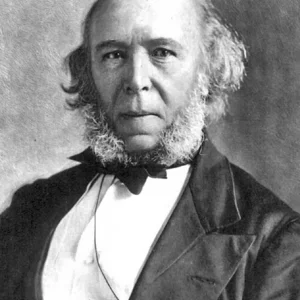

Herbert Spencer (1820-1903) was an English philosopher and sociologist, one of the leading thinkers of social evolutionism in the 19th century. He applied the idea of evolution to all natural and social phenomena and coined the phrase “survival of the fittest.”
Herbert Spencer(1820 — 1903)
Herbert Spencer
Royaume-Uni de Grande-Bretagne et d'Irlande
6 min read
Frequently asked questions
Famous Quotes
« Survival of the fittest»
Key Facts
- Born in 1820 in Derby (England) and died in 1903 in Brighton
- Published “Social Statics” in 1851, the first statement of his liberal and evolutionist thought
- Coined the phrase “survival of the fittest” in 1864 in his Principles of Biology, after reading Darwin
- Developed a vast “System of Synthetic Philosophy” (1862-1896) applying evolution to biology, psychology, sociology, and morality
- Regarded as one of the founders of sociology and a major figure of social Darwinism
Works & Achievements
Spencer's first major work, defending individual liberty and already applying the idea of evolutionary progress to society.
An essay in which Spencer formulates his general law of evolution: the passage from the homogeneous to the heterogeneous in all phenomena.
A highly influential work advocating an education founded on observation and usefulness rather than on memorization.
The founding volume of the System of Synthetic Philosophy, setting out his general conception of evolution and of the Unknowable.
The work in which the expression “survival of the fittest” appears for the first time.
A major work that compares society to a living organism and helps to establish scientific sociology.
A liberal pamphlet denouncing the expansion of the State and defending laissez-faire.
A vast multi-volume undertaking aiming to unify all the sciences under the principle of evolution.
Anecdotes
Herbert Spencer barely ever attended school: his father and uncle, two nonconformist educators, taught him to observe nature and reason for himself rather than recite lessons. As an adult, he would boast of having read very few books, preferring to draw his ideas from his own reflection.
It was Spencer, not Darwin, who coined the phrase “survival of the fittest” in 1864, in his Principles of Biology. Darwin himself would adopt the expression in later editions of On the Origin of Species, feeling that it neatly captured his thinking.
Spencer suffered from chronic insomnia and nervousness that forced him to work in short sessions. It is said that he wore special earplugs to shut out the tedious conversations he deemed harmful to his nerves.
During his lifetime, Spencer was one of the most widely read and translated philosophers in the world: his works sold hundreds of thousands of copies in the United States and were translated into Russian, Japanese, and Chinese. Yet his fame collapsed almost immediately after his death in 1903.
Spencer worked for a few years as a railway engineer in his youth, which familiarized him with science and technology. Throughout his life he refused all official honors, notably declining distinctions and university posts.
Primary Sources
This survival of the fittest, which I have here sought to express in mechanical terms, is that which Mr. Darwin has called “natural selection”, or the preservation of favoured races in the struggle for life.
Every man is free to do that which he wills, provided he infringes not the equal freedom of any other man.
The great aim of education is not knowledge but action.
From childhood, I was encouraged to discover the causes of things for myself rather than to accept ready-made explanations.
Key Places
Industrial town in the Midlands where Spencer was born in 1820 and grew up in a family of nonconformist educators.
Capital where Spencer pursued his intellectual career, worked at the magazine The Economist, and moved in the learned circles of the Victorian era.
Seaside town in the south of England where Spencer spent his final years and died in 1903.
Country where Spencer made a triumphant journey in 1882 and where his evolutionary philosophy enjoyed considerable success among intellectuals and businessmen.
London cemetery where Spencer is buried, not far from the grave of Karl Marx.
Typical Objects

Writing instruments with which Spencer composed the thousands of pages of his System of Synthetic Philosophy. Suffering from nervous fatigue, he often dictated his texts to a secretary.

Hypersensitive to noise and to conversations he found exhausting, Spencer used earplugs to protect his fragile nerves. The object became a symbol of his anxious temperament.

A surveying instrument used by Spencer during his career as a railway engineer. This work familiarized him with the scientific method and mechanical reasoning.

A London periodical of liberal leanings for which Spencer served as deputy editor. This press milieu shaped his economic and political convictions in favour of laissez-faire.

A vast collection of works published over nearly forty years, in which Spencer applies evolution to biology, psychology, sociology, and ethics. They made him a worldwide best-seller in his own lifetime.
School Curriculum
Vocabulary & Tags
Key Vocabulary
Tags
Daily Life
Morning
Spencer began his day cautiously, sparing his fragile nerves. He worked in short sessions, dictating to his secretary, often outdoors or while walking, rather than spending long hours hunched over his desk.
Afternoon
The afternoon was devoted to measured reading, reflection, and sometimes walks. He strictly limited his intellectual effort to avoid the bouts of mental fatigue that plagued him.
Evening
In the evening, Spencer frequented London clubs where he conversed with scientists and writers, but he would break off any conversation that became too taxing, even going so far as to plug his ears to preserve his rest.
Food
A bachelor all his life, Spencer lived in boarding houses and watched his diet with an almost obsessive attention, convinced that what he ate directly affected his nervous condition. He worried constantly about the effects of his meals on his health.
Clothing
He wore the sober attire of the Victorian gentleman: a dark frock coat, a high-collared shirt, a waistcoat, and a tie, in keeping with the bourgeois respectability of nineteenth-century England.
Housing
Spencer never owned a home of his own: he lodged in boarding houses and with hosts in London, then in residences in Brighton, leading the life of a solitary and independent intellectual.
Historical Timeline
Period Vocabulary
Liens externes & ressources
Références
Œuvres
Statique sociale (Social Statics)
1851
Du progrès, sa loi et sa cause (Progress: Its Law and Cause)
1857
De l'éducation (Education: Intellectual, Moral and Physical)
1861
Premiers principes (First Principles)
1862
Principes de biologie (Principles of Biology)
1864
Principes de sociologie (Principles of Sociology)
1876
L'Individu contre l'État (The Man versus the State)
1884