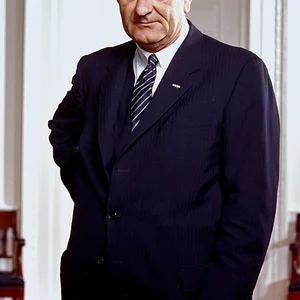

American statesman, 36th President of the United States (1963-1969) following the assassination of John F. Kennedy. He pushed through major laws against racial segregation but became bogged down in the Vietnam War.
Lyndon B. Johnson(1908 — 1973)
Lyndon B. Johnson
États-Unis
6 min read
Frequently asked questions
Famous Quotes
« We shall overcome.»
Key Facts
- Becomes the 36th President of the United States on November 22, 1963, following the assassination of John F. Kennedy
- Has the Civil Rights Act enacted on July 2, 1964, outlawing racial segregation
- Signs the Voting Rights Act in 1965, guaranteeing the right to vote for African Americans
- Launches the social program of the “Great Society” (war on poverty, Medicare, Medicaid) in 1964-1965
- Commits the United States massively to the Vietnam War (Gulf of Tonkin Resolution, 1964), before declining to run for reelection in 1968
Works & Achievements
Landmark law banning discrimination based on race, color, religion, sex, or national origin in employment and public accommodations. A cornerstone of the end of legal segregation.
Law guaranteeing the right to vote for African Americans by outlawing discriminatory practices such as literacy tests in the South.
Public health insurance programs for the elderly (Medicare) and the poorest Americans (Medicaid), among the most enduring social reforms of the Great Society.
A set of programs designed to reduce poverty in the United States, including Head Start, Job Corps, and educational assistance.
Law abolishing the national-origins quota system, which lastingly transformed the face of American immigration.
Establishment of the Department of Housing and Urban Development (HUD) and the Department of Transportation, as well as public broadcasting (Public Broadcasting).
Law expanding access to higher education through grants and student loans, as part of the Great Society.
Anecdotes
On November 22, 1963, a few hours after the assassination of John F. Kennedy in Dallas, Johnson was sworn in aboard the presidential plane Air Force One, on the airport runway. Jacqueline Kennedy, still wearing her blood-stained suit, stood by his side in this photograph that has since become famous.
Johnson was renowned for his “Johnson Treatment” (the Johnson Treatment): to win over a reluctant senator, he would lean in to within a few centimeters of the man's face, grab him by the lapels of his jacket, and tower over him with his great height (6 ft 4 in) while arguing relentlessly. Few could withstand this physical and verbal pressure.
Deeply concerned about his image, Johnson once summoned reporters to show them the scar from his gallbladder operation, lifting his shirt in front of the photographers. The image caused an uproar and came to symbolize his unconventional relationship with the presidency.
On the evening of March 31, 1968, in a televised address, Johnson stunned all of America by announcing that he would not run for reelection, worn down by the growing unpopularity of the Vietnam War: “I shall not seek, and I will not accept, the nomination of my party.”
Johnson had a habit of holding work meetings while swimming in the White House pool, or even receiving his aides from the bathroom, to show that not a single moment should be wasted.
Primary Sources
“No memorial oration or eulogy could more eloquently honor President Kennedy's memory than the earliest possible passage of the civil rights bill for which he fought so long.”
“The Great Society rests on abundance and liberty for all. It demands an end to poverty and racial injustice.”
“Their cause must be our cause too. Because it is not just Negroes, but really it is all of us, who must overcome the crippling legacy of bigotry and injustice. And we shall overcome.”
“I shall not seek, and I will not accept, the nomination of my party for another term as your President.”
Key Places
Region of the Texas Hill Country where Johnson was born in 1908 and where the family ranch was located. He returned to live there after his presidency.
Residence and seat of presidential power where Johnson led the United States from 1963 to 1969 and launched the Great Society reforms.
Seat of Congress where Johnson served as a representative and then a senator, becoming a feared majority leader before his presidency.
City where John F. Kennedy was assassinated on November 22, 1963; Johnson was sworn in as president there a few hours later.
Site of the May 1964 speech in which Johnson laid out his vision of the “Great Society,” the flagship program of his social reforms.
Home of Southwest Texas State Teachers College, where Johnson studied and briefly taught poor young Mexican-American children, an experience that shaped his commitment to social causes.
Typical Objects

Johnson used many pens to sign a single law, handing one to each person who had helped pass it. This ritual turned the pens of the Civil Rights Act into political relics.

Johnson spent hours on the phone negotiating and pressuring lawmakers. His calls, which were recorded, have become a major historical source.

Proud of his Texas roots, Johnson liked to wear a cowboy hat on his ranch. He embodied the image of the authentic man of the West.

Johnson had three televisions installed side by side in the Oval Office so he could watch all three major news networks at once. He constantly monitored public opinion on Vietnam.

The presidential limousine, a symbol of American executive power. Johnson inherited a fleet that had been transformed after Kennedy's assassination and was now armored.

The presidential aircraft aboard which Johnson took the oath of office on November 22, 1963. It became a symbol of the continuity of the State after the tragedy in Dallas.
School Curriculum
Vocabulary & Tags
Key Vocabulary
Tags
Daily Life
Morning
Johnson often began his day late, in bed, surrounded by newspapers and files, already making phone calls. He would hold one meeting after another with his advisers while eating breakfast.
Afternoon
The afternoon was devoted to meetings with members of Congress, decisions on Vietnam, and press conferences. He used the “Johnson Treatment” to win lawmakers over to his bills.
Evening
In the evening, Johnson watched the TV news on his three television sets, gauging public opinion. In his final years, the evenings were darkened by bad news from the Vietnamese front.
Food
A lover of Texan cooking, he enjoyed barbecue, chili, and steak. After a heart attack early in his political career, he had to watch his diet, without always succeeding.
Clothing
In public, Johnson wore the classic dark suit of statesmen. At his ranch, he gladly traded the tie for cowboy gear and a Stetson hat.
Housing
In Washington, he lived in the White House, but his heart remained at the LBJ Ranch, his vast property in the Texas Hill Country, on the banks of the Pedernales River, which he called his “second White House.”
Historical Timeline
Period Vocabulary
Liens externes & ressources
Références
Œuvres
Civil Rights Act
1964
Voting Rights Act
1965
Medicare et Medicaid
1965
Guerre contre la pauvreté (Economic Opportunity Act)
1964
Immigration and Nationality Act
1965
Création de départements et agences fédérales
1965-1966
Higher Education Act
1965