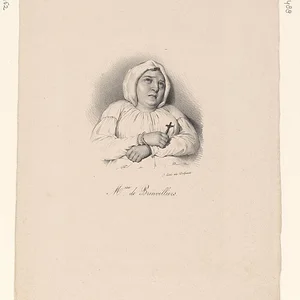

A Carmelite nun at the convent of Louviers, Madeleine Bavent was at the center of a demonic possession affair and witchcraft accusations in 1647. Her trial, emblematic of the excesses of the witch hunts, led to the execution of Father Thomas Boulle and the condemnation of several members of the religious community.
Madeleine Bavent
Madeleine Bavent
France
8 min read
Frequently asked questions
Key Facts
- Entered the Hospitaller convent of Louviers around 1625
- Demonic possession affair officially triggered in 1642
- Trial conducted by the Parlement of Rouen from 1647
- Father Thomas Boulle, confessor of the convent, burned alive in 1647
- Madeleine Bavent sentenced to life imprisonment in a dungeon
Works & Achievements
An account attributed to Madeleine Bavent, published after her conviction, blending confessions of witchcraft, descriptions of diabolical rituals, and autobiographical elements. A complex document, likely written or heavily reworked by third parties, but the primary source for her version of events.
Official transcript of the exorcism sessions performed on the nuns of the convent, recording the words of the 'demons' and the accusations leveled against Madeleine Bavent. A key document for understanding the judicial and religious mechanics of the affair.
The court ruling sentencing Thomas Boulle to be burned at the stake, ordering the cremation of Picard's corpse, and condemning Madeleine Bavent to life imprisonment. A central legal document illustrating the severity of witchcraft repression in 17th-century France.
A body of pamphlets and counter-investigations produced around the cases of demonic possession in Normandy and Poitou, forming the intellectual context in which the Louviers affair was tried and debated.
Anecdotes
Madeleine Bavent entered the Franciscan convent of Louviers around 1625, after working as an apprentice seamstress. She was placed under the spiritual guidance of Father Mathurin Picard, the convent's confessor, who reportedly initiated her into deviant practices presented as mystical. This ambiguous relationship between a young novice and her confessor lies at the heart of the scandal that erupted years later.
In 1642, following the death of Father Picard, several of the convent's nuns began displaying dramatic episodes: convulsions, blasphemies, and contortions. The exorcists called in to intervene identified Madeleine Bavent as the witch responsible for these possessions. Under pressure during interrogations, she confessed to having attended sabbaths held in the convent garden.
Father Thomas Boulle, a Capuchin friar and Picard's successor as spiritual director, was accused of being Madeleine's demonic accomplice. Despite his protestations of innocence, he was condemned and burned alive in Rouen on August 21, 1647, at the same time as the exhumed corpse of Father Picard, who was condemned posthumously. This stands as one of the last major executions for witchcraft in France.
Madeleine Bavent, though considered the presumed instigator of the affair, was not executed: she was sentenced to perpetual confinement in pace — that is, walled up alive in a cell at the Ursuline convent in Rouen. She died there in miserable conditions, the exact date unknown, likely before 1653. Her case illustrates the institutional violence inflicted on women in witchcraft trials.
Primary Sources
I confess to having been led by Father Picard into the convent garden at night, where gatherings were held that I cannot describe without shame, under the pretense of a secret devotion and a mystical love of God.
Said Thomas Boulle shall be taken to the Place du Vieux-Marché in Rouen and there, bound to a stake, burned alive together with the body of said Picard; their ashes cast to the wind.
The nuns, during the public exorcisms, declared that they had been seduced by their confessors and delivered over to the demon; several named Madeleine Bavent as the one through whom evil had entered the house.
We have conducted the investigation of this matter with all the rigor that the gravity of the facts demands: demonic possession, a pact with Satan, and the desecration of the sacraments within the convent itself.
Key Places
The central site of the affair, this convent in the town of Louviers was the scene of the possession crises and the first accusations against Madeleine Bavent. Its garden was identified as the site of a witches' sabbath.
On this iconic square — where Joan of Arc was burned at the stake in 1431 — Father Thomas Boulle was executed on August 21, 1647, and the ashes of Father Picard were scattered.
The place of Madeleine Bavent's final imprisonment, having been sentenced to perpetual confinement. She was locked in a dungeon there until her death, in conditions of total isolation.
The seat of Bishop François Rouxel de Médavy, who handled the ecclesiastical investigation before the case was referred to the Parlement of Rouen. Lisieux was the diocese under which Louviers fell.
Liens externes & ressources
Références
Œuvres
Histoire de Madeleine Bavent (mémoire-confession)
1652
Procès-verbal des exorcismes de Louviers
1643-1644
Arrêt du Parlement de Rouen
21 août 1647
Examen et discussion critique de l'histoire des diables de Loudun (référence comparative)
1634-1650