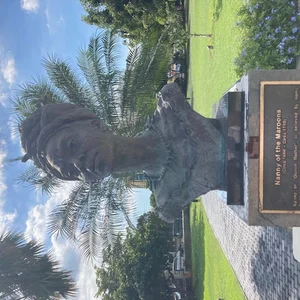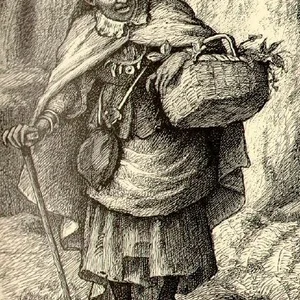

An enslaved woman of Native American or Caribbean origin (probably Arawak), owned by Reverend Samuel Parris in Salem. In 1692, she was the first accused to confess to witchcraft, triggering the spiral of the Salem witch trials.
Tituba(1659 — ?)
Tituba
9 min read
Frequently asked questions
Key Facts
- Around 1692: accused of witchcraft by the Parris and Putnam girls in Salem, Massachusetts
- The first of the accused to confess, likely saving her own life by doing so
- Her confession gave Puritan authorities the 'proof' of a diabolical pact, triggering a wave of further accusations
- Imprisoned for several months, she was eventually sold to cover the costs of her detention
- Her exact origins are debated: colonial records point to the Caribbean (Barbados), while one tradition links her to the Arawak people
Works & Achievements
Extraordinarily detailed oral confessions that Tituba gave during her public interrogation. This testimony, transcribed by court clerks, is the only document where her own voice — however filtered — is preserved, and it served as the direct trigger for the hysteria of the witch trials.
A novel by Guadeloupean Nobel Prize laureate Maryse Condé that gives Tituba a fictional voice, restoring her Caribbean, Indigenous, and feminine perspective. A landmark work of Francophone literature that helped rehabilitate Tituba's memory worldwide.
An American play that uses the Salem trials as an allegory for McCarthyism. Tituba appears as a secondary character; the play brought the Salem trials to worldwide audiences and cemented Tituba's place in collective cultural memory.
A critical edition of the original Salem trial documents, including transcriptions of Tituba's interrogations. These digitized archives are the essential primary source for any researcher studying Tituba.
A young adult novel that reconstructs Tituba's life before and during the trials. One of the first works to place Tituba as the central protagonist of the Salem story, written for a school-age audience.
Anecdotes
During the interrogations of February 1692, Tituba was the first of the three accused women to confess to witchcraft. Unlike Sarah Good and Sarah Osborne, who denied everything, she delivered a vivid account of sabbaths, black books, and animal spirits — captivating her judges and fueling the mass panic gripping Salem Village.
Tituba's confessions described a 'man dressed in black' who had asked her to sign a book in exchange for powers. She named other supposed accomplices, turning a single accusation into a witch hunt that would engulf the entire Massachusetts Bay Colony and cost twenty people their lives.
Tituba had taught Reverend Parris's daughter and her friends divination practices rooted in her Caribbean culture — including the preparation of a 'witch cake,' a concoction of rye and urine believed to identify witches. It was precisely this practice, discovered by Parris, that triggered the first accusations.
After more than a year in prison under squalid conditions, Tituba was acquitted but did not immediately regain her freedom: Samuel Parris refused to pay her jail fees, leaving her behind bars. She was eventually sold to an unknown buyer to settle the debt, and all trace of her vanishes from the historical record after 1693.
The figure of Tituba has captivated writers and playwrights for three centuries. Arthur Miller drew on her story for his play 'The Crucible' (1953), but it was Guadeloupean novelist Maryse Condé who truly restored her voice and Caribbean complexity in the novel 'I, Tituba, Black Witch of Salem' (1986), giving back the identity and dignity that official history had denied her.
Primary Sources
Q: Why do you hurt these children? A: I do not hurt the children. Q: Who is it then? A: The Devil, for all I know. [...] He told me to serve him and to hurt the children.
Tituba, an Indian, servant to Mr. Samuel Parris, confessed to having made a pact with the Devil and having seen his mark in the Black Book; she described spirits in the form of cats and black dogs, and a man dressed in black who came from Boston.
The first accusations in this village began with an Indian slave named Tituba, who confessed to having been instructed by her mistress in Barbados in the art of discovering witches through certain ceremonies.
God forgive me for having contributed to the execution of innocent persons. I take upon myself the shame and blame, humbly praying that all the ignorance and error of these proceedings may be forgiven me.
Tituba's confession was the first stone of an edifice of accusations that ultimately collapsed upon itself; for this woman, schooled in the beliefs of her homeland, gave her judges exactly what they wished to hear, saving her own life at the cost of others'.
Key Places
A Puritan farming community where the Parris family lived and where Tituba was accused. This is where the girls' fits began and the first arrests took place in February 1692.
A British island in the West Indies where Tituba was likely enslaved before becoming the property of Samuel Parris. It was there that she acquired her divination practices and knowledge of Caribbean plants.
A colonial jail where Tituba was transferred after her confession, where she remained imprisoned for over a year in miserable conditions, until she was sold to cover her detention costs.
The seat of the Court of Oyer and Terminer, which tried those accused of witchcraft. It was here that nineteen people were sentenced to death during the summer of 1692.
The execution site where those condemned in the Salem trials were hanged. Nineteen innocent people were executed there; Tituba, thanks to her confession, escaped this fate but remained imprisoned.
Typical Objects

A preparation made from rye flour mixed with the urine of the afflicted girls, baked and fed to a dog in order to identify the witch. It was Tituba's making of this cake — at a neighbor's suggestion — that sparked Reverend Parris's fury and the first accusations.

In her confessions, Tituba described a book in which the Devil recorded the names of his servants. This imaginary object, central to Puritan theology of witchcraft, underpinned the entire logic of the trials: judges sought to identify the other 'signatories.'

Tituba was kept in chains for more than a year in Boston's jail, under conditions of extreme squalor. The irons placed on prisoners accused of witchcraft were believed to restrain their malevolent powers and prevent their spirits from causing harm.

A common accessory among enslaved people and Caribbean servants in the 17th century, often associated in the Puritan imagination with diabolical practices. The pipe was among the attributes that witnesses attributed to women accused of witchcraft in Salem.

Tituba possessed botanical knowledge rooted in her Native American and Caribbean heritage, including plants with hallucinogenic or medicinal properties. This kind of knowledge, misunderstood by the Puritans, contributed to the suspicion that hung over her.

In Reverend Parris's household, the Bible was the central object of domestic and spiritual life. As an enslaved person, Tituba likely had daily contact with a text she was probably forbidden to read — a symbol of the religious order that would ultimately be turned against her.
School Curriculum
Vocabulary & Tags
Key Vocabulary
Tags
Daily Life
Morning
Tituba rose before dawn to light the fires and prepare breakfast for the Parris family — corn porridge, rye bread, warm cider. She carried out these tasks in the parsonage's detached kitchen, alone or alongside John Indian, her husband, who was also enslaved.
Afternoon
Afternoons were devoted to household chores: washing laundry at the wash basin, cleaning rooms, and preparing the main meal (salt pork or dried cod stew with root vegetables). She also looked after the Parris children, sometimes telling them stories from her Caribbean culture.
Evening
In the evenings, the family gathered for prayer and Bible reading; Tituba and John Indian were required to attend these devotions before retiring to their allotted space — most likely the kitchen or an outbuilding. It was during these winter evening gatherings that the young girls reportedly asked her about divination practices.
Food
As an enslaved person, Tituba ate leftovers and the most basic provisions: cornbread, dried fish, boiled vegetables, and occasionally low cuts of pork. She likely knew of Caribbean plants and spices she could not obtain in New England, where flavors were austere and monotonous.
Clothing
Tituba wore the dress of a Puritan servant: a coarse wool gown in a dark color (brown, gray, or black), an undyed linen apron, a white cap covering her hair entirely, and simple leather shoes. No adornment was permitted in the home of a Puritan minister.
Housing
Tituba and John Indian most likely slept in the parsonage kitchen or an unheated adjacent space, on a straw mattress or a basic wooden bed frame. The Salem Village parsonage was a plain, functional two-story wooden house, with none of the comforts found in the homes of wealthier colonists.
Historical Timeline
Period Vocabulary
Visual Style
Esthétique coloniale puritaine sombre et austère, clair-obscur dramatique soulignant le contraste entre la rigueur de la Nouvelle-Angleterre et les origines caribéennes de Tituba.
Sound Ambience
L'hiver austère d'un village puritain de Nouvelle-Angleterre, entre prières murmurées et vent glacial, avec en filigrane le souvenir lointain des Caraïbes.
Liens externes & ressources
Références
Œuvres
Confession et témoignage devant le tribunal de Salem
1er mars 1692
Moi, Tituba sorcière… Noire de Salem — Maryse Condé (roman)
1986
Les Sorcières de Salem — Arthur Miller (pièce de théâtre)
1953
The Salem Witchcraft Papers — Paul Boyer et Stephen Nissenbaum (éd.)
1977
Tituba of Salem Village — Ann Petry (roman jeunesse)
1964