
Mahishasura is a buffalo-demon (asura) from Hindu mythology who, after obtaining invincibility against any man or god, conquered the three worlds and drove the gods from paradise. The goddess Durga, created from the combined energy of all the gods, ultimately defeated him after nine days of battle.
Mahishasura
Mahishasura
9 min read
Frequently asked questions
Key Facts
- Mahishasura receives a boon from Brahma making him invincible against any man or male god
- He conquers the three worlds — earth, heaven, and the underworld — and drives the gods from their own paradise
- The goddess Durga is created from the united energy (shakti) of all the gods to fight him
- Their battle lasts nine nights, commemorated every year during the festival of Navratri
- His story is told in the Devi Mahatmya (5th–6th century CE), a founding text of Shaktism
Works & Achievements
A Sanskrit text of 700 verses drawn from the Mârkandeya Purâna, it is the primary literary source for the myth of Mahishasura. It is still recited in its entirety during Navratri in millions of Hindu homes and temples.
A monumental rock-cut masterpiece of Pallava art, this bas-relief depicts Durgâ with eighteen arms slaying Mahishasura. It stands as one of the finest examples of narrative sculpture from medieval India.
A Dravidian temple dedicated to the goddess who vanquished Mahishasura, it is one of the 18 Maha Shakti Peethas (sacred seats of the Goddess) and draws hundreds of thousands of pilgrims every year.
A major Purâna of the Shâkta tradition that elaborates extensively on the myth of Mahishasura and the theology of the Great Goddess. It asserts the supremacy of Durgâ-Shakti over all male deities.
A ten-day annual celebration commemorating Chamundeshvari's victory over Mahishasura, this festival ranks among the greatest in India; its royal elephant processions draw millions of visitors.
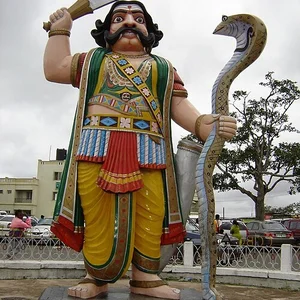
An imposing five-metre polychrome sculpture depicting Mahishasura standing armed and crowned, erected at the summit of the Chamundi Hills. Paradoxically, the vanquished demon has become the tourist emblem of the city of Mysuru.
Anecdotes
Mahîshâsura performed such intense austerities (tapas) for thousands of years that Brahmâ, deeply impressed, granted him an extraordinary boon: no man or god could kill him. In his arrogance, the buffalo demon never thought to include women in his request — an oversight that would seal his fate.
Emboldened by his invincibility, Mahîshâsura launched an all-out war against the gods and drove them from the three worlds — heaven (svarga), earth (bhûloka), and the underworld (pâtâla). Humiliated and homeless, the gods wandered until they decided to unite all their divine energies and forge a new power.
From the fusion of the energy (shakti) of Brahmâ, Vishnu, Shiva, and all the other gods, the goddess Durgâ was born — radiant and formidable. Each god gave her his most powerful weapon: Shiva his trident, Vishnu his discus, Indra his thunderbolt — making her the embodiment of all divine power combined.
The battle between Durgâ and Mahîshâsura lasted nine days and nine nights. The demon constantly changed shape — buffalo, lion, elephant, man — trying to escape the goddess. On the tenth day, Durgâ pierced him with her trident as he returned to his buffalo form, then severed his head with a single stroke of her sword.
Durgâ's victory over Mahîshâsura is celebrated every year during Navratri (nine nights) and Vijayadashami (the tenth day). The city of Mysuru (Mysore) in India takes its name from 'Mahishûru,' meaning the city of the buffalo, and the goddess Chamundeshvari — a local form of Durgâ — has been honored there as the protector of its people for centuries.
Primary Sources
Then Mahisha, in his buffalo form, terrified the army of the gods; some he struck with his muzzle, others he trampled with his hooves, still others he struck with his tail, and others he wounded with his horns. [...] Seeing this, the great goddess, blazing with anger, said to him: 'Roar, roar a moment longer, O fool! When I have slain you, the gods will cry out with joy.'
Mahisha obtained from Brahmâ the boon of being unable to be slain by any male being. Empowered by this boon, he conquered the three worlds, drove Indra and the other gods from their celestial abodes, and established himself as master of the universe.
The goddess, mounted on her lion, confronted the buffalo demon. After a fierce battle, she pinned him beneath her foot, pierced him with her trident, and severed his head with her sword. The gods reclaimed their place in paradise and celebrated Durgâ's victory.
Mahishasura, drunk with Brahma's blessing, declared: 'I am the lord of the three worlds; let no god dare challenge me.' And he sat upon Indra's throne, drinking the nectar reserved for the immortals.
The goddess Chamundeshvari, who triumphed over the demon Mahisha on this sacred hill, has been the protector of the kingdom of Mysore since the most ancient times; the kings of the Wadiyar dynasty paid her homage before every battle.
Key Places
According to tradition, it was on these hills that Durga — under the name Chamundeshvari — slew Mahishasura. A temple dedicated to her stands at the summit, and a massive statue of the buffalo demon was erected there in 1975, making this a major pilgrimage site.
The city is said to derive its name from 'Mahishuru' (the city of Mahisha), reflecting how deeply the myth is rooted in the local geography. The Mysore Dasara, which commemorates every October the victory over Mahishasura, is one of India's most spectacular festivals.
A great sacred city and center of Shakta worship, Varanasi is home to many temples dedicated to the forms of the Goddess who defeated Mahishasura. The Devi Mahatmya has been recited there during Navratri for centuries.
This archaeological site (7th century) preserves one of the oldest and largest sculpted depictions of Mahishasura-Mardini (Durga slaying Mahisha), carved directly into the rock. It stands as evidence of the early spread of the myth across southern India.
The capital of Durga Puja celebrations, Bengal's greatest festival, which commemorates over five days Durga's descent to earth to slay Mahishasura. Millions of people take part each year in this festival, inscribed on UNESCO's Intangible Cultural Heritage list in 2021.
Typical Objects

A sacred weapon given to Durga by Shiva to fight Mahishasura, the trident symbolizes the destruction of ignorance, ego, and illusion. It was with this weapon that the goddess pierced the buffalo-demon during the final battle.

The buffalo is both the demon's primary form and a chthonic animal associated with death in Hindu mythology. Yama, god of the dead, also rides a buffalo, underscoring the link between Mahishasura and the forces of the underworld.

Durga holds a sword in one of her many hands, a gift from the moon god. It was this sword that severed Mahishasura's head on the tenth day of battle, bringing an end to the demon's tyranny over the three worlds.

A symbol of divine usurpation, Mahishasura seized the throne of Indra, king of the gods, and his crown after conquering the heavens (svarga). These royal attributes illustrate the full extent of his dominion over the cosmos.

Among the weapons given to Durga to defeat Mahishasura, Vishnu's spinning discus holds a prominent place. This detail emphasizes that it was the combined energy of all the gods — not any single deity — that made it possible to vanquish the demon.

The conch shell, a sacred wind instrument, was given to Durga by Varuna. Her breath before battle signals the opening of the fight against Mahishasura, and its sound symbolizes the victory of dharma over the forces of chaos.
School Curriculum
Vocabulary & Tags
Key Vocabulary
Daily Life
Morning
In mythological accounts, Mahishasura ruled over the three worlds from the celestial palace of Indra, which he had usurped. Each morning, he received tributes from the asuras (demons) and earthly beings under his authority, seated upon the golden throne of the king of the gods.
Afternoon
The buffalo demon spent his days organizing his demonic armies, dictating laws to the three worlds, and humiliating the gods who had been reduced to wandering. He could change form at will — buffalo, lion, elephant, or warrior — displaying his power for all to see.
Evening
In the evenings, according to the Puranic texts, Mahishasura feasted with his generals, drinking soma (divine nectar) stolen from the gods and listening to demonic bards sing of his victories, unaware that the gods were preparing their response by creating Durga.
Food
As a mythological being associated with chaos and excess, Mahishasura is described as consuming sacrificial offerings he had redirected for himself and food originally meant for the gods. In his buffalo form, he also symbolizes the raw, primordial forces of nature.
Clothing
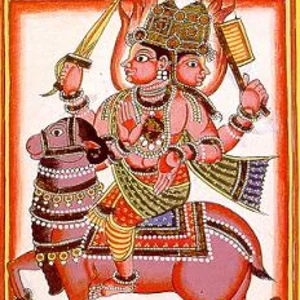
In traditional iconography, Mahishasura is depicted wearing golden armor adorned with gemstones, a royal crown, and warrior's bracelets. His half-human, half-buffalo form is covered with dark fur on the animal half, while his human half displays royal ornaments stolen from the gods.
Housing
Mahishasura dwelt in Devaloka, the celestial paradise seized from the gods, which he had transformed into a demonic fortress. The texts also mention his underground palaces (patala), richly decorated with precious stones, from which he extended his dominion over the worlds.
Historical Timeline
Period Vocabulary
Visual Style
Style inspiré de la sculpture Pallava et de la miniature indienne médiévale : compositions dramatiques en rouge et or, figures hiératiques aux nombreux attributs divins, fond de bataille céleste sous un ciel de mousson.
Sound Ambience
Ambiance épique de bataille cosmique mêlant tambours de guerre, conques sacrées, rugissements de lion, fracas d'armes divines et incantations sanscrites, évoquant le combat entre Durgâ et le démon-buffle Mahishasura.
Liens externes & ressources
Références
Œuvres
Devî Mâhâtmya (Durgâ Saptashatî)
vers 400-600 apr. J.-C.
Bas-relief de Mahishasura-Mardini, grotte de Mahabalipuram
VIIe siècle apr. J.-C.
Temple de Chamundeshvari, Chamundi Hills
Xe siècle (structure principale) ; reconstructions aux XVIe-XVIIe siècles
Devî Bhâgavata Purâna
vers 600-1000 apr. J.-C.
Festival Dasara (Vijayadashami) de Mysore
Établi comme fête royale en 1610 ; tradition continue jusqu'à nos jours
Statue de Mahishasura, Chamundi Hills
1975