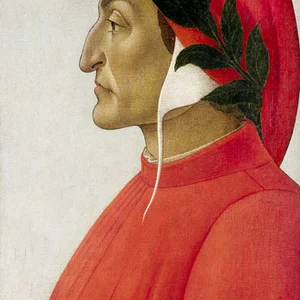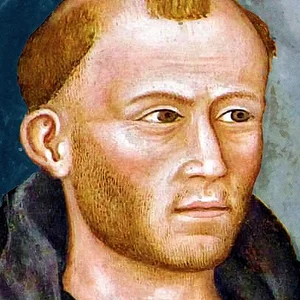

German Dominican theologian, philosopher, and mystic of the Middle Ages. A major figure of Rhineland mysticism, he preached the union of the soul with God and the idea of detachment. Some of his theses were condemned by a papal bull in 1329.
Meister Eckhart(1260 — 1328)
Meister Eckhart
Allemagne
6 min read
Frequently asked questions
Key Facts
- Born around 1260 in Thuringia (Holy Roman Empire)
- Joins the Dominican order and teaches theology in Paris in the early 14th century
- A Master of theology (hence his nickname “Meister”), he preaches in the German vernacular
- In 1326, an inquisition trial is opened against him in Cologne over his theses
- Died around 1328; in 1329, the bull “In agro dominico” condemns 28 of his propositions
Works & Achievements
Advice given to the young Dominicans of Erfurt on obedience and the inner life; his first major work in German.
The heart of his influence: vernacular preaching on the union of the soul with God and the birth of God in the soul.
A treatise that places detachment above all other virtues, a key concept of his spirituality.
A great unfinished Latin summa blending propositions, questions, and biblical commentaries, intended for scholars.
A major philosophical exegesis developing his thought on the Word and the relationship between God and creation.
A treatise of consolation written for a grieving queen, explaining how the detached soul finds peace in God.
Part of his Latin work connecting Aristotelian philosophy with Christian theology.
Anecdotes
Meister Eckhart taught twice at the University of Paris as a “Master of Theology,” an exceptionally rare honor that, among the Dominicans, only Thomas Aquinas had received before him. It is from this double mastership that he draws his nickname, the “Master.”
He preached in German before nuns and laypeople, not only in the Latin reserved for scholars. By coining new words to express the inexpressible (such as “detachment,” *Abgeschiedenheit*), he profoundly shaped the German philosophical language.
Accused of heresy near the end of his life, Eckhart defended himself before the judges of Cologne, declaring that he could be mistaken but could not be a heretic, for error belongs to the intellect and heresy to the will.
He died around 1328 before the end of his trial. The following year, in 1329, the papal bull “In agro dominico” condemned 28 of his propositions, 17 of them judged heretical and 11 suspect.
His sermons nearly vanished after his condemnation, but copies circulated quietly in the convents. Rediscovered in the 19th century by German philosophers, he is today regarded as one of the greatest mystics of the West.
Primary Sources
As long as you still have the will to do the will of God, you are not poor in the sense we mean. For that person is poor who wills nothing, knows nothing, and has nothing.
I have read many writings, both of pagan masters and of the prophets, and I have found no virtue higher than pure detachment from all things.
We condemn the first fifteen articles and the last two as heretical, and the remaining eleven articles as suspect and rash.
In the beginning, that is, in the Son, God created heaven and earth, for through him all things were made.
Key Places
Region of Thuringia, in the Holy Roman Empire, where Eckhart was born around 1260 into a family of the minor nobility.
The greatest intellectual center of the West, where Eckhart taught twice as a master of theology, an exceptional achievement for a Dominican.
Rhineland city where Eckhart settled around 1314, preaching to Beguines and nuns and becoming a central figure of Rhineland mysticism.
Seat of the Dominican studium generale where Eckhart taught and where the heresy trial against him opened in 1326.
Residence of the popes in the 14th century, where Eckhart went to defend his theses and where he most likely died around 1328.
Dominican priory in Thuringia where Eckhart served as prior in his youth and wrote his “Talks of Instruction” intended for novices.
Typical Objects

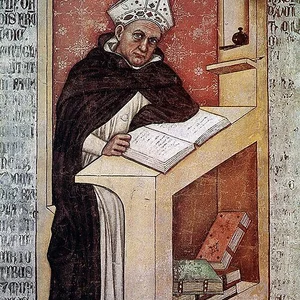
White tunic and large black cape (cappa) of the Order of Preachers, hence their nickname of “Dominicans” and “black friars.” Eckhart wore it throughout his life as a friar.

Raised platform from which the preacher addressed the faithful in the church. Eckhart delivered his sermons there in the German language before nuns and laypeople.

Collection copied by hand, often by the nuns who took notes during his preaching. These clandestine copies allowed his work to survive the condemnation.

Standard theology textbook that every medieval master had to comment on in order to teach. Eckhart commented on it in Paris at the start of his academic career.

Plain crucifix worn or contemplated in prayer, the central symbol of Christian meditation. For Eckhart, it was a support for detachment and union with God.

Tools of the copyist and the master of theology for writing commentaries and treatises in Latin. Eckhart used them for his scholarly work intended for clerics.
School Curriculum
Vocabulary & Tags
Key Vocabulary
Daily Life
Morning
Woken before dawn, Eckhart joins his brothers for the religious offices that structure the monastic day, beginning with matins in the dead of night. The morning blends communal prayer, mass, and time spent studying Scripture and the great theologians.
Afternoon
The afternoon is devoted to teaching and writing: Latin commentaries for his students, and the preparation of sermons in German. As provincial and later as master, he also visits convents and settles questions concerning the governance of the order.
Evening
In the evening, after vespers and compline, comes a time of silence and meditation suited to inner reflection. Eckhart practices and teaches inner detachment, that “poverty” of spirit which silences desires and knowledge to make room for God.
Food
Dominican fare is plain and largely vegetarian according to the rule: bread, vegetables, legumes, sometimes fish, washed down with wine cut with water. Fasts are frequent, especially during Advent and Lent.
Clothing
Eckhart wears the habit of the Order of Preachers: a white wool tunic gathered with a belt, a scapular, and a large black hooded cloak. This habit, a sign of poverty and of belonging to the order, follows him into the pulpit as on his travels.
Housing
He lives in the austere cells of the Dominican convents in Erfurt, Strasbourg, or Cologne, set around a cloister, a church, and a study hall. The furnishings are reduced to the essentials: a simple bed, a table, and books.
Historical Timeline
Period Vocabulary
Liens externes & ressources
Références
Œuvres
Les Entretiens spirituels (Reden der Unterweisung)
vers 1294-1298
Sermons allemands (Deutsche Predigten)
vers 1300-1325
Du détachement (Von abegescheidenheit)
début XIVe siècle
Opus tripartitum (Œuvre en trois parties)
vers 1311-1325
Commentaire sur l'Évangile de Jean
vers 1313-1325
Le Livre de la consolation divine (Buch der göttlichen Tröstung)
vers 1308-1318
Commentaire sur le livre de la Sagesse
vers 1313-1325