
A fabulous creature of Persian origin, the manticore has the body of a lion, a human face, and a venomous scorpion tail. Described by Ctesias of Cnidus in the 5th century BC, it was later referenced by Pliny the Elder in his Natural History.
Manticore
Manticore
8 min read
Frequently asked questions
Key Facts
- 5th century BC: Ctesias of Cnidus, a Greek physician at the Persian court, describes the manticore in his Indica
- 1st century AD: Pliny the Elder includes the description in his Natural History (Book VIII)
- The name comes from the Persian 'mardkhora', meaning 'man-eater'
- The creature is depicted with three rows of teeth, a lion's body, and a tail that shoots venomous spines
- During the Middle Ages, the manticore was incorporated into illuminated bestiaries as a symbol of evil or tyranny
Works & Achievements
The first Greek text to describe the manticore in detail. Although the original is lost, fragments are preserved in Photius's Bibliotheca, making it the fundamental primary source for the study of this creature.
A 37-volume naturalist encyclopedia that established the manticore in Latin scholarship. Pliny's description, enriched with details about the tail's ability to launch spines, served as a reference throughout the Middle Ages.
A compilation of accounts about real and fantastical animals, including the manticore. Aelian confirms and expands upon Ctesias's description, helping to anchor the creature firmly within the Greco-Roman naturalist tradition.
The first major Christian bestiary to incorporate the manticore within a moral and allegorical framework. This foundational text influenced all subsequent medieval bestiaries and their iconography of the creature.
One of the most celebrated illuminated medieval bestiaries, containing a detailed visual depiction and description of the manticore. It bears witness to the enduring vitality of the ancient tradition within medieval Christian culture.
A scholastic encyclopedic treatise that reproduces the ancient description of the manticore. Albertus Magnus attempts to reconcile the Greco-Latin naturalist tradition with Christian theology, keeping the creature alive within learned scholarship.
Anecdotes
Ctesias of Cnidus, a Greek physician at the court of Persian king Artaxerxes II in the 5th century BCE, was the first to describe the manticore in his work Indica. He claimed to have received this information from Persian eyewitnesses who had observed the creature in India, lending it an air of scientific credibility.
The name 'manticore' comes from the Old Persian 'merthykhuwar', literally meaning 'man-eater'. This etymology reveals the terrifying role the Persians assigned to it: an insatiable predatory creature capable of swallowing a man whole — bones and all — without leaving a trace.
Pliny the Elder, in his Historia Naturalis written in the 1st century CE, revisits the description of the manticore, noting that it possesses a triple row of teeth and that its tail can shoot quills like arrows. This ballistic detail fascinated medieval scholars, who incorporated it into their illuminated bestiaries.
Aristotle himself mentions the manticore in his writings on animals, while expressing measured skepticism. This debate between credulity and rationalism perfectly illustrates the tension in Antiquity between emerging empirical knowledge and the mythological traditions inherited from Eastern cultures.
In the Middle Ages, the manticore was reinterpreted as a symbol of the devil or tyranny in Christian bestiaries. Its human face combined with a bestial and murderous nature made it an ideal metaphor for evil concealed beneath a seductive appearance.
Primary Sources
There exists in India a wild animal called the martichoras. It has a human face, a size comparable to that of a lion, and a color as red as cinnabar. It has three rows of teeth and a tail like that of a land scorpion, with a sting at the tip.
Ctesias reports that in Ethiopia lives an animal he calls the manticore, with a triple row of teeth fitting together like a comb, a human face and ears, blue eyes, blood-red in color, the body of a lion, and a scorpion's tail with which it can hurl stingers.
The manticore is an Indian beast. It is the color of cinnabar, the size of a lion, with a human face and three rows of teeth. Its ears resemble those of a human being. Its eyes are grey-blue, and its gaze is reminiscent of a man's.
The manticore has the face of a man but is the enemy of men. Its tail acts like a scorpion's, and it can shoot its quills at a distance to strike its prey. No animal can escape it.
Key Places
Ceremonial capital of the Achaemenid Empire where Ctesias served at the royal court. It was in this diplomatic and intellectual setting that he gathered accounts of the manticore from his Persian informants.
Birthplace of Ctesias and a major medical center of the ancient world. Cnidian physicians traveled throughout the eastern world, bringing back observations on plants, animals, and peoples unknown to the Greeks.
A distant and mysterious region to the ancient Greeks, India was presented as the natural homeland of the manticore. Accounts from merchants and soldiers helped sustain this imaginary geography.
A great Hellenistic intellectual center where the texts of Ctesias and Pliny were copied and commented upon. The Library of Alexandria played a crucial role in preserving and spreading descriptions of the manticore.
Where Pliny the Elder wrote his Historia Naturalis, an encyclopedia that secured the manticore's fame throughout the Latin West. The Roman fascination with exotic monsters fueled the creature's enduring popularity.
Typical Objects

Greek scholars recorded on papyrus the accounts of travelers and merchants describing exotic fauna. It was through this type of medium that descriptions of the manticore were transmitted and commented upon.

According to ancient sources, the manticore could launch the spines of its tail like arrows, in the manner of a giant scorpion. This defensive and offensive attribute is one of its most spectacular features.

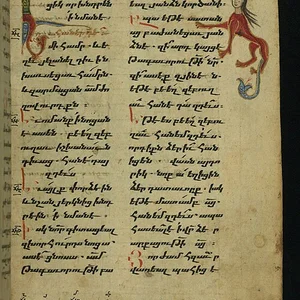
In the Middle Ages, the manticore was depicted in sumptuous illustrated manuscripts known as bestiaries. These images helped fix its iconography: a lion's body, a smiling human face, and a curved tail.

Mesopotamian and Persian sources, predating Ctesias, describe hybrid creatures comparable to the manticore. These tablets attest to the ancient origins of anthropomorphic monster depictions in the East.

In ancient geographical representations, unknown regions — such as distant India — were populated with fabulous creatures, including the manticore. These maps mark the boundary between the known world and the realm of wonders.

Scorpion venom, very real and greatly feared in antiquity, served as a reference for authors describing the deadly poison in the manticore's tail, grounding the creature in a medical and naturalistic reality.
School Curriculum
Vocabulary & Tags
Key Vocabulary
Tags
Daily Life
Morning
The manticore, described as a nocturnal creature in ancient texts, begins its day at sunrise by resting in rocky caves or the thick undergrowth of the Indian jungle. It surveys its territory from a high vantage point, its blue-grey eyes scanning the horizon for prey.
Afternoon
In the afternoon, the manticore sets out to hunt across the plains and forests of India. According to Ctesias, it moves with extraordinary speed and can pursue any animal or human. Its triple row of teeth allows it to swallow prey whole, leaving no remains behind.
Evening
At dusk, according to ancient texts, the manticore produces a strange sound — a mix of flute and trumpet — said to disorient its prey. It then uses its tail to launch venomous quills, paralyzing at a distance anything that dares approach.
Food
The manticore is described as strictly carnivorous and particularly fond of human flesh — its Persian name means 'man-eater.' It devours its prey entirely, bones included, thanks to its three rows of teeth. According to the ancients, no prey can ever escape it.
Clothing
As a mythological creature, the manticore wears no clothing. Its 'appearance' is defined by its blood-red lion's fur, its beardless human face with exposed teeth, and its curved scorpion tail — features that make up its visual identity throughout ancient and medieval iconography.
Housing
The manticore is said to inhabit the wild, remote regions of India, in areas beyond human reach. It favors caves, dense jungles, and arid plains — spaces that symbolized radical otherness and danger for ancient travelers venturing far from known roads.
Historical Timeline
Period Vocabulary
Visual Style
Style inspiré des enluminures de bestiaires médiévaux et de la peinture sur vase grecque, avec des teintes chaudes perses — ocre, terre de Sienne et rouge sang — soulignant la nature hybride et menaçante de la créature.
Sound Ambience
Ambiance de steppe aride perse au crépuscule, mêlant les sonorités animales du lion et du scorpion à une inquiétante présence humaine, pour évoquer la nature hybride et terrifiante de la manticore.
Liens externes & ressources
Références
Œuvres
Indica — Ctésias de Cnide
v. 400 av. J.-C.
Historia Naturalis — Pline l'Ancien
77 apr. J.-C.
De Natura Animalium — Élien
IIe-IIIe siècle apr. J.-C.
Physiologus (Bestiaire grec)
IIe-IVe siècle apr. J.-C.
Aberdeen Bestiary (Bestiaire d'Aberdeen)
v. 1200
De Animalibus — Albert le Grand
v. 1258-1262