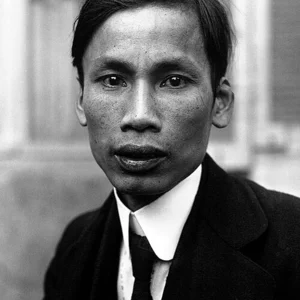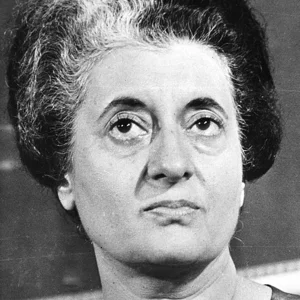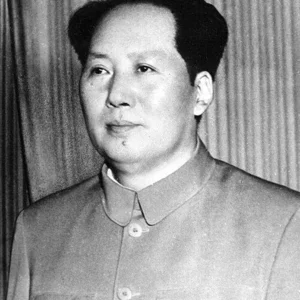

Chinese statesman (1893-1976) and founder of the People's Republic of China. Leader of the Chinese Communist Party, he established a communist regime and launched the Great Proletarian Cultural Revolution. A major figure of the 20th century, his political legacy remains complex and controversial.
Mao Zedong(1893 — 1976)
Mao Zedong
République populaire de Chine, dynastie Qing, République soviétique chinoise, république de Chine
7 min read
Frequently asked questions
Key Facts
- 1921: Participates in the founding of the Chinese Communist Party
- 1934-1935: Leads the Long March, a strategic retreat by the Communist Party in the face of Nationalist forces
- 1949: Proclaims the People's Republic of China and becomes its chairman
- 1958-1962: Launches the Great Leap Forward, an economic and agricultural modernization campaign with disastrous consequences
- 1966-1976: Initiates the Cultural Revolution, a period of massive social upheaval and repression
Works & Achievements
Foundational analysis of the revolutionary role of the Chinese peasantry. This text breaks with Marxist orthodoxy and lays the groundwork for Maoism.
Two major philosophical essays constituting Mao's contribution to dialectical materialism, widely studied in Chinese universities.
Military treatise influenced by Sun Tzu's theories, describing the guerrilla tactics that enabled the Communists to defeat a superior army.
Collection of poems in classical Chinese forms, blending romantic lyricism with revolutionary ideals. They are part of the contemporary Chinese literary canon.
Major political act of the 20th century, unifying China under a communist regime after decades of civil war and foreign occupation.
Forced economic modernization program aimed at catching up with the West within a few years; it caused one of the greatest famines in human history.
Radical political and social movement launched by Mao to purge the Party and society of 'revisionist' elements, with devastating social and cultural consequences.
Anecdotes
As a young man, Mao Zedong traveled hundreds of kilometers on foot across Hunan to observe the living conditions of peasants. This fieldwork forged his conviction that the Chinese revolution had to rely on the peasantry, rather than on the urban proletariat as Marxist orthodoxy prescribed.
During the Long March (1934-1935), the Communist Red Army traveled approximately 12,000 kilometers to escape the Kuomintang nationalists. Of the 100,000 men who set out, fewer than 10,000 reached Yan'an. Mao emerged from this ordeal as the undisputed leader of the Chinese Communist Party.
Mao was a voracious reader and passionate poet. He composed poems in classical Chinese forms (ci and shi) throughout his life, including during periods of war. His poem 'Snow' (1936) is still studied in Chinese schools today.
On October 1, 1949, from the rostrum of the Tiananmen Gate in Beijing, Mao proclaimed the founding of the People's Republic of China before an immense crowd. His first words were: 'The Chinese people have stood up!' This phrase remains one of the most famous in modern Chinese history.
Mao was known for his swims in the Yangtze River. At age 72, in 1966, he swam in the Yangtze to publicly demonstrate his physical vitality and reassert his political authority at the moment he was launching the Cultural Revolution. State media turned it into a national event.
Primary Sources
Political power grows out of the barrel of a gun. […] All political questions ultimately come down to the question of power.
In a few months, the peasants have accomplished what several decades of work by the democrats could not accomplish. It is magnificent! It is fine! It is not 'terrible' at all!
Knowledge begins with practice, and theoretical knowledge, acquired through practice, must then return to practice.
The law of contradiction in things, that is, the law of the unity of opposites, is the fundamental law of materialist dialectics.
The Central People's Government of the People's Republic of China is hereby proclaimed today. […] The Chinese people, who represent one quarter of humanity, have stood up.
Key Places
Mao Zedong's birthplace, in Hunan Province. It became a national pilgrimage site, with millions of Chinese traveling there to honor the 'Great Helmsman'.
Base of the Chinese communist revolution after the Long March (1935–1947). Mao consolidated his power there and developed his political doctrine.
It was from the rostrum of the Tiananmen Gate that Mao proclaimed the People's Republic of China on October 1, 1949. A major symbolic site of the regime.
A residential and governmental compound adjacent to the Forbidden City, which served as Mao's residence and workplace throughout his leadership of China.
Built at the center of Tiananmen Square following Mao's death in 1976, it houses his embalmed remains, which remain open for public viewing.
Typical Objects

A collection of Mao's quotations, distributed to hundreds of millions of copies during the Cultural Revolution. Every Chinese citizen was expected to carry it and recite from it.

The monumental portrait of Mao hanging above the Gate of Heavenly Peace in Beijing became the official image of the leader. It remains in place to this day.

A jacket with a stand-up collar and four pockets, popularized by Sun Yat-sen and then Mao, it became the official garment of the People's Republic and a symbol of egalitarianism.

Mao practiced Chinese calligraphy with great passion; his personal style, vigorous and expressive, was disseminated throughout the country and appeared on official posters.

An indispensable tool for Mao the military strategist; his theories of guerrilla warfare and people's war were developed through a careful reading of the terrain.
Mao was a lifelong heavy smoker; during Party meetings, cigarette smoke was ever-present in his office at Zhongnanhai.
School Curriculum
Vocabulary & Tags
Key Vocabulary
Daily Life
Morning
Mao had pronounced nocturnal habits and often woke up late in the morning, sometimes around 11 a.m. or noon. He had his first meals late, often after a long reading session in bed in his Zhongnanhai study. His day frequently began with reviewing reports and dispatches.
Afternoon
Afternoons were devoted to Politburo meetings, audiences with dignitaries, and working sessions with his secretaries. Mao often dictated his texts and poems, received foreign delegations, and made major strategic decisions in his vast wood-paneled office.
Evening
Mao stayed up very late into the night, often until dawn. He devoted these hours to reading (he owned a personal library of tens of thousands of volumes), political reflection, and calligraphy. He also enjoyed film screenings at his residence, including American westerns.
Food
Mao had a diet rooted in the flavors of Hunan: spicy dishes, soy-braised pork ('hong shao rou', his favorite dish), stir-fried vegetables, and rice. He drank little alcohol but smoked heavily. In public, he would symbolically share simple meals with workers and peasants.
Clothing
Mao wore almost exclusively the Zhongshan suit (or 'Mao suit'): a grey or khaki jacket with a stand-up collar and four pockets, with matching trousers. This garment embodied revolutionary egalitarianism and became the sartorial symbol of the People's Republic of China. He sometimes wore a military coat at official events.
Housing
Mao resided at Zhongnanhai, the government compound in Beijing, in a traditional dwelling surrounded by gardens and an artificial lake. His office was cluttered with books and documents. He also had secondary residences in several provinces, including a villa in Wuhan where he enjoyed staying and swimming in the Yangtze River.
Historical Timeline
Period Vocabulary
Visual Style
Esthétique du réalisme socialiste chinois dominée par le rouge révolutionnaire et l'or impérial, avec des foules héroïques, des affiches de propagande et le portrait monumental de Mao à Tian'anmen.
Sound Ambience
Un mélange de chants révolutionnaires, de discours amplifiés par des haut-parleurs et de bruits de foule sur les grandes places chinoises. En fond, les sons agraires du Hunan rural contrastent avec l'industrialisation bruyante du Grand Bond en avant.
Liens externes & ressources
Références
Œuvres
Rapport sur l'enquête dans le Hunan
1927
De la pratique / De la contradiction
1937
Sur la guerre de guérilla
1937
Poèmes (Mao Zedong shici)
1925-1963
Fondation de la République populaire de Chine
1er octobre 1949
Grand Bond en avant
1958-1962
Révolution culturelle prolétarienne
1966-1976