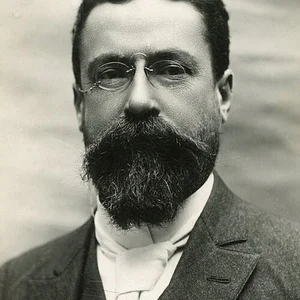

Socialist deputy for the Seine and close associate of Jean Jaurès, Marcel Sembat served as Minister of Public Works in the Sacred Union government (1914–1916). A committed pacifist, he left a political legacy shaped by his defense of socialism and his polemical 1913 essay.
Marcel Sembat(1862 — 1922)
Marcel Sembat
France
8 min read
Frequently asked questions
Famous Quotes
« Make a king, or else make peace.»
Key Facts
- Born in 1862 in Bonnières-sur-Seine, died in 1922 in Chamonix.
- Elected socialist deputy for the Seine from 1893, and a close collaborator of Jean Jaurès.
- Author of the polemical essay Faites un roi, sinon faites la paix (1913), a pacifist and republican manifesto.
- Minister of Public Works in the Sacred Union government under Viviani, then Briand (1914–1916).
- A station on line 9 of the Paris Métro bears his name in Boulogne-Billancourt.
Works & Achievements
A provocative political pamphlet in which Sembat analyzes the contradictions of the French Republic in the face of rising European military tensions. The deliberately shocking title caused a great stir, and the work remains his most widely read text.
For nearly thirty years, Sembat championed workers' rights, secularism, and pacifism from the parliamentary floor. His speeches stand as a valuable record of parliamentary socialism during the Belle Époque and the First World War.
As Minister of Public Works, Sembat organized the mobilization of the railway and road network for the armies while maintaining essential services for civilians. A considerable administrative achievement, accomplished despite his pacifist convictions.
Sembat contributed regularly to the socialist press to spread his ideas and comment on parliamentary and international affairs. These writings bear witness to his intellectual commitment to the labor movement.
Anecdotes
In 1913, Marcel Sembat published a deliberately provocative pamphlet titled: 'Make a King, or Make Peace!' He argued that the French Republic, torn between its pacifist ideals and the rising threat of military danger, had to choose: either equip itself with a strong executive power like a monarchy, or negotiate peace. The work caused a scandal and sparked lively debate in political and intellectual circles.
A convinced pacifist and close friend of Jean Jaurès, Sembat found himself deeply torn when war broke out in August 1914. Just days after the assassination of Jaurès, he agreed to join the Union sacrée government as Minister of Public Works, believing it was better to influence decisions from within than to protest uselessly from the opposition.
Marcel Sembat and his wife, the painter Georgette Agutte, were great friends and collectors of Henri Matisse. They welcomed the painter into their Parisian apartment and at Chamonix, and their collection was among the finest of the era. Matisse, as a sign of deep friendship, dedicated several canvases to them and maintained an ongoing correspondence with them.
On September 5, 1922, in Chamonix, Georgette Agutte died suddenly of a heart attack. Marcel Sembat, devastated by the loss of his lifelong companion, passed away himself on the same day, just a few hours later. Their double passing deeply moved the French political and artistic world.
A deputy for Montmartre since 1893, Sembat was deeply rooted in this working-class and bohemian neighborhood of Paris. In the National Assembly, he championed workers, small craftsmen, and the neighborhood's artists, and his repeated re-elections bore witness to the population's genuine attachment to this man of conviction.
Primary Sources
The Republic is not equipped for war. If you do not wish to wage it, speak of it no more. If you wish to wage it, prepare for it in earnest — or else seek another regime.
We are socialists, we are internationalists, we are advocates of peace. But faced with aggression, faced with the homeland in danger, we answer present in the name of our constituents and our republican convictions.
The mobilization of the national railway network is an absolute necessity for supplying the armies and maintaining the public services indispensable to the life of the nation.
Socialism is not a doctrine of hatred or disorder, but a doctrine of justice and organization. We want every worker to be able to live with dignity from the fruit of their labor, in a truly social Republic.
Key Places
A small town in Seine-et-Oise where Marcel Sembat was born on **August 13, 1862**. This commune on the banks of the Seine shaped his early years before he moved to Paris to pursue his studies and political career.
Sembat's electoral stronghold from **1893** onward, this working-class and bohemian neighborhood of Paris was the heart of his political activity. He championed its workers and artists in the Chamber, and was re-elected there several times.
Home of the Chamber of Deputies, where Sembat sat for nearly thirty years. From this chamber he defended socialism, secularism, and workers' rights against successive governments.
The seat of Sembat's ministerial power from **August 1914** to **December 1916**. There he coordinated the mobilization of the railway network and national infrastructure in support of the war effort, while keeping civilian public services running.
The Alpine resort where Marcel Sembat and his wife **Georgette Agutte** regularly stayed. It was here that both of them died on **September 5, 1922**, within hours of each other, sending shockwaves through France's political and artistic circles.
Typical Objects

As minister from 1914 to 1916, Sembat handled daily technical reports on roads, railways, and canals mobilized for the war effort. These bundles of papers symbolize the concrete management of the home front during the Great War.

Sembat and his wife Georgette Agutte collected works by their friend Matisse and displayed them throughout their Parisian apartment. These canvases bear witness to the singular bond between parliamentary socialism and the artistic avant-garde of the early twentieth century.

This short 1913 book circulated widely in political and intellectual circles. In just a few pages it lays out the dilemma Sembat posed to the Republic: fully commit to war, or seek peace.

Founded by Jaurès in 1904, this socialist daily was Sembat's indispensable reading. He published articles in it and kept up with political news through its pages, staying connected to the party's grassroots base.

It was from the floor of the Palais Bourbon that Sembat delivered his speeches for nearly thirty years. This symbol of parliamentary democracy embodied for him the legal, republican path to social change.

His seat as deputy for the Seine, renewed several times over, symbolized Sembat's deep roots among the people of Montmartre. It gave him the legitimacy to carry the aspirations of the workers and artists of his neighborhood all the way to Paris.
School Curriculum
Vocabulary & Tags
Key Vocabulary
Daily Life
Morning
Marcel Sembat began his day by reading the morning newspapers — *L'Humanité* first among them — to keep up with political and social news. He would then work through the considerable correspondence that came with being a deputy before sitting down to a modest breakfast of coffee and toast, typical of the bourgeois republican habits of the era.
Afternoon
His afternoons were devoted to sessions at the Chamber of Deputies, committee meetings, or — during his time in government — consultations with his chiefs of staff and engineers from the Ministry of Public Works. He also received workers' delegations who came to present their demands to the deputy for Montmartre.
Evening
In the evenings, Sembat and his wife Georgette frequently entertained artist and intellectual friends — Henri Matisse among them — in their apartment hung with paintings. These gatherings brought together left-wing politicians and the artistic avant-garde for lively conversations about art, politics, and society.
Food
Like many bourgeois republicans of the Belle Époque, Sembat favoured an unpretentious classic French table: soups, slow-cooked meats, cheeses, and house wines. Meals with friends were occasions for conviviality as much as for political debate.
Clothing
In public, Sembat wore the dark three-piece suit typical of Third Republic politicians: a double-breasted jacket, matching waistcoat and trousers, stiffened collar, and tie. This understated dress suited both his reputation as a serious man and his egalitarian convictions.
Housing
Sembat and his wife lived in a Parisian apartment where they displayed their fine art collection, with works by Matisse particularly prominent. They made regular stays in Chamonix to recharge away from the bustle of the capital.
Historical Timeline
Period Vocabulary
Liens externes & ressources
Références
Œuvres
Faites un Roi, sinon faites la Paix !
1913
Action parlementaire socialiste à la Chambre des députés
1893-1922
Gestion ministérielle des transports de guerre
1914-1916
Articles dans la presse socialiste (L'Humanité, La Lanterne)
1904-1922