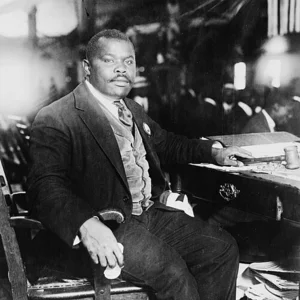

Marcus Garvey (1887-1940) was a Jamaican activist and founder of the Universal Negro Improvement Association (UNIA). A theorist of Pan-Africanism and the “Back to Africa” movement, he was one of the most influential promoters of Black pride and Black nationalism in the early 20th century.
Marcus Garvey(1887 — 1940)
Marcus Garvey
colonie de Jamaïque
5 min read
Frequently asked questions
Famous Quotes
« Up, you mighty race, accomplish what you will.»
« A people without the knowledge of their past history, origin and culture is like a tree without roots.»
Key Facts
- Born in 1887 in Saint Ann's Bay, Jamaica
- Founded the Universal Negro Improvement Association (UNIA) in 1914
- Created the Black Star Line shipping company in 1919 to connect the diaspora with Africa
- Convicted of mail fraud in 1923 and deported from the United States in 1927
- Died in 1940 in London; his ideology (“Garveyism”) influenced Rastafarianism and decolonization movements
Works & Achievements
The largest mass organization in the history of the Black diaspora, with hundreds of thousands of members across the world.
A Pan-African press organ distributed internationally, a major vehicle for the ideology of Black pride.
A Black-owned shipping company, a concrete symbol of the project for economic self-reliance and connection with Africa.
A text adopted at the first UNIA Convention, affirming the equality and rights of Black people on a global scale.
A foundational editorial setting out the philosophy of racial unity and African pride.
A collection of his speeches and writings, compiled by his wife Amy Jacques Garvey, which became a classic of Pan-African thought.
Anecdotes
In 1916, Marcus Garvey arrived in Harlem with almost nothing in his pocket. A few years later, his rallies drew thousands of people to Madison Square Garden, and his newspaper, the *Negro World*, sold across the Black world, from New York to Lagos.
Garvey founded the Black Star Line, a shipping company entirely owned by Black people, by selling shares at 5 dollars within the community. The goal: to connect America, the Caribbean, and Africa with ships crewed by Black sailors, a concrete symbol of economic self-reliance.
During the great UNIA parades in Harlem in 1920, Garvey marched in a plumed uniform, surrounded by the African Legion and the Black Cross Nurses. These spectacular processions proudly asserted Black dignity in an America still deeply segregated.
In 1923, Garvey was convicted of mail fraud connected to the sale of Black Star Line shares. Imprisoned in Atlanta, he had his sentence commuted in 1927 by President Coolidge, then was deported to Jamaica without ever having set foot in Africa.
Garvey never traveled to Africa in his entire life, even though he made it the heart of his dream of a “return.” Yet his slogan “Africa for the Africans” would inspire generations of African and Caribbean leaders, and his influence runs through the Rastafari movement.
Primary Sources
"Up, you mighty race, you can accomplish what you will."
"Be it known to all men that whereas all men are created equal and entitled to the rights of life, liberty and the pursuit of happiness... we believe in the supreme authority of our race in all things racial."
"A people without the knowledge of their past history, origin and culture is like a tree without roots."
"If I die in Atlanta my work shall then only begin... Look for me in the whirlwind or the storm, look for me all around you."
Key Places
Marcus Garvey's birthplace, on the north coast of colonial British Jamaica.
The neighborhood where Garvey set up the headquarters of the UNIA and Liberty Hall, the epicenter of his mass movement.
The prison where Garvey served part of his sentence for mail fraud, from 1925 to 1927.
The city where Garvey settled in the 1930s and where he died in 1940.
The Jamaican capital where Garvey continued his activism after his deportation from the United States in 1927.
Typical Objects

A plumed, braided military uniform that Garvey wore during the great Harlem parades. It embodied the dignity, discipline, and pride of the Black organization.

A shareholder certificate sold for 5 dollars to members of the Black community to fund the shipping company. It gave concrete form to the dream of Pan-African economic self-reliance.

The UNIA's weekly paper, distributed throughout the Atlantic world, sometimes in several languages. It spread the ideas of Black pride and Pan-Africanism.

A tricolor banner adopted by the UNIA in 1920, in which red evokes blood, black the skin, and green the African land. It became the definitive Pan-African flag.

The stage from which Garvey rallied crowds of thousands, notably at Harlem's Liberty Hall. A place of public speech and mobilization.
School Curriculum
Vocabulary & Tags
Key Vocabulary
Tags
Daily Life
Morning
During his years in Harlem, Garvey often began his day at his UNIA office, reading the press and the correspondence arriving from the Caribbean and Africa. He dictated articles and editorials for the *Negro World*.
Afternoon
The afternoon was devoted to running the organization: meetings with branch leaders, follow-up on Black Star Line affairs, planning conventions. Garvey also received journalists and delegations.
Evening
In the evening, he frequently took the floor at **Liberty Hall** before large crowds. His fiery speeches on Black pride and the return to Africa could last for hours.
Food
Garvey shared the diet of the Black working classes of his time, blending Caribbean and urban American influences. Rice, root vegetables, fish, and simple dishes made up everyday fare.
Clothing
In public, Garvey took care with his appearance: a dark city suit in ordinary times, and a plumed ceremonial uniform during the great UNIA parades. For him, dress was an instrument of dignity.
Housing
In Harlem, Garvey lived in housing typical of this Black neighborhood in the midst of cultural ferment. His living conditions remained modest, with most of his resources going to his movement.
Historical Timeline
Period Vocabulary
Liens externes & ressources
Références
Œuvres
Fondation de l'UNIA
1914
Journal Negro World
1918
Black Star Line
1919
Déclaration des droits des peuples noirs du monde
1920
« African Fundamentalism »
1925
Philosophy and Opinions of Marcus Garvey
1923