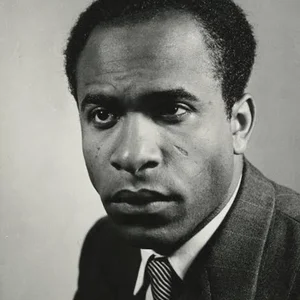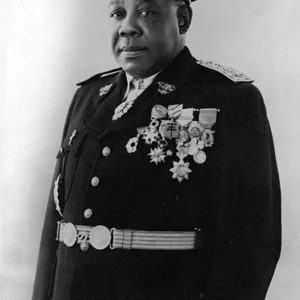

Guyanese colonial administrator (1884–1944), Félix Éboué was the first governor to rally French Equatorial Africa to Free France in 1940. Appointed Governor-General of the FEA by de Gaulle, he died in Cairo in 1944 and was interred in the Panthéon in 1949.
Félix Éboué(1884 — 1944)
Félix Éboué
France
7 min read
Frequently asked questions
Famous Quotes
« France has lost a battle. She has not lost the war.»
Key Facts
- Born on December 26, 1884, in Cayenne (French Guiana)
- In August 1940, the first governor to rally his territory (Chad) to Free France
- Appointed Governor-General of the FEA in 1941 by General de Gaulle
- Died on May 17, 1944, in Cairo
- Transferred to the Panthéon in 1949, alongside his wife Eugénie
Works & Achievements
A major political act of the Second World War: Éboué was the first colonial governor to join de Gaulle, bringing in his wake the Congo, Ubangi-Shari, and Cameroon, offering Free France a vast African territory.
A groundbreaking administrative circular advocating respect for traditional African social structures against the prevailing assimilationist doctrine. This innovative text had a lasting influence on French thinking about colonial law and foreshadowed the debates of decolonization.
Éboué oversaw the logistical organization of the strategic route crossing the Sahara from Chad to Libya, enabling General Leclerc's forces to join the Allies in North Africa and take part in the liberation of France.
Éboué contributed to the preparation of this historic conference bringing together de Gaulle and the African colonial governors, which laid the groundwork for a reform of the French colonial empire and sketched the early outlines of decolonization.
Anecdotes
In August 1940, when virtually all French colonial governors were rallying to the Vichy regime, Félix Éboué made a historic decision: on August 26, he brought Chad under the authority of Free France, becoming the first governor to join de Gaulle. This allegiance opened a crucial strategic route toward Libya for the Allied forces.
Born in Cayenne in 1884 into a middle-class Guyanese family, Éboué was one of the extremely rare Black students admitted to the École coloniale in Paris at the turn of the twentieth century. He had to overcome the racial prejudices of the French administration to climb the ranks of a system that regarded him as inherently inferior.
An avid banjo player and lover of Antillean music, Éboué regularly hosted musical evenings at his official residences in Africa. This cultural openness allowed him to build bonds of trust with local populations and traditional chiefs, greatly easing his work as an administrator.
In his 1941 circular on the "New Indigenous Policy
Éboué directly challenged the dominant assimilationist doctrine: he argued for respecting African social structures and customary authorities, contending that trying to transform Africans into Frenchmen was a profound and counterproductive mistake.
Éboué died in Cairo on May 17, 1944, worn out by years of war and administration. He was given a state funeral in Brazzaville before being brought back to France. In 1949, his ashes were transferred to the Panthéon, making him one of the very first Black figures to be honored there.
Primary Sources
The Governor of Chad informs General de Gaulle that the colony of Chad is rallying to Free France and placing itself at his disposal to continue the war alongside the Allies.
The indigenous person is not a European in the making... He has his laws, his customs, his homeland which he loves, his ancestors whom he venerates, his chiefs whom he respects. Our role is not to transform him but to help him rise according to his own path.
Félix Éboué, at one of the most dramatic moments in our history, chose honor for France and for himself. He is among those who saved the honor of France.
General de Gaulle appoints Mr. Félix Éboué, colonial governor, to the post of Governor-General of French Equatorial Africa, in recognition of his distinguished services rendered to Fighting France.
Key Places
Birthplace of Félix Éboué, born there on **December 26, 1884**. French Guiana, an overseas territory, shaped this son of the Republic who would rise through the ranks of the colonial administration despite pervasive racial prejudice.
Capital of Chad and seat of Éboué's governorship at the time of France's collapse in 1940. It was from this city that the historic rallying call of **August 26, 1940** to Free France was issued.
Capital of French Equatorial Africa (FEA), where Éboué established his governor-generalship from November 1940. Brazzaville became the symbolic capital of Free France, welcoming de Gaulle and serving as a rear base for the Allied forces.
The city where Félix Éboué died on **May 17, 1944**, worn out by years of unrelenting service to Free France. He was there on an official mission to the Allied forces.
The republican monument to which Éboué's ashes were transferred on **May 20, 1949**. His pantheonization made him one of the first Black figures to receive this supreme honor from the French Republic.
Typical Objects

Regulation headwear adorned with gold-embroidered oak leaves, worn during official ceremonies. For Éboué, it was an ambiguous symbol of authority hard-won within a system that was, in principle, closed to him.

A fundamental communication tool of colonial administration, the telegram allowed Éboué to announce Chad's rallying to de Gaulle in August 1940. This single message changed the course of the war for Free France.

A musical instrument of African-American origin, for which Éboué had a deep passion. He organized musical evenings at his official residences, blending Caribbean and African music, building bridges between cultures.

Bundles of official documents — reports, decrees, correspondence — making up the day-to-day substance of a governor's work. Éboué produced thousands of them, most notably his groundbreaking circular on indigenous policy.

A detailed map of French Equatorial Africa covering a territory seven times the size of France. An indispensable instrument of governance, it makes tangible the vastness of the territory Éboué had to administer from Brazzaville.
School Curriculum
Vocabulary & Tags
Key Vocabulary
Daily Life
Morning
Éboué's day began early, at dawn, in the humid heat of Brazzaville or the dry air of Chad. After rising in the early hours, he devoted the first part of the morning to reading the dispatches and telegrams that had arrived overnight from London or the other posts of French Equatorial Africa, then to holding audiences with the heads of department in his governorate.
Afternoon
The afternoon was reserved for official audiences with African traditional chiefs, whom the governor received with a respect unusual for the era. Éboué was determined to hear their concerns directly, without intermediaries. He would then sign the decrees and official correspondence that made up the bureaucratic workload of colonial administration.
Evening
In the evenings, Éboué often unwound through music, playing the banjo or hosting gatherings that brought together civil servants, officers, and African community leaders. He was an avid reader — history, ethnology, literature — and kept up a lively correspondence with intellectuals and friends in France and the Caribbean.
Food
Éboué ate a mixed diet, combining French colonial cuisine (pork, imported vegetables) with local African specialties he had come to appreciate over his decades of service. Like many Guianese, he retained a fondness for spices and Creole dishes that his family would sometimes send him.
Clothing
On official duty, Éboué wore the white uniform of a colonial governor with its embroidered képi — a symbol of authority made all the more visible and symbolically powerful by the color of his skin. Outside of ceremonies, he favored light cotton clothing suited to tropical African climates.
Housing
Éboué resided in the grand colonial residences provided to governors — the governor's palace in Brazzaville, the official residence in Fort-Lamy. These white colonnaded buildings with their verandas and surrounding gardens served at once as his home, his office, and the venue for receiving local dignitaries and official visitors.
Historical Timeline
Period Vocabulary
Liens externes & ressources
Références
Œuvres
Ralliement du Tchad à la France libre
26 août 1940
La Nouvelle Politique indigène pour l'Afrique équatoriale française
8 novembre 1941
Organisation de la route du Fezzan
1941-1942
Conférence de Brazzaville
Janvier-février 1944