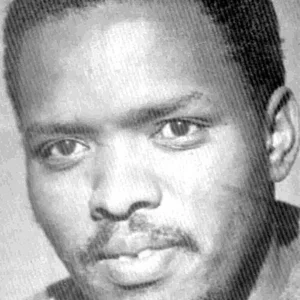

Steve Biko was a South African anti-apartheid activist, founder of the Black Consciousness Movement in the 1970s. A leading figure in the emancipation of black South Africans, he died in 1977 from the injuries inflicted on him in police custody, becoming a global symbol of the struggle against apartheid.
Steve Biko(1946 — 1977)
Steve Biko
Afrique du Sud
6 min read
Frequently asked questions
Famous Quotes
« The most potent weapon in the hands of the oppressor is the mind of the oppressed.»
Key Facts
- Born in 1946 in King William's Town (Cape Province, South Africa)
- Founded the South African Students' Organisation (SASO) and the Black Consciousness Movement in 1968-1969
- Hit with a banning order by the apartheid regime in 1973
- Died on 12 September 1977 in Pretoria from mistreatment in police detention
- His funeral drew thousands of people and his name became an international symbol of the anti-apartheid struggle
Works & Achievements
The first independent Black student organization, breaking away from white-dominated structures and launching the Black Consciousness Movement.
A philosophy centered on the pride, dignity, and psychological autonomy of Black people, seen as a precondition for any political liberation.
A series of articles published in the SASO journal, setting out his ideas under a pseudonym; collected after his death into an influential book.
A political body uniting the Black Consciousness organizations to carry the struggle beyond university campuses.
Concrete self-reliance projects: the Zanempilo clinic, workshops, and literacy programs, aimed at giving Black communities their own resources.
During the trial of nine activists, Biko publicly and eloquently explained the principles of Black Consciousness before the court.
Anecdotes
As a medical student at the University of Natal, Steve Biko first joined the National Union of South African Students (NUSAS), which was mostly white. Frustrated that well-meaning whites were speaking on behalf of blacks, in 1968 he founded the South African Students' Organisation (SASO), reserved for black students: for him, emancipation had to come first from the oppressed themselves.
Biko summed up his philosophy in a formula that became famous: “The most potent weapon in the hands of the oppressor is the mind of the oppressed.” He wanted black South Africans to stop being ashamed of their identity and to take pride in their culture even before demanding political rights.
From 1973 onwards, the apartheid regime hit him with a “banning order”: he was forbidden to leave his town of King William's Town, to speak to more than one person at a time, or to be quoted in the press. Despite this, he secretly continued his work and received foreign journalists such as Donald Woods.
Arrested on 18 August 1977 at a road block, Biko was interrogated and beaten by the security police in Port Elizabeth. Severely injured in the head, he was driven naked and handcuffed in the back of a Land Rover for over 1,100 km to Pretoria, where he died on 12 September 1977 at the age of 30.
Justice Minister Jimmy Kruger cynically declared that Biko's death “left him cold.” But worldwide outrage was such that singer Peter Gabriel dedicated the 1980 song “Biko” to him, and the film “Cry Freedom” (1987) brought his story to a wide audience.
Primary Sources
The most potent weapon in the hands of the oppressor is the mind of the oppressed.
Black Consciousness is an attitude of mind, a way of life. We seek to instill in the black community a renewed pride in itself, in its efforts, in its value systems.
The black person must reject from their mind every servile attitude and fully realize themselves as a complete human being, proud and dignified.
He spoke of the need for black people to recover their self-esteem before they could wage an effective political struggle.
Key Places
Biko's birthplace, where he was placed under house arrest by a banning order and where he developed his community programs (the Zanempilo clinic).
Where Biko studied medicine and founded SASO in 1968, the starting point of the Black Consciousness Movement.
The city where Biko was detained, interrogated and violently beaten in September 1977, causing his fatal injuries.
The administrative capital where Biko, transported in the back of a Land Rover, died on 12 September 1977 in a prison cell.
A township of Johannesburg whose 1976 uprising marked a turning point in the anti-apartheid struggle, strongly inspired by the ideas of Black Consciousness.
Biko's burial place; his funeral on 25 September 1977 drew nearly 20,000 people.
Liens externes & ressources
Références
Œuvres
Fondation de la SASO
1968
Théorisation de la Conscience noire (Black Consciousness)
1969-1972
Colonne « I Write What I Like » (signée Frank Talk)
1970-1972
Création de la Black People's Convention (BPC)
1972
Programmes communautaires noirs (Black Community Programmes)
1972-1977
Témoignage au procès SASO/BPC
1976