
Margaret Roper, the eldest daughter of Thomas More, was an English humanist and translator of the Renaissance. Renowned for her exceptional scholarship, she was one of the first women not of royal birth to publish a translation in English.
Margaret Roper(1505 — 1544)
Margaret Roper
royaume d'Angleterre
6 min read
Frequently asked questions
Key Facts
- Born in 1505, the eldest daughter of Thomas More and raised in his humanist family school
- Mastered Latin and Greek, praised by Erasmus for her scholarship
- Published around 1524 an English translation of Erasmus's treatise on the Pater Noster (A Devout Treatise upon the Pater Noster)
- Recovered her father's head after his execution in 1535 and preserved it
- Died in 1544
Works & Achievements
English translation of Erasmus's commentary on the Lord's Prayer; one of the first printed works attributed to an English woman outside royalty.
Letters in elegant Latin that earned Margaret the admiration of European humanists and testify to her erudition.
According to humanist tradition, Margaret is said to have proposed scholarly corrections to a corrupt passage in a Latin text by Saint Cyprian, a rare philological feat for a woman.
Margaret watched over her father's manuscripts and memory after his execution, helping to pass on his legacy.
Anecdotes
Margaret Roper received a humanist education extraordinary for a woman of her time: her father Thomas More had his daughters taught Latin, Greek, logic, and astronomy, exactly as he did his sons. This family “school” at Chelsea became so famous that Erasmus himself cited it as a model across Europe.
Around 1524, when she was under twenty, Margaret translated into English Erasmus's treatise on the Lord's Prayer (Precatio Dominica), published under the title *A Devout Treatise upon the Pater Noster*. She thus became one of the first English women, outside the royal family, to see a translation printed under her name (even if hidden behind initials).
It is said that Henry VIII and Thomas More exchanged letters about Margaret's learning, the king marvelling that a young woman could write such elegant Latin. Erasmus even dedicated a commentary to her, a sign that her scholarly reputation extended beyond the family circle.
After her father's execution in 1535, Margaret is said to have bribed a guard to recover his head, which was displayed on London Bridge, in order to keep it piously. According to tradition, this relic was buried with her or in the Roper family vault at Canterbury.
Margaret remained close to her father until the end: imprisoned in the Tower of London, Thomas More wrote her several moving letters, and she was granted permission to visit him. Their surviving correspondence bears witness to an intellectual and emotional bond rare between a father and his daughter in the Renaissance.
Primary Sources
English translation of Erasmus's treatise on the Lord's Prayer, presented as the work of “a young, virtuous and well-learned gentlewoman of nineteen years.”
“I desire nothing more in this world than to know that you are well and in good health, my dearest daughter.” In them More expresses his tenderness and his acceptance of his fate.
Erasmus praises the education of More's daughters and Margaret's quickness of mind, presenting her as a model of the learned woman.
A biography of More written by his son-in-law, recounting episodes of family life and of the imprisonment, including Margaret's visits.
Key Places
Margaret's birthplace and the center of Tudor power, where the More family lived and worked.
The family home on the banks of the Thames where More established his household and his humanist “school” for his children.
The fortress-prison where Thomas More was held from 1534 until his execution in 1535, and where Margaret was able to visit him.
The town where the Roper family is buried; according to tradition, Thomas More's head was interred there in the family vault.
Typical Objects

Working sheets on which Margaret rendered Latin texts by **Erasmus** into English. A central tool of her work as a humanist translator.

Everyday writing instruments of Renaissance scholars, used for correspondence and exercises in Latin composition.

Humanist editions of the classics and the Church Fathers, the foundations of the scholarly education Margaret received. The printed book was then spreading knowledge far and wide.

Wax-sealed correspondence exchanged with her imprisoned father. A vehicle for the emotional and intellectual bond between Margaret and **Thomas More**.

A long outer gown with wide sleeves worn by ladies of the Tudor gentry, often in fine wool or dark velvet. It marked the social rank of the More family.

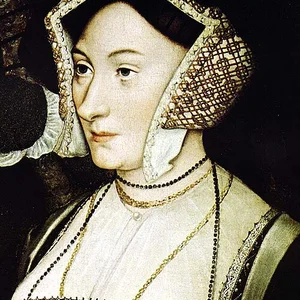
A stiff, gable-shaped headdress characteristic of English women under **Henry VIII**, framing the face in velvet and cloth.

An object of Catholic devotion that remained important in a family loyal to Rome despite the Reformation. It reflects the piety running through the translation of the *Pater Noster*.
School Curriculum
Vocabulary & Tags
Key Vocabulary
Tags
Daily Life
Morning
The morning began early with prayer and Mass, in keeping with the family's Catholic piety. Margaret then devoted herself to study: reading Latin and Greek, and translation exercises under the guidance of tutors chosen by her father.
Afternoon
The afternoon combined scholarly work with managing the household. Margaret wrote letters, continued her translations, and took part in the learned discussions that enlivened the house at Chelsea, frequented by visiting humanists.
Evening
The evening gathered the family around readings, music, and conversations in Latin. Thomas More liked to test his children's wits through debates, and Margaret shone in them with her quickness of mind.
Food
The diet of a well-to-do family of the Tudor gentry included wheaten bread, meats (beef, mutton, poultry), fish on fast days, as well as small beer and wine. Fruits, cheeses, and tarts rounded out the meals.
Clothing
Margaret wore the clothes of a lady of good birth: a long gown of wool or dark velvet, a fitted bodice, and the gable hood typical of Henry VIII's England.
Housing
She lived in her father's vast house at Chelsea, a brick residence surrounded by gardens sloping down to the Thames, equipped with a library and a private chapel — an ideal setting for study.
Historical Timeline
Period Vocabulary
Liens externes & ressources
Références
Œuvres
A Devout Treatise upon the Pater Noster
vers 1524, imprimé v. 1526
Correspondance latine avec Érasme et son père
années 1520-1530
Travaux de restauration du texte de saint Cyprien
années 1520-1530
Conservation des écrits et de la mémoire de Thomas More
1535-1544