
A French Ursuline nun and mystic, Marie Guyart set out in 1639 to found the first women's monastery in North America, in Quebec. A major figure of seventeenth-century spirituality, she evangelized and educated the young French and Native American girls of New France.
Marie de l'Incarnation(1566 — 1618)
Barbe Acarie
France
5 min read
Frequently asked questions
Key Facts
- Born in Tours in 1599 under the name Marie Guyart
- Entered the Ursulines of Tours in 1631 after being widowed
- Departed for New France and founded the monastery of the Ursulines of Quebec in 1639
- Wrote Spiritual Relations as well as dictionaries and catechisms in Native American languages
- Died in Quebec in 1672; canonized by Pope Francis in 2014
Works & Achievements
Barbe Acarie's main achievement: bringing the Discalced Carmelites over from Spain and founding their first convent in Paris.
A devotional salon gathering François de Sales, Bérulle and Canfield, regarded as a cradle of the French school of spirituality.
Support for the spread of Carmels across France (Pontoise, Dijon, Amiens, Tours, Rouen).
A direct influence on many vocations: three of her daughters became Carmelites.
Anecdotes
Born in Paris in 1566 into a wealthy family of the legal bourgeoisie, Barbe Avrillot was nicknamed “la belle Acarie” (the beautiful Acarie) after her marriage at the age of sixteen to Pierre Acarie. Mother of six children, she ran a large household while leading an intense life of prayer, which made her a rare figure of a married, lay mystic.
Her Parisian residence became one of the great spiritual centers of the kingdom: there one might encounter Francis de Sales, Pierre de Bérulle (her cousin), or the English Capuchin Benet of Canfield. This circle is often regarded as the cradle of the “French school of spirituality.”
After reading the works of Teresa of Ávila, Barbe Acarie is said to have had a vision of the Spanish saint inviting her to establish the reformed Carmel in France. Thanks to her determination, the first convent of Discalced Carmelites opened in Paris in 1604.
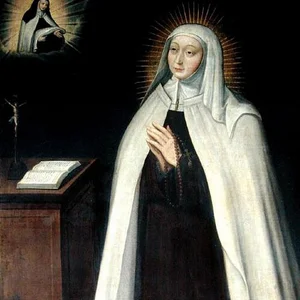
Widowed in 1613, she finally fulfilled her wish to enter the Carmel: in 1614, at nearly fifty years of age, she became a simple lay sister at Amiens under the name Marie de l'Incarnation, choosing the humble work of the kitchen and the infirmary over honors.
Renowned for her ecstasies and her penances, she died at Pontoise in 1618. Three of her daughters had become Carmelites; she was beatified by Pope Pius VI in 1791.
Primary Sources
She was, after God, the first and principal cause of the establishment of the Carmelite nuns in France.
The witnesses report her raptures during prayer and her extreme humility in the lowliest duties of the monastery.
The nuns shall keep a strict enclosure, live by the work of their hands, and devote themselves to mental prayer.
Key Places
Birthplace of Barbe Acarie and seat of her townhouse, a major spiritual hub where the first reformed Carmel of France was founded in 1604.
First monastery of Discalced Carmelites founded in France in 1604, the fruit of Barbe Acarie's efforts.
Monastery where Barbe Acarie entered as a lay sister in 1614, taking the name Marie de l'Incarnation.
Monastery where Marie de l'Incarnation spent her final months and died in 1618.
Typical Objects

Bead by bead, the rosary set the rhythm for Marian prayer and meditation. It was the most common object of devotion among pious lay people as well as in convents.

A brown homespun robe, scapular and black veil, a sign of the self-stripping of the Teresian reform. Barbe Acarie took it on as a simple lay sister in 1614.

The writings of the Spanish mystic, read by Barbe Acarie, inspired the establishment of the reformed Carmel in France. They circulated in translation among devout Parisians.

A garment of horsehair or a spiked belt worn next to the skin as a sign of penance. Barbe Acarie was renowned for her bodily mortifications.

A small whip with several lashes used for voluntary flagellation, an ascetic practice widespread in the reformed convents of the 17th century.

A book containing the divine office recited at fixed hours of the day. It paced the prayer life of nuns and clerics.
School Curriculum
Vocabulary & Tags
Key Vocabulary
Daily Life
Morning
Rising before dawn, she began the day with a long period of mental prayer and Mass. As a wife, she then oversaw the management of the large Acarie household; as a lay sister, she joined the convent's labors.
Afternoon
Her afternoons combined charity toward the poor and the sick, spiritual conversations, and reading the works of *Teresa of Ávila*. At the Carmel, she humbly carried out the tasks of the kitchen and the infirmary.
Evening
The evening was devoted to prayer, vespers, and the examination of conscience. It is said that her prayer sometimes plunged her into long ecstasies.
Food
In keeping with monastic frugality: bread, vegetables, soup, and fish, observing the frequent fasts and abstinences of the Carmelite rule. Meat was usually excluded.
Clothing
As a lady of the Parisian bourgeoisie, she wore plain but quality dresses; upon entering the Carmel, she took on the brown habit, the scapular, and the veil of the Discalced Carmelites.
Housing
She first lived in the comfortable Hôtel Acarie in Paris, a vast bourgeois residence, then in the bare cell and austere cloister of the monasteries of Amiens and Pontoise.
Historical Timeline
Period Vocabulary
Liens externes & ressources
Références
Œuvres
Introduction du Carmel réformé en France
1604
Cercle spirituel de l'hôtel Acarie
vers 1600-1613
Fondations de nouveaux carmels
1604-1618
Direction spirituelle de ses filles et proches
début XVIIe siècle