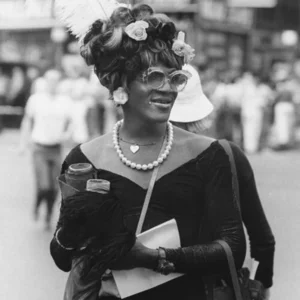

A transgender African American activist, Marsha P. Johnson was one of the iconic figures of the Stonewall uprising in 1969. Co-founder of STAR, she spent her entire life fighting for the rights of LGBT+ people and the homeless.
Marsha P. Johnson(1945 — 1992)
Marsha P. Johnson
États-Unis
8 min read
Frequently asked questions
Famous Quotes
« No pride for some of us without liberation for all of us.»
« I may be crazy, but that don't make me wrong.»
Key Facts
- Born on August 24, 1945, in Elizabeth, New Jersey
- Participated in the Stonewall Inn uprising in New York in June 1969
- Co-founded STAR (Street Transvestite Action Revolutionaries) with Sylvia Rivera in 1970
- AIDS activist in the 1980s–1990s as a member of ACT UP
- Died under murky circumstances on July 6, 1992, in New York
Works & Achievements
Together with Sylvia Rivera, Marsha co-founded the first American organization dedicated to the rights of marginalized transgender and transvestite people, pioneering the articulation of civil rights, LGBT, and anti-poverty struggles.
Marsha and Sylvia opened an apartment shelter for LGBT youth rejected by their families, a forerunner of the specialized support structures that would develop across the United States in the following decades.
Present during the resistance at the Stonewall Inn, Marsha became a symbolic figure of this founding event of the global gay liberation movement, commemorated every year by Gay Pride.
An active member of ACT UP, Marsha demonstrated to demand a political response to the AIDS crisis, taking part in direct actions that helped pressure American authorities into accelerating therapeutic research.
Photographed by Andy Warhol for this major series, Marsha helped inscribe the image of transgender women of color into the history of American contemporary art.
Anecdotes
The “P” in Marsha P. Johnson’s name didn’t stand for any first name. During a court appearance, a judge asked her what the initial represented. She replied without missing a beat: “Pay it no mind.” That phrase became her motto — an elegant brush-off for any intrusive question about her gender identity.
On the night of June 28, 1969, police raided the Stonewall Inn, a bar in Greenwich Village frequented by gay men and transgender people. For once, the patrons fought back. Marsha P. Johnson, who was there that night, actively took part in the resistance. The Stonewall Riots marked the beginning of the modern gay liberation movement in the United States.
In 1970, Marsha and her friend Sylvia Rivera founded STAR (Street Transvestite Action Revolutionaries), a mutual-aid organization for homeless LGBT youth. They opened the “STAR House,” an apartment in Manhattan where they welcomed young people rejected by their families. To pay the rent and feed the residents, Marsha and Sylvia sometimes had to work the streets of the Village at night.
In 1975, celebrated artist Andy Warhol photographed Marsha P. Johnson for his “Ladies and Gentlemen” series — a collection of portraits of drag queens and transgender women of color. These portraits helped bring Marsha visibility in New York art circles, even as she continued to live in poverty despite that recognition.
Through the 1980s and 1990s, the AIDS crisis was devastating New York’s LGBT community. Marsha joined ACT UP (AIDS Coalition to Unleash Power) and regularly demonstrated to demand government funding for research and accessible treatments. She lost many friends to the disease before dying in 1992 at age 46, in circumstances that were never fully clarified.
Primary Sources
STAR is a revolutionary group of street drag queens committed to fighting for the liberation of all oppressed people, including homeless youth, gay people, and street people.
I was no one, nobody, from Nowheresville, until I became a drag queen. That's what made me in New York, that's what made me move ahead.
We're not going to be silent while our community is dying. The government has blood on its hands.
As long as my people don't have their rights across America, there's no reason for celebration.
Key Places
Marsha P. Johnson's hometown, where she grew up in a religious African-American family. She left the city at 17 to escape rejection tied to her gender identity.
The iconic bar where the riots of June 28–29, 1969 took place. Marsha was present on that historic night, now considered the founding moment of the global gay liberation movement. The site is today a national monument.
An apartment opened in 1972 by Marsha and Sylvia Rivera to shelter homeless LGBT youth — the first refuge of its kind in the United States. It embodied their hands-on commitment to the most vulnerable members of the community.
The main thoroughfare of New York's gay neighborhood, where Marsha lived and organized on a daily basis. Each year the Gay Pride march set off from here, and she was one of its most iconic participants.
On July 6, 1992, Marsha P. Johnson's body was found in this river. The circumstances of her death remain shrouded in mystery; her friend Victoria Cruz spent years investigating in an effort to have the case reopened as a homicide.
Typical Objects

Marsha's visual signature was her crowns of artificial or fresh flowers worn in her hair. They symbolized her joy for life and her refusal of the invisibility imposed on transgender people.

Marsha made and carried signs at demonstrations organized by the gay liberation movement and ACT UP. These signs bore slogans demanding equal rights and an urgent response to the AIDS crisis.

Often living in poverty, Marsha assembled her outfits from thrift-store clothes, found accessories, and wigs. These flamboyant ensembles were at once an artistic expression and an assertion of identity.

These artworks present Marsha as a subject worthy of artistic attention — something mainstream society denied her. They stand today as some of the few professional visual records of her era.

Marsha and Sylvia Rivera handed out printed flyers to recruit members, announce actions, and spread their manifesto. These handmade materials were the central tool of political communication for marginalized movements before the internet.
School Curriculum
Vocabulary & Tags
Key Vocabulary
Tags
Daily Life
Morning
Marsha often woke up in precarious housing or at friends' places in Greenwich Village. She started her day by tending to her outfit and accessories, as her appearance was an affirmation of her identity. She frequented community mutual aid networks for breakfast when resources were scarce.
Afternoon
Afternoons were devoted to daily survival: she sometimes worked as a sex worker on the streets of the West Village to pay for food and housing, while remaining a familiar and caring face in the neighborhood. She often helped other homeless people, sharing whatever she had.
Evening
In the evenings, Marsha put on her extravagant drag queen outfits and headed to the bars and clubs of the Village. Nights were also the time for activist meetings, where she planned actions alongside Sylvia Rivera for STAR. She was known for her generosity, her humor, and her ability to make people smile even in the hardest situations.
Food
Marsha often lived in poverty, and her diet depended on what she could find or what friends and neighbors offered her. She ate at cheap restaurants in the Village or relied on community mutual aid networks. At STAR House, food was shared collectively.
Clothing
Marsha was famous for her colorful outfits: secondhand evening gowns, wigs, flower crowns, and costume jewelry assembled with whatever means she had. She transformed poverty into creativity, making her flamboyant visibility a political act of resistance.
Housing
Marsha lived for a long time without stable housing, sleeping at friends' places, in squats, or on the streets of Greenwich Village. STAR House, which she co-managed, served as shelter for her just as much as for the young people she took in. Her residential precarity was representative of the situation faced by many marginalized transgender people in New York in the 1970s.
Historical Timeline
Period Vocabulary
Liens externes & ressources
Références
Œuvres
Cofondation de STAR (Street Transvestite Action Revolutionaries)
1970
STAR House — premier refuge LGBT de New York
1972
Participation active aux émeutes de Stonewall
1969
Militantisme au sein d'ACT UP
1987-1992
Portraits « Ladies and Gentlemen » par Andy Warhol
1975