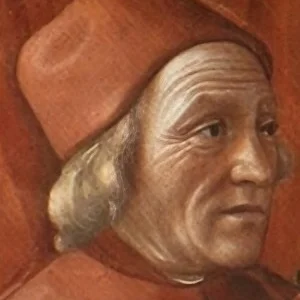

Italian philosopher and humanist of the Florentine Renaissance, a major figure of Neoplatonism. The first to translate the complete works of Plato into Latin, he led the Platonic Academy of Florence under the patronage of the Medici.
Marsilio Ficino(1433 — 1499)
Marsilio Ficino
République florentine
6 min read
Frequently asked questions
Key Facts
- Born in 1433 in Figline Valdarno, near Florence, the son of a physician to the Medici
- Founds and leads the Platonic Academy of Florence under the patronage of Cosimo de' Medici around 1462
- Completes the full Latin translation of Plato's dialogues in 1469, published in 1484
- Translates the Corpus Hermeticum (1471) attributed to Hermes Trismegistus
- Author of the Platonic Theology (1474), which sought to reconcile Platonism and Christianity; dies in 1499
Works & Achievements
First Latin translation of these texts attributed to Hermes Trismegistus, which fueled the Renaissance fascination with ancient wisdom and Hermeticism.
Founding work of the notion of “Platonic love,” which had a lasting influence on European love poetry and thought.
Treatise seeking to demonstrate the harmony between Platonic philosophy and the Christian faith.
A great philosophical synthesis defending the immortality of the soul and placing humankind at the center of creation.
Ficino's major achievement: for the first time, the entire body of Plato's work became accessible in Latin to the West.
Famous treatise blending medicine, hygiene, astrology, and natural magic to preserve the health of melancholic intellectuals.
Latin version of the work of the great ancient Neoplatonist, which spread his thought throughout humanist Europe.
Anecdotes
Cosimo de' Medici gave Ficino a villa at Careggi and precious Greek manuscripts of Plato. But the old patron, sensing that his end was near, asked him to set Plato aside and first translate the mysterious Corpus Hermeticum: he wanted to read these texts attributed to an Egyptian sage before he died.
Ficino felt an almost religious devotion to Plato. It is said that he kept a lamp burning before a bust of the philosopher, and that every 7 November he celebrated Plato's supposed birthday with a banquet bringing together his humanist friends, in the manner of the ancient dialogues.
Convinced that music healed the soul, Ficino accompanied himself on a lyre he called his “orphic lyre” to sing hymns and drive away melancholy. He believed that good harmonies balanced the body's humors as much as the remedies of physicians.
In his book De vita, Ficino blended medicine, astrology, and the magic of talismans to help scholars worn out by study. This bold chapter nearly got him into trouble with the Church: a priest himself, he had to write a defense to fend off the suspicion of heresy.
Ficino was of frail health and said he was born “under Saturn,” the planet of melancholy. Far from treating this as a misfortune, he transformed this dark temperament into a sign of contemplative genius, an idea that lastingly shaped the figure of the melancholic artist and thinker.
Primary Sources
The human soul is by its nature placed at the center of all beings, and it is like the knot and the bond of the world, uniting things divine and things corporeal.
Love is the desire to enjoy beauty; and beauty is a certain grace that arises chiefly from the harmony of several elements.
Let men of letters guard above all against melancholy, for no plague is more harmful to those who devote themselves to study.
Know thyself, O divine race clothed in a mortal body; recognize how great you are, and then you will know how great God is.
Key Places
A small town in Tuscany where Marsilio Ficino was born in 1433, in the Arno valley south of Florence.
The Medici residence on the outskirts of Florence, gifted to Ficino and the heart of the Platonic Academy. There he translated Plato, taught, and died in 1499.
The capital of the Renaissance under the Medici, where Ficino was ordained a priest and a canon of the cathedral. The intellectual center of all his activity.
The Duomo of Florence, where Ficino served as a canon after his ordination in 1473. It was also the scene of the bloody Pazzi conspiracy in 1478.
A teaching institution where humanist ideas circulated and where Ficino spread Platonic philosophy among the learned citizens of Florence.
Typical Objects

A Greek codex given by Cosimo de' Medici, from which Ficino produced the first complete Latin translation of Plato. Such volumes were rare treasures during the Renaissance.

A stringed instrument that Ficino played to accompany himself while singing hymns in the manner of Orpheus. He saw it as a musical remedy capable of soothing the soul and balancing the humors.

An effigy of the ancient master before which Ficino was said to keep a lamp burning. It symbolized the Florentine Academy's devotion to Platonic philosophy.

A medal or stone engraved with planetary images that Ficino describes in the *De vita* as a way to capture the beneficial influences of the stars. An object on the boundary between medicine and magic.

The everyday tools of a tireless translator who produced thousands of pages of Latin. Ficino wrote translations, treatises, and an abundant correspondence.

An instrument for locating the position of the stars, useful to Ficino for his astrological calculations. During the Renaissance, astronomy and astrology had not yet been separated.
School Curriculum
Vocabulary & Tags
Key Vocabulary
Daily Life
Morning
Ficino rose early to pray and meditate, being both a priest and a philosopher. The morning was devoted to reading Greek texts and the slow work of translation, pen in hand before his manuscripts.
Afternoon
In the afternoon, he welcomed the friends and disciples of the Academy at Careggi: there they discussed Plato, love, and the immortality of the soul. These learned conversations could turn into true philosophical banquets.
Evening
In the evening, Ficino liked to relax by playing his lyre and singing Orphic hymns, convinced that music soothed the soul. He also devoted his evenings to his voluminous correspondence with the learned men of Europe.
Food
Mindful of his fragile health, Ficino recommended in the *De vita* a light and temperate diet, rich in “solar” foods such as honey, sugar, good wine, and golden fruits, believed to combat melancholy.
Clothing
As a canon, he wore the dark, sober robe of Florentine clerics and scholars. His attire reflected his dual status as churchman and scholar, far from the splendor of courtiers.
Housing
He lived mainly in the villa of Careggi given to him by the Medici, a country residence surrounded by gardens, well suited to study and contemplation. He also had lodgings in Florence, near the cathedral.
Historical Timeline
Period Vocabulary
Liens externes & ressources
Références
Œuvres
Traduction latine du Corpus hermeticum (Pimandre)
1463
De amore (Commentaire sur le Banquet de Platon)
1469
De christiana religione
1474
Theologia Platonica de immortalitate animorum
1482
Traduction latine complète des Dialogues de Platon
1484
De vita libri tres
1489
Traduction latine des Ennéades de Plotin
1492