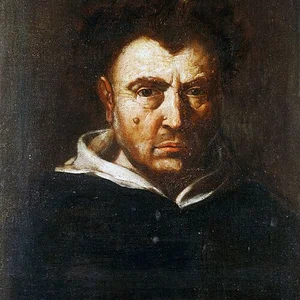

Tommaso Campanella was an Italian Dominican friar, philosopher, theologian, and poet of the late Renaissance. Imprisoned for nearly twenty-seven years for heresy and conspiracy against Spanish rule, he is the author of the utopia *The City of the Sun*.
Tommaso Campanella(1568 — 1639)
Tommaso Campanella
royaume de Naples
6 min read
Frequently asked questions
Key Facts
- Born in 1568 in Stilo, in Calabria, he entered the Dominican order at a young age
- Wrote *The City of the Sun* (*La Città del Sole*) around 1602, published in Latin in 1623
- Imprisoned in Naples from 1599 to 1626 after the failure of a conspiracy against the Spanish
- Defended Galileo in his *Apologia pro Galileo* (1622)
- Died in 1639 in Paris, under the protection of the King of France
Works & Achievements
First work, a defense of Telesio's natural philosophy against scholastic Aristotelianism.
His most famous work: the utopia of an ideal city governed by reason, knowledge, and the sharing of goods in common.
An account of his animist vision of nature, in which every thing possesses a form of sensibility.
A plea for Galileo's freedom and for the compatibility of science and faith.
An apologetic treatise meant to refute atheism and defend the Christian religion.
A vast philosophical summa synthesizing his thought, published in Paris near the end of his life.
A collection of sonnets and canzones in which he expresses his convictions, his rebellion, and his faith while in prison.
Anecdotes
To escape torture at the hands of the Inquisition, Campanella feigned madness for months in 1600. He endured the *veglia*, a forty-hour ordeal during which he was suspended by his arms over spikes, yet he never contradicted himself: pretending to be insane saved his life, for a madman could not be sentenced to death.
Campanella spent nearly twenty-seven years in prison, including a long stretch in the dungeons of the **Castel Nuovo** and the **Castel dell'Ovo** in Naples. Yet it was while locked away, sometimes without any light, that he composed most of his works, including *The City of the Sun*.
Fascinated by astrology, Campanella organized rituals for Pope **Urban VIII** meant to ward off an eclipse believed to foretell his death: a sealed room, white hangings, candles, and plants to imitate a favorable sky.
Having taken refuge in France at the end of his life, he was received by **Cardinal Richelieu** and granted a pension by King **Louis XIII**. He wrote a poem celebrating the birth of the future **Louis XIV** in **1638**, shortly before dying in Paris.
As a very young Dominican, Campanella drew attention for his prodigious memory and his taste for the natural philosophy of **Bernardino Telesio**, which he defended against Aristotle — earning him the suspicion of his superiors from very early on.
Primary Sources
They say that a first ignorance gave birth in the world to private property, because each person made for himself a separate house, a wife and children of his own: from this springs self-love.
The philosophy that agrees with nature cannot oppose Holy Scripture, given by the same God who is the author of nature.
All things in the world have sensation and awareness in their own way, for they flee what destroys them and seek what preserves them.
I was born to fight against three great evils: tyranny, sophistry and hypocrisy.
Key Places
Small Calabrian town where Campanella was born and where he later plotted his conspiracy against the Spanish.
Capital of the kingdom under Spanish rule, where Campanella was tried, tortured and imprisoned for many years.
Seaside fortress where he was held in extremely harsh conditions, and where he wrote several of his works.
City to which he was transferred after his release and where he enjoyed for a time the protection of Pope Urban VIII.
Refuge of his final years, where he was welcomed by Richelieu and where he died at the Dominican convent on the Rue Saint-Honoré.
Liens externes & ressources
Références
Œuvres
Philosophia sensibus demonstrata
1591
La Cité du Soleil (La Città del Sole)
1602 / 1623
De sensu rerum et magia
1620
Apologia pro Galileo
1622
Atheismus triumphatus
1631
Metaphysica
1638
Poésies philosophiques
vers 1605-1622