 flip
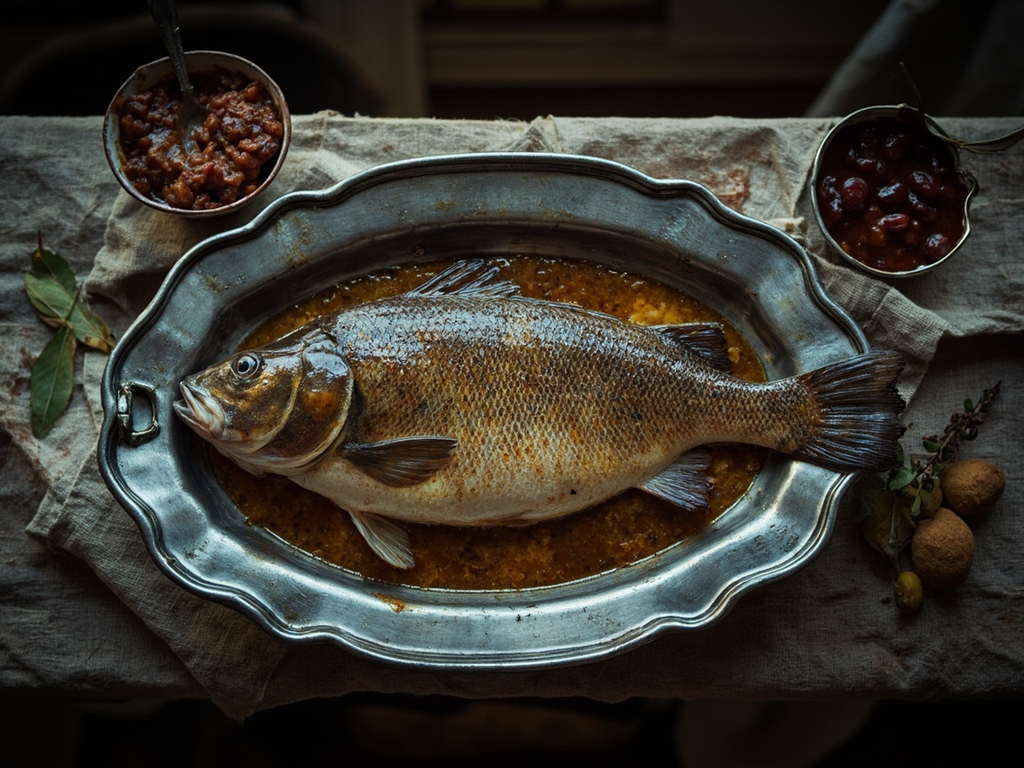
flipKarpfen blau — blue carp in vinegar court-bouillon with spiced sauce
Karpfen blau — blue carp in vinegar court-bouillon with spiced sauce
Why this dish? "The typical meal included... fish." Carp, raised in the ponds of monasteries and manors in Saxony, was THE festive and fast-day fish in Luther's Germany. Served "blue" in vinegar, it adorned wedding tables — like those that followed the marriage of the defrocked monk to Katharina in 1525.
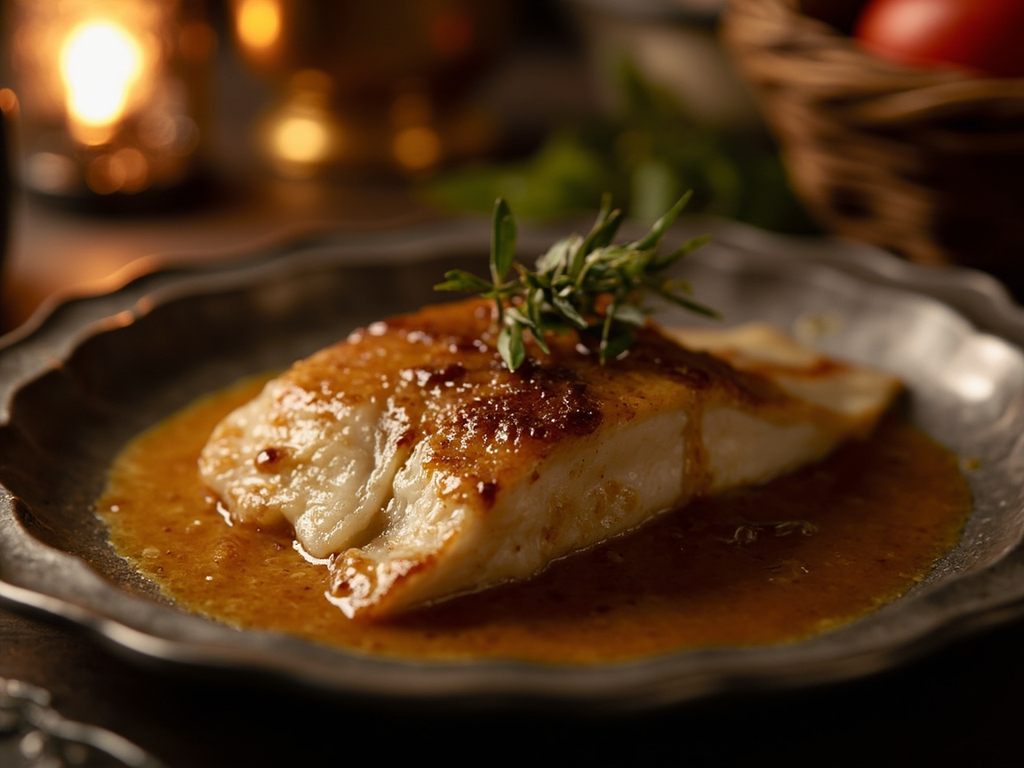
A whole carp gently poached in a vinegar court-bouillon that tints its skin a bluish hue, served warm with a medieval sauce of gingerbread, ginger, and clove, sweet-and-sour and fragrant. A prestige dish to share.
For a feast day, have a fine carp brought from the pond, still frisky! Place it alive in the vinegar broth, and behold, it adorns itself in a blue like the cloak of heaven — God slips his wonders even into our bowls. Käthe serves it with a sauce where ginger and clove sing, neither too sweet nor too sour, as a good doctrine should be. It is wedding meat and joyful table fare: give thanks, and keep some for the poor at the door.
- •Whole carp, gutted — a fine one (centrepiece)
- •Wine vinegar — a splash (court-bouillon, blue sheen)
- •Onion, bay leaf, juniper berries — as needed (bouillon aromatics)
- •Gingerbread (or toasted breadcrumbs) — a piece (sauce thickener)
- •Ginger, clove, pepper — pinches (sauce spices)
- •Honey — a drizzle (sweet-and-sour balance)
Karpfen blau — blue carp in vinegar court-bouillon with spiced sauce
A whole carp gently poached in a vinegar court-bouillon that tints its skin a bluish hue, served warm with a medieval sauce of gingerbread, ginger, and clove, sweet-and-sour and fragrant. A prestige dish to share.
Why this dish? "The typical meal included... fish." Carp, raised in the ponds of monasteries and manors in Saxony, was THE festive and fast-day fish in Luther's Germany. Served "blue" in vinegar, it adorned wedding tables — like those that followed the marriage of the defrocked monk to Katharina in 1525.
For a feast day, have a fine carp brought from the pond, still frisky! Place it alive in the vinegar broth, and behold, it adorns itself in a blue like the cloak of heaven — God slips his wonders even into our bowls. Käthe serves it with a sauce where ginger and clove sing, neither too sweet nor too sour, as a good doctrine should be. It is wedding meat and joyful table fare: give thanks, and keep some for the poor at the door.
Ingredients (period version)
- Whole carp, gutted — a fine one (centrepiece)
- Wine vinegar — a splash (court-bouillon, blue sheen)
- Onion, bay leaf, juniper berries — as needed (bouillon aromatics)
- Gingerbread (or toasted breadcrumbs) — a piece (sauce thickener)
- Ginger, clove, pepper — pinches (sauce spices)
- Honey — a drizzle (sweet-and-sour balance)
Ingredients
- Carp (or trout/tench as substitute), gutted, scaled as little as possible — 1.2 kg (centrepiece)
- White wine vinegar — 200 ml (blue sheen and acidity)
- Water — 1.5 L (court-bouillon)
- Onion — 1 (aromatic)
- Bay leaf + juniper berries — 2 leaves + 6 berries (aromatics)
- Stale gingerbread — 2 slices (sauce thickener)
- Ground ginger, clove, pepper — 1/2 tsp each (spices)
- Honey — 1 tbsp (sweetness)
- Salt — to taste (seasoning)
Method
- Prepare the court-bouillon: water, vinegar, sliced onion, bay leaf, juniper, salt. Bring to a simmer for 10 min.
- Handle the carp without damaging the skin (mucus + vinegar give the "blue" sheen). Gently pour the hot broth over it in a shallow dish.
- Poach at a very gentle simmer (never boiling) for 20-25 min depending on size, until the flesh flakes.
- For the sauce: take a ladle of broth, crumble in the gingerbread, add ginger, clove, pepper, and honey. Reduce and thicken.
- Carefully drain the carp, arrange it whole on a platter.
- Spoon a little spiced sauce over it, serve the rest on the side.
How it was made : Monastic fish farming provided carp and tench for the many "lean" days of the Christian calendar. Late medieval and German Renaissance cuisine loved sweet-and-sour sauces thickened with gingerbread and loaded with imported spices (ginger, clove, pepper) — a marker of prestige. "Karpfen blau" remains a Christmas and New Year classic in Germany.
The contemporary twist : As individual fillets napped with the spiced sauce, on a bed of melted leeks, with a gingerbread chip stuck in for crunch.
Martin Luther · Charactorium