 flip
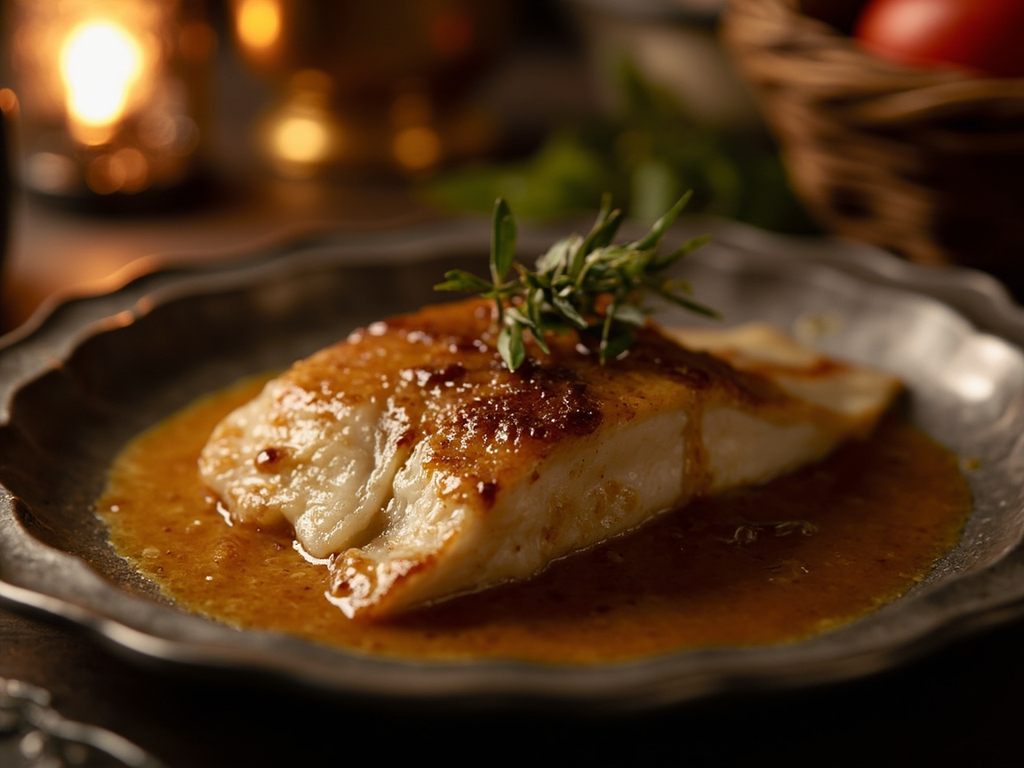
flipRhine Pike with Cameline Sauce
Rhine Pike with Cameline Sauce
Why this dish? Fish was the great pitance allowed on feast days, when the meat of quadrupeds remained forbidden. Albert, who passed through Cologne and Regensburg on the Rhine and Danube, knew freshwater fish well — he describes their habits himself in his *De animalibus*.
A handsome river fish, poached and then coated with a cameline sauce: toasted bread, cinnamon, ginger, and verjuice, sweet-sour and fragrant. The feast dish par excellence of a Rhenish medieval refectory.
For the solemnity of a saint, the charity of the house permits fish, and we receive it as a gift. I have long observed the pike in the waters of the Rhine: it is a voracious fish, with firm and dry flesh, which must be moistened with a sauce. So toast the crumb, grind it with cinnamon and ginger, and moisten it all with the sour juice of green grapes — the acid tempers the cold nature of the fish, as the just measure of qualities teaches. Serve it coated with this russet sauce: in this union of hot and cold there is a harmony that delights the body as much as it instructs the attentive mind.
- •Pike or river carp — one, gutted and scaled (centerpiece)
- •Toasted bread (crumb) — a few slices (sauce binder)
- •Cinnamon, ginger, a little clove — to taste (cameline spices)
- •Verjuice (green grape juice) — a good glass (acidity)
- •Wine and water — for the court-bouillon (poaching)
- •Salt — to taste (seasoning)
Rhine Pike with Cameline Sauce
A handsome river fish, poached and then coated with a cameline sauce: toasted bread, cinnamon, ginger, and verjuice, sweet-sour and fragrant. The feast dish par excellence of a Rhenish medieval refectory.
Why this dish? Fish was the great pitance allowed on feast days, when the meat of quadrupeds remained forbidden. Albert, who passed through Cologne and Regensburg on the Rhine and Danube, knew freshwater fish well — he describes their habits himself in his *De animalibus*.
For the solemnity of a saint, the charity of the house permits fish, and we receive it as a gift. I have long observed the pike in the waters of the Rhine: it is a voracious fish, with firm and dry flesh, which must be moistened with a sauce. So toast the crumb, grind it with cinnamon and ginger, and moisten it all with the sour juice of green grapes — the acid tempers the cold nature of the fish, as the just measure of qualities teaches. Serve it coated with this russet sauce: in this union of hot and cold there is a harmony that delights the body as much as it instructs the attentive mind.
Ingredients (period version)
- Pike or river carp — one, gutted and scaled (centerpiece)
- Toasted bread (crumb) — a few slices (sauce binder)
- Cinnamon, ginger, a little clove — to taste (cameline spices)
- Verjuice (green grape juice) — a good glass (acidity)
- Wine and water — for the court-bouillon (poaching)
- Salt — to taste (seasoning)
Ingredients
- Pike, zander, or carp fillets or steaks — 600 g (centerpiece)
- Stale country bread — 2 slices (sauce binder)
- Cinnamon — 1/2 tsp (spice)
- Ground ginger — 1/2 tsp (spice)
- Ground clove — 1 pinch (spice)
- Verjuice (or green grape juice + a dash of lemon juice) — 120 ml (acidity)
- Dry white wine and water — 500 ml total (court-bouillon)
- Salt — to taste (seasoning)
Method
- Prepare a light court-bouillon: white wine, water, salt. Bring to a simmer.
- Gently poach the fish for 8–12 min depending on thickness, without letting it boil. Keep warm.
- Toast the bread, soak it in the verjuice, then blend with the spices to obtain a smooth sauce.
- Thin the sauce with a little hot court-bouillon: it should coat without being thick. Adjust sweet-sour (a touch of honey if too sharp) and salt.
- Drain the fish, arrange it, coat with the russet cameline sauce, and serve immediately.
How it was made : Cameline sauce (from 'camel' color, russet) was one of the most common sauces in the Middle Ages: it was thickened with toasted bread, never with flour or butter. Verjuice, green grape juice, replaced lemon, still rare north of the Alps. Spices, imported at great expense from the East, signaled an exceptional day.
The contemporary twist : Serve the pike on a slate plate with a comma of cameline sauce and a few petals of fresh green grapes — the medieval sweet-sour takes on Nordic gastronomic airs.
Sources : Liber de coquina (Italy/France, late 13th – early 14th c.) · Albert le Grand, De animalibus, books on fish (ca. 1260)
Albert the Great · Charactorium