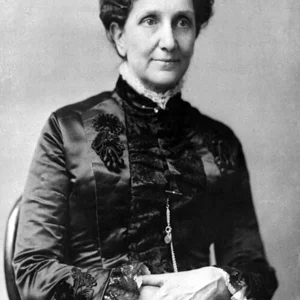

American theologian, founder of Christian Science, a religious movement based on healing through prayer. In 1875 she published the movement's foundational work and established a Church as well as a respected newspaper.
Mary Baker Eddy(1821 — 1910)
Mary Baker Eddy
États-Unis
5 min read
Frequently asked questions
Key Facts
- Born in 1821 in Bow, New Hampshire (United States)
- Published in 1875 “Science and Health with Key to the Scriptures,” the founding text of Christian Science
- Founded the Church of Christ, Scientist in Boston in 1879
- Created the daily newspaper “The Christian Science Monitor” in 1908
- Died in 1910 in Newton, Massachusetts
Works & Achievements
Founding work setting out the doctrine of Christian Science and healing through prayer.
Establishment of the Church that gave the religious movement a lasting structure.
Training school for practitioners, which spread Eddy's teaching.
Set of rules organizing the Church, its services, and its discipline.
Autobiographical account shedding light on her spiritual journey.
Daily newspaper founded at age 87, which became an internationally respected publication.
Anecdotes
A fragile and often sickly child, Mary Baker was largely educated at home in New Hampshire. Throughout her life, the question of illness and healing haunted her, eventually becoming the heart of her religious doctrine.
In 1866, after a fall on the ice in Lynn (Massachusetts) that left her seriously injured, Mary Baker Eddy claimed she had recovered her health by reading an account of a healing in the Gospel. She dated her “discovery” of Christian Science to that moment.
When she published 'Science and Health' in 1875, the book was at first ignored, then sharply criticized by physicians and the clergy. Eddy revised it dozens of times over the course of her life to refine her thinking.
At the age of 87, in 1908, when many believed she had withdrawn from public life, Mary Baker Eddy founded 'The Christian Science Monitor', a daily newspaper that would become a respected publication, awarded the Pulitzer Prize several times.
A controversial figure, she led her Church with a firm hand from her residence, inspiring both intense devotion among her followers and fierce press campaigns, notably from the writer Mark Twain.
Primary Sources
Sickness is an image of thought projected onto the body. (“Sickness is a belief, which must be annihilated by the divine Mind.”)
Bylaws of the Church of Christ, Scientist, setting out the organization, offices, and discipline of the movement founded by Eddy.
An autobiographical account in which Eddy looks back on her youth, her spiritual quest, and the discovery she calls Christian Science.
A daily newspaper founded by Eddy with the motto “to injure no man, but to bless all mankind.”
Key Places
Family farm where Mary Baker was born in 1821 and spent her childhood.
Town where, in 1866, Eddy suffered the fall followed by the healing that she associated with the discovery of Christian Science.
The First Church of Christ, Scientist, the worldwide center of the movement, built in Boston starting in 1894.
Institution founded by Eddy in 1881 to train practitioners of Christian Science.
Eddy's last residence near Boston, where she died in 1910.
Typical Objects

The foundational book of Christian Science, regarded by the movement as the reference textbook alongside the Bible. Eddy revised it tirelessly.

The sacred Christian text from which Eddy drew the accounts of Christ's healings, the scriptural foundation of her teaching.

A daily newspaper founded by Eddy in 1908, designed to report the news without sensationalism and to bless all mankind.

A lectern used in Christian Science churches, where “Readers” read aloud passages from the Bible and from Science and Health.

Writing instruments with which Eddy tirelessly composed and revised her works and her abundant correspondence.

The characteristic attire of the elderly Eddy, an austere black dress set off by a brooch, an image of Victorian respectability.
School Curriculum
Vocabulary & Tags
Key Vocabulary
Tags
Daily Life
Morning
In her later years, Eddy began her days early with silent prayer and the reading of the Bible and of her own writings. She often devoted her mornings to revising her texts and dictating her correspondence.
Afternoon
The afternoon was dedicated to leading the movement: instructions to her secretaries, decisions concerning the Church, and replies to the many letters from disciples and practitioners.
Evening
In the evening, she withdrew into strict quiet, continuing her reading and meditation. Her daily ride in a horse-drawn carriage, at a fixed hour, became a ritual well known to those around her.
Food
Eddy advocated temperance: she discouraged alcohol, tobacco, and excess, recommending a simple, moderate diet in keeping with the ideal of self-mastery of her time.
Clothing
She wore dark, plain Victorian-style dresses, often set off by a brooch or a discreet bit of lace, an image of respectability and dignity.
Housing
She lived in several residences in the Boston area, including her home at Chestnut Hill, spacious upper-class houses from which she directed her Church away from the crowds.
Historical Timeline
Period Vocabulary
Liens externes & ressources
Références
Œuvres
Science and Health with Key to the Scriptures
1875
Fondation de la Church of Christ, Scientist
1879
Massachusetts Metaphysical College
1881
Manual of The Mother Church
1895
Retrospection and Introspection
1891
The Christian Science Monitor
1908