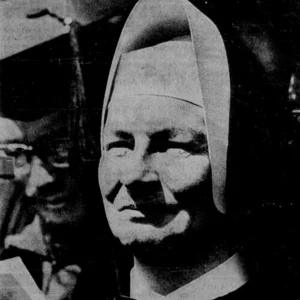

Mary Kenneth Keller was an American Catholic nun and a computing pioneer. She was one of the first people to earn a doctorate in computer science in the United States (1965) and contributed to the development of the BASIC programming language.
Mary Kenneth Keller(1913 — 1985)
Mary Kenneth Keller
États-Unis
6 min read
Frequently asked questions
Key Facts
- Enters the congregation of the Sisters of Charity of the Blessed Virgin Mary in 1932
- Takes part in the development of the BASIC language at Dartmouth College in the mid-1960s
- Earns in 1965 one of the first doctorates in computer science awarded in the United States
- Founds and leads the computer science department at Clarke College in 1965
- Dies in 1985 after two decades of teaching computer science
Works & Achievements
Research work that makes her one of the first people to earn a PhD in computer science in the United States.
At the Dartmouth computing center, she helps develop a simple language designed to make programming accessible to beginners.
She creates one of the first undergraduate computer science programs in the United States, open to students from every discipline.
For twenty years, she trains generations of students and champions the idea that computer science should be taught widely.
She takes part in the movement encouraging the use of small computers in education, ahead of her time.
Anecdotes
At the time when Mary Kenneth Keller was working at the Dartmouth College computing center, women were not normally admitted there. An exception was made for her so that she could take part in developing the BASIC language, which made her one of the very few women present in this pioneering place of computer science.
In 1965, Mary Kenneth Keller became one of the very first people to earn a doctorate in computer science in the United States. At roughly the same time, a man, Irving Tang, also defended his thesis at another university — historians still debate who was technically the “first.”
Sister Mary Kenneth Keller led a remarkable double life: a Catholic nun who took her vows in 1940, she was also a cutting-edge scientist. She saw the computer as a tool serving education and access to knowledge for everyone.
In 1965, she founded the computer science department at Clarke College in Iowa, which she would lead for twenty years. There she championed an idea far ahead of its time: computer science should be taught to all students, including those studying the arts and humanities.
Keller was convinced that computers could help make information accessible to everyone. The BASIC language, which she helped develop, was designed precisely to be easy for beginners to learn — which fit perfectly with her vision of computing open to the greatest number of people.
Primary Sources
Dissertation defended at the University of Wisconsin–Madison, focusing on inductive inference applied to computer-generated patterns, one of the first doctoral dissertations in computer science in the United States.
“For the first time, we can now mechanically simulate the cognitive process. We can make studies in artificial intelligence.”
The BASIC language was designed to be simple, accessible to beginners, and usable by students of all disciplines, as part of the work of the Dartmouth computing center in which Keller took part.
Key Places
City where Mary Kenneth Keller was born in 1913.
University where she earned her bachelor's degree in mathematics and then her master's degree in mathematics and physics.
University where, in 1965, she defended her doctorate in computer science, one of the very first awarded in the United States.
Computing center where the BASIC language was developed and where Keller worked, despite the ban on women entering it.
Institution where she founded and led the computer science department for twenty years, and where she died in 1985.
Typical Objects

A huge machine that often filled an entire room, used in 1960s universities for scientific computations. It was on this kind of computer that Keller programmed and taught.

A cardboard card in which holes encode data or program instructions. Hundreds of them were stacked to run a computer before screens came along.
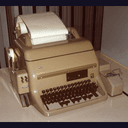
A device combining a keyboard and a printer that let users type commands and read the computer's responses on paper. It was with this kind of terminal that students used BASIC.
📷 CC BY-SA 3.0 · Wikimedia Commons ↗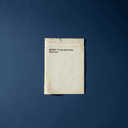
A booklet explaining how to write simple programs in the BASIC language. Designed for beginners, it embodied the idea that anyone could learn to program.
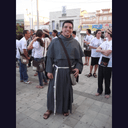
An outfit worn by Catholic nuns, a symbol of Keller's commitment and consecrated life. It served as a reminder that this computing pioneer was also a Sister of Charity.
📷 CC BY-SA 3.0 · Wikimedia Commons ↗
A string of beads counted off to recite prayers in the Catholic tradition. An everyday object in the spiritual life of a nun like Keller.
School Curriculum
Vocabulary & Tags
Key Vocabulary
Tags
Daily Life
Morning
In the morning, Sister Mary Kenneth often began with prayer and Mass, as her life as a nun required. She would then head to the college to prepare her lessons and grade her students' programs.
Afternoon
The afternoon was devoted to teaching and the computer lab. She helped students write and test their programs on the terminals, sharing the processing time of the central computer.
Evening
In the evening, she rejoined the religious community for prayers and shared meals. It was also a time to read, reflect on her research, and prepare for the next day.
Food
As a member of a religious community, she shared simple, communal meals at the convent or college. The food was plain, typical of consecrated life and of mid-twentieth-century America.
Clothing
She wore the habit of the Sisters of Charity of the Blessed Virgin Mary, which became simpler over the course of the Church's reforms in the 1960s. This habit set her clearly apart in the computer labs.
Housing
She lived within her religious community, near Clarke College in Dubuque, Iowa. Her lodging, plain and shared, reflected her commitment as a nun.
Historical Timeline
Period Vocabulary
Liens externes & ressources
Références
Œuvres
Thèse de doctorat « Inductive Inference on Computer Generated Patterns »
1965
Participation au développement du langage BASIC
1964
Fondation du département d'informatique du Clarke College
1965
Direction du département d'informatique de Clarke College
1965-1985
Engagement pour l'informatique dans l'enseignement (ASCUE)
années 1970-1980