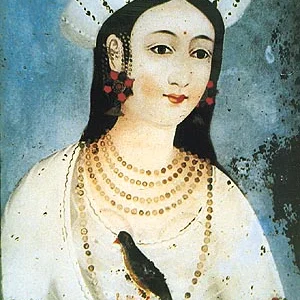

Mastani (c. 1699–1740) was the second wife of Bajirao I, the Maratha Peshwa. Daughter of a Rajput raja and a Muslim concubine, she was an accomplished dancer and warrior. Their interfaith love caused a scandal at the Maratha court and gave rise to legend.
Mastani(1699 — 1740)
Mastani
9 min read
Frequently asked questions
Key Facts
- Born around 1699, daughter of Chhatrasal, raja of Bundelkhand, and a Muslim concubine named Ruhani Bai
- Met Bajirao I around 1720 during his military campaign alongside her father
- Their union met with fierce opposition from the Brahmin Maratha court due to her Muslim heritage
- Gave birth to a son, Krishna Rao (known as Shamsher Bahadur), in 1734
- Died in 1740, shortly after the sudden death of Bajirao I
Works & Achievements
A palatial wing built within the Shaniwar Wada complex in Pune at Bajirao's order to house Mastani. This construction spoke to the Peshwa's deep attachment to her and to the political compromises required to keep his wife at court despite the hostility surrounding them.
Mastani enriched the cultural life of the Maratha court through her classical dance and music performances. Her presentations blended Rajput traditions, the influences of kathak dance, and elements drawn from Mughal culture, bringing vitality to a court otherwise shaped by strict Brahmanical norms.
Mastani is said to have accompanied Bajirao on certain military expeditions, a presence attested in several Maratha sources. This involvement reflected the martial training she inherited from her father Chhatrasal and her singular standing within the Peshwa's inner circle.
Despite their son's rejection by the Brahman community, Mastani ensured his education. Shamsher Bahadur went on to become a distinguished Maratha military commander, fighting at the Battle of Panipat in 1761 where he was killed — carrying forward the dual warrior heritage of both his parents.
Anecdotes
Mastani was not only a dancer and musician: her father, Raja Chhatrasal of Bundelkhand, had trained her in swordsmanship and horsemanship. According to several Maratha chronicles, she is said to have accompanied Bajirao on certain military campaigns — an extremely rare occurrence for a court woman in the 18th century. This dual identity as artist and warrior made her an extraordinary figure in the India of her time.
Around 1728, Raja Chhatrasal found himself in grave danger when the army of the Mughal governor Muhammad Khan Bangash invaded his kingdom of Bundelkhand. Bajirao arrived in time to save him. As a sign of deep gratitude, Chhatrasal offered the Peshwa a third of his kingdom along with his daughter Mastani, considered the most precious of his possessions — marking the beginning of a union that would cause a scandal.
The Brahmin court of Pune categorically refused to accept Mastani because of her Muslim origins through her mother. The priests forbade Bajirao from performing certain religious rituals in her presence, and their son Shamsher Bahadur was excluded from the Brahmin community at birth. Bajirao, one of the greatest warriors of his time, could never impose acceptance of his wife on his own family and court.
During Bajirao's military absences, members of his family had Mastani imprisoned at Pabal, a locality near Pune, in order to permanently break their union. Informed of this while on campaign, Bajirao sent men to free her, openly defying the hostility of his own kin. This episode illustrates the intensity of their bond despite the political and religious pressures bearing down on them.
Bajirao died suddenly on April 28, 1740, at Raver Khedi, most likely from a severe fever, at around forty years of age. Mastani survived him by only a few weeks. Popular tradition attributes her death to grief over the loss of her husband, making their story one of the great tragic love narratives of Mughal India — comparable in Indian memory to that of Layla and Majnun.
Primary Sources
The Peshwa records mention Mastani in the context of court expenditures at Shaniwar Wada and the domestic arrangements reserved for her, as well as the tensions surrounding her status within the Maratha royal family.
This Marathi-language account describes Mastani as the second wife of Bajirao and details the controversies arising from her dual religious identity, highlighting the opposition of the court Brahmins to the marriage and to the recognition of their son.
The letters and communications from the Peshwa court contain references to Mastani Sahiba as well as the arrangements made concerning her son Shamsher Bahadur, born of her union with Bajirao.
This Persian chronicle, written by a contemporary, discusses the rising power of Bajirao and the dynastic complexities of the Maratha court against the backdrop of declining Mughal authority in northern India.
Key Places
Historical region of central India ruled by Raja Chhatrasal, Mastani's father. She was born here around 1699 and received her dual training as both artist and warrior, before being offered to Bajirao in 1728.
The Peshwas' fortified palace headquarters in Pune, where Mastani lived alongside Bajirao. The Mastani Mahal was built especially for her around 1732, and it was within these walls that most of her life at the Maratha court unfolded.
A small town near Pune where Mastani was imprisoned by the Peshwa family during Bajirao's absences. This place symbolizes the persecution she endured because of her origins and her religion.
A village on the banks of the Narmada River where Bajirao died on 28 April 1740. News of his death was the final event of Mastani's life; she died shortly afterward.
The tomb traditionally attributed to Mastani is located in Pabal according to local tradition. This site has become a place of remembrance for those who honor the story of this woman whose fate was so deeply intertwined with another's.
Liens externes & ressources
Références
Œuvres
Mastani Mahal (Palais de Mastani à Shaniwar Wada)
vers 1732
Performances artistiques à la cour des Peshwas
1728–1740
Participation aux campagnes militaires de Bajirao
vers 1728–1735
Éducation de Shamsher Bahadur
1730–1740