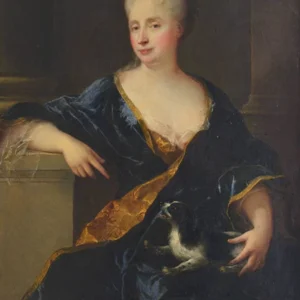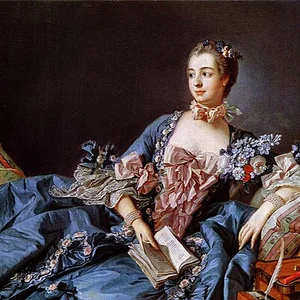

Official mistress of King Louis XV from 1745 until her death in 1764, she wielded considerable influence over French politics and culture. A great patron of the arts and protector of the Enlightenment philosophers, she helped shape the Rococo style and supported the Encyclopédie of Diderot and d'Alembert.
Madame de Pompadour(1721 — 1764)
Madame de Pompadour
France
9 min read
Frequently asked questions
Famous Quotes
« After us, the deluge.»
Key Facts
- 1721: Birth of Jeanne-Antoinette Poisson in Paris
- 1745: Presented to Louis XV, she becomes his official mistress and is elevated to the rank of Marquise de Pompadour
- 1756: She plays a role in the Diplomatic Revolution, bringing France closer to Austria
- 1751–1764: Protects and finances the Encyclopédie of Diderot and d'Alembert, supports Voltaire
- 1764: Dies at Versailles at the age of 42, after twenty years of influence at court
Works & Achievements
Madame de Pompadour actively protected the Encyclopédie against attempts at censorship by the Parlement de Paris and conservative circles. Her support allowed this landmark work of the Enlightenment to continue publication despite several temporary bans.
She contributed to the transfer of the royal manufactory from Vincennes to Sèvres and shaped its artistic output. Under her influence, the manufactory became one of the most prestigious in Europe, rivalling the porcelain of Meissen.
Madame de Pompadour had this château built and decorated by assembling the finest artists and craftsmen of the era. It became a model of the French Rococo style and a gathering place for the philosophers and artists she patronised.
In collaboration with the financier Pâris-Duverney, she persuaded Louis XV to create and fund this institution, designed to train officers from the lesser nobility. The architect Ange-Jacques Gabriel designed the iconic building that still stands today.
Playing a leading political role, she fostered a diplomatic rapprochement between France and the Austria of Maria Theresa, overturning two centuries of hostility. This diplomatic revolution reshaped French foreign policy in response to the rising power of Prussia.
A great patron of the arts, she commissioned hundreds of works from the most talented artists of her time: François Boucher (official court painter), Jean-Baptiste-Siméon Chardin, and the sculptor Jean-Baptiste Pigalle. Her taste defined the official aesthetic of the reign of Louis XV.
Anecdotes
As a child, Jeanne-Antoinette Poisson received a prediction from a fortune teller: she would one day become the king's mistress. Her mother immediately nicknamed her "Reinette
(little queen) and carefully oversaw her artistic and intellectual education. This prophecy left a deep mark on the young girl
who spent her entire childhood preparing to shine in the highest circles.
It was at a masked ball held at Versailles in February 1745, to celebrate the Dauphin's wedding, that Jeanne-Antoinette encountered King Louis XV disguised as a trimmed yew tree. She was dressed as Diana the Huntress. This romantic encounter, carefully arranged by the young bourgeoise, marked the beginning of a liaison that would last twenty years.
Despite her fragile health — she suffered from tuberculosis and frequent bronchitis — Madame de Pompadour refused to let her weakness show at court. She used large quantities of rouge to mask her pallor and kept up an exhausting pace of life to remain indispensable to the king. She is said to have once declared:
One can always be beautiful if one wishes to be.
Madame de Pompadour was one of the key architects of the "reversal of alliances" of 1756: she played a personal role in the diplomatic rapprochement with Austria under Maria Theresa, breaking with two centuries of Franco-Austrian hostility. The empress herself wrote her a letter addressing her as "my cousin" — an exceptional recognition for a woman of bourgeois origin.
Passionate about the decorative arts, Madame de Pompadour actively contributed to the development of the Sèvres porcelain manufactory, which produced in her honor a famous shade of pink known as "rose Pompadour." She also supported the creation of the École Militaire in Paris alongside the financier Pâris-Duverney: it was in this institution that, decades later, a certain Napoléon Bonaparte would be educated.
Primary Sources
I beg you, my dear brother, to ensure that the artists chosen for Bellevue are among the finest; the King wishes everything to be completed before autumn, and you know how sensitive he is to the beauty of places and the perfection of works.
Mme de Pompadour was presented to the King on 14 September 1745; she appeared with great grace and acquitted herself well before the entire court, which surprised several people who had not credited her with such an advantage.
You unite, Madame, every form of glory. You patronize letters and the arts as an enlightened sovereign; your taste sets the standard and your generosity carries it out with a constancy that the great do not always display.
In the library of the Versailles apartment: approximately three thousand five hundred volumes, among them the *Encyclopédie* of MM. Diderot and d'Alembert in complete volumes, the works of M. de Voltaire, M. de Montesquieu, and M. Rousseau.
The Marquise de Pompadour passed away on 15 April 1764, at Versailles. No one did more for the arts and letters of this century; philosophers and painters owe her a steadfast patronage that the court would never have extended to them without her.
Key Places
Jeanne-Antoinette Poisson was born on 29 December 1721 in this bourgeois neighborhood of Paris. Her mother, a shrewd businesswoman, opened the doors of cultivated salons to her from an early age and ensured she received an exceptional artistic and intellectual education.
Madame de Pompadour's principal residence from 1745, where she occupied apartments on the first floor and then the second, connected to the king's apartments by a private staircase. It was from Versailles that she exercised her political and cultural influence for twenty years, and where she died on 15 April 1764.
From 1748, Madame de Pompadour had this château built and decorated on the banks of the Seine, ultimately gifting it to the king. It was one of the many architectural projects she initiated to spread the Rococo style and promote the French decorative arts.
Madame de Pompadour played a key role in the transfer of the royal porcelain manufactory from Vincennes to Sèvres in 1756, close to her Château de Bellevue. She was its patron and first client, championing the Rococo style and the shade of pink that bears her name.
Madame de Pompadour actively supported the creation of this institution, founded in 1750 to train young impoverished nobles for a military career. She persuaded Louis XV to finance its construction; the architect Ange-Jacques Gabriel drew up the plans that still stand today.
Typical Objects

An indispensable accessory for ladies of quality in the 18th century, the fan allowed Madame de Pompadour to communicate through a coded language at court and display her elegance. She owned dozens of them, some painted by the greatest artists of the era.

Madame de Pompadour ordered and collected hundreds of pieces from the royal porcelain manufactory, some of which bear the famous vivid pink named in her honor. These porcelain pieces symbolized the refinement of rococo taste that she imposed on the French court.

Madame de Pompadour's daily toilette lasted several hours and required an army of ladies' maids. Beauty patches (small pieces of black velvet glued to the face) and cosmetics were essential accessories of her daily performance at Versailles.

An accomplished musician, Madame de Pompadour played the harpsichord and sang with great talent. She organized and took part in private concerts in her apartments, gathering around her the finest artists and composers of the era.

Boucher painted several official portraits of Madame de Pompadour, versions of which were engraved and circulated throughout the kingdom. These images built her public persona, depicting her surrounded by books — a symbol of her role as an enlightened patron of the arts.

A woman of power as much as a woman of letters, Madame de Pompadour corresponded extensively with her brother the Marquis de Marigny, the artists she patronized, and foreign representatives. Her desk was the nerve center of her political and cultural influence.
School Curriculum
Vocabulary & Tags
Key Vocabulary
Daily Life
Morning
Madame de Pompadour's morning began with a ceremonial toilette lasting one to two hours, attended by chambermaids, hairdressers, and ladies-in-waiting. This public dressing ritual, during which she received certain distinguished visitors, was an opportunity to learn the latest court news and make the first decisions of the day.
Afternoon
The afternoon was devoted to the king's service: accompanying him on his walks, hunts, or favorite pursuits. Madame de Pompadour also took part in informal discussions through which she influenced appointments to ministerial positions and the kingdom's artistic direction.
Evening
Evenings at Versailles were spent in the private apartments — card games, music — or at intimate suppers in the king's inner cabinets. Madame de Pompadour regularly organized theatrical performances in the Théâtre des Petits Cabinets, which she had built, and sometimes took the stage herself.
Food
Madame de Pompadour's table was renowned for its refinement: delicate dishes prepared by talented cooks, accompanied by the finest Burgundy and Champagne wines. She was, however, a moderate eater, as attentive to her image as to her delicate health.
Clothing
Her outfits were made by the best Parisian dressmakers and followed — or set — the fashions of the day. She wore pannier gowns of embroidered silk in pastel shades — pinks, mauves, and soft blues — adorned with lace and ribbons, helping to define the rococo aesthetic in the world of fashion.
Housing
At Versailles, Madame de Pompadour first occupied an apartment on the first floor, then increasingly grand apartments as her favor with the king grew. She also owned several residences that she had furnished with the utmost care: the Château de Bellevue, the Hôtel d'Évreux in Paris (now the Élysée Palace), and several pleasure houses.
Historical Timeline
Period Vocabulary
Liens externes & ressources
Références
Œuvres
Soutien à l'Encyclopédie de Diderot et d'Alembert
1751-1764
Développement de la manufacture de porcelaine de Sèvres
1756
Construction du château de Bellevue
1748-1757
Création de l'École Militaire de Paris
1750-1752
Traité de Versailles et renversement des alliances
1756
Mécénat artistique — Boucher, Chardin, Pigalle, Gabriel
1745-1764