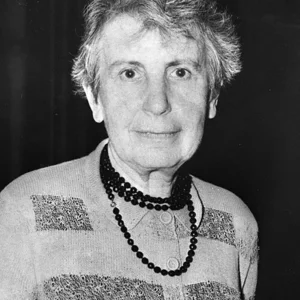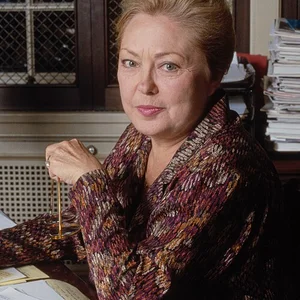

Mathilde Krim was a medical biology researcher specializing in virology and cancer. She is best known for her pioneering fight against AIDS, having founded a research foundation that became amfAR in the 1980s.
Mathilde Krim(1926 — 2018)
Mathilde Krim
États-Unis
5 min read
Frequently asked questions
Key Facts
- Born in 1926 in Como (Italy), she earned a doctorate in biology from the University of Geneva in 1953
- She conducted research on cancer and interferon, notably at the Sloan Kettering Institute in New York
- In 1983 she founded the AIDS Medical Foundation, which merged in 1985 to become amfAR (American Foundation for AIDS Research), co-chaired with Elizabeth Taylor
- She received the Presidential Medal of Freedom in 2000 for her commitment
- She died on January 15, 2018, in the United States
Works & Achievements
Participation in a pioneering advance in prenatal diagnosis at the Weizmann Institute, paving the way for modern amniocentesis.
Work at Sloan-Kettering on this antiviral protein, studied as a possible weapon against tumors.
The first organization she created to fund AIDS research and defend patients against fear and rejection.
A merger giving rise to the major American AIDS research foundation, which she chaired and embodied worldwide.
Editing reference works that spread knowledge about this molecule among the scientific community.
Public advocacy for education, prevention, and respect for HIV-positive people, against calls for their exclusion.
Anecdotes
As a young woman in Geneva, Mathilde Krim was deeply shaken by the images of the concentration camps revealed after the Second World War. She converted to Judaism and joined the Irgun, an underground Zionist organization for which she is said to have taken part in smuggling weapons into Palestine. This activist past reflects a youth committed to causes long before her scientific battles.
At the Weizmann Institute in Israel, in the 1950s, she was part of a pioneering team that managed to determine the sex of a fetus from cells taken in the amniotic fluid. It was one of the first breakthroughs in prenatal diagnosis, a technique still used today.
Her marriage to Arthur Krim, head of a major Hollywood film studio and adviser to American presidents, opened the doors of power and show business to her. She would use this network to convince stars like Elizabeth Taylor to publicly support the fight against AIDS, at a time when the disease inspired fear.
In 1983, while AIDS was causing worldwide panic and some were calling for the sick to be isolated, Mathilde Krim founded a research foundation and firmly opposed all discrimination. She would repeat that the epidemic was twofold: that of the virus, but also that of fear and rejection.
In 2000, President Bill Clinton awarded her the Presidential Medal of Freedom, the highest civilian honor in the United States, for her pioneering role in research and her advocacy for AIDS patients.
Primary Sources
Report of unusual cases of Pneumocystis pneumonia in previously healthy young men — the first official report of what would become AIDS, which would mobilize Mathilde Krim in the years that followed.
Creation of a foundation dedicated to funding AIDS research and informing the public, founded by Mathilde Krim to address the lack of resources and to fight the stigmatization of those affected.
The honor salutes a pioneer of medical research and a tireless advocate for people with AIDS, who helped rally both science and public opinion against the epidemic.
Key Places
City where Mathilde Galland is born in 1926, before her family settles in Switzerland.
Where she studied and earned her doctorate in biology, the starting point of her scientific career.
Research center where she took part in the early work on prenatal determination of fetal sex.
Institute where she carried out her research on interferon and cancer after moving to the United States.
Town in New York State where she died in 2018.
Typical Objects
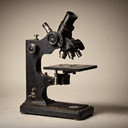
The central instrument of her work as a virologist and cancer researcher, used to observe cells and viruses.

She studied interferon and the behavior of cancer cells on these laboratory cultures.

Linked to her pioneering work on prenatal diagnosis at the Weizmann Institute in the 1950s.

A representation of chromosomes that she analyzed to determine the sex and abnormalities of the fetus.

A worldwide symbol of solidarity with AIDS patients, a cause to which she devoted the second half of her life.

She edited and published specialized works on this antiviral protein studied against cancer.

Her charity evenings brought together celebrities and donors to fund AIDS research.
School Curriculum
Vocabulary & Tags
Key Vocabulary
Tags
Daily Life
Morning
A rigorous researcher, she often begins her day in the laboratory or in her New York office, reading the latest scientific publications. The morning is devoted to experiments, analyzing results, and exchanges with her colleagues.
Afternoon
The afternoon blends meetings, mentoring young researchers, and, starting in the 1980s, intense work leading a foundation. She writes funding applications and prepares public talks on AIDS.
Evening
The evening is often filled with dinners, charity galas, or meetings with donors, political figures, and celebrities whom she rallies to the cause. For her, these society evenings are a genuine tool of activism.
Food
Living in the cosmopolitan New York of the second half of the 20th century, she has access to varied and refined cuisine. Gala meals and fundraising dinners are part of her daily life as an organizer.
Clothing
A woman of science and of networks, she wears elegant, polished outfits suited equally to the academic world and to the prestigious evenings where she represents her foundation.
Housing
She lives in Manhattan, at the heart of New York's intellectual and cultural life, and has a residence in the affluent suburbs of Long Island, in Kings Point.
Historical Timeline
Period Vocabulary
Liens externes & ressources
Références
Œuvres
Détermination prénatale du sexe fœtal par cytogénétique
vers 1955-1956
Recherches sur l'interféron et le cancer
années 1960-1970
Fondation de l'AIDS Medical Foundation
1983
Création d'amfAR
1985
Direction d'ouvrages scientifiques sur l'interféron
années 1970-1980
Campagnes contre la discrimination des malades du sida
années 1980-1990