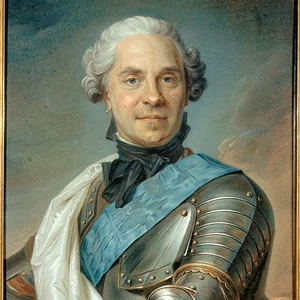

Marshal General of France and illegitimate son of Augustus II of Saxony-Poland. Regarded as one of the greatest military commanders of the 18th century, he distinguished himself with his decisive victory at Fontenoy in 1745 during the War of the Austrian Succession.
Maurice de Saxe(1696 — 1750)
Maurice de Saxe
France, Allemagne, Empire russe
6 min read
Frequently asked questions
Key Facts
- Born in 1696 in Goslar, illegitimate son of Augustus II the Strong, King of Poland and Elector of Saxony
- Appointed Marshal of France in 1744 by Louis XV
- Won the Battle of Fontenoy on 11 May 1745 against the Anglo-Dutch forces, in the king's presence
- Raised to the dignity of Marshal General of the King's Camps and Armies in 1747
- Died in 1750 at the Château de Chambord, which Louis XV had given to him; posthumous author of the *Mes Rêveries* (1757), a treatise on the art of war
Works & Achievements
A decisive battle against the British, Hanoverian, and Austrian armies, which opened the way to the conquest of the Austrian Netherlands and made the marshal's glory.
A daring nighttime operation in which the troops scaled the city walls, demonstrating Maurice's spirit of initiative.
A visionary treatise on the art of war, proposing reforms to the organization of armies, later praised by great strategists.
A success against the coalition army that consolidated French dominance in the Netherlands and earned him the title of marshal general.
Another victory over the coalition forces, which definitively asserted the superiority of the French army in the conflict.
A campaign of sieges and battles that brought a large part of present-day Belgium and neighboring provinces under French control.
A light cavalry corps that he organized and maintained, illustrating his ideas about mobile and self-sufficient units.
Anecdotes
Maurice de Saxe was the natural son of Augustus II of Poland, Elector of Saxony. It is said that this king possessed prodigious strength, able to break horseshoes with his bare hands, and that Maurice inherited this legendary physical robustness that impressed his soldiers.
At the Battle of Fontenoy in 1745, Maurice de Saxe was so ill with dropsy that he could barely ride a horse anymore. He had himself carried onto the battlefield in a wicker litter and directed the French victory from this improvised stretcher, before the eyes of King Louis XV, who had come to witness the fighting.
In his youth, Maurice was for a time madly in love with the idea of becoming Duke of Courland: he was indeed elected duke in 1726, but Russia opposed him militarily and he had to give up this throne after a few months of adventures.
A lover of theatre and a great enthusiast of festivities, Maurice de Saxe carried on a long affair with the famous actress Adrienne Lecouvreur, one of the greatest tragediennes of her time, who is even said to have sold her jewels to finance his military campaigns.
Louis XV rewarded Maurice de Saxe by offering him the magnificent Château de Chambord as a residence. The marshal installed there his own regiment of Tartar horsemen and lived like a prince until his death in 1750.
Primary Sources
War is a science covered in shadows, in whose darkness one does not move with a sure step; routine and prejudice are its foundation.
The king publicly congratulated Marshal de Saxe, telling his son the Dauphin to look closely at what a victory costs and the price of the blood that is spilled.
Marshal de Saxe, though a foreigner and ill, led the army at Fontenoy with a firmness and presence of mind that decided the fate of the day.
He carried into battle a calm and a cheerfulness that reassured the soldier, and with a single word could restore confidence to shaken troops.
Key Places
Town in Germany where Maurice de Saxe was born in 1696, the illegitimate son of the Elector of Saxony.
Village in the Austrian Netherlands where Maurice won his most famous victory on 11 May 1745, in the presence of Louis XV.
Capital of Bohemia taken by storm through escalade in 1741 during the campaign led by Maurice de Saxe.
Royal estate granted by Louis XV to Maurice de Saxe as a reward for his victories; he lived there and died there in 1750.
Resting place of Maurice de Saxe beneath a monumental mausoleum sculpted by Jean-Baptiste Pigalle, a masterpiece of funerary art.
Site of the 1747 victory won by Maurice against the allied coalition forces during the War of the Austrian Succession.
Liens externes & ressources
Références
Œuvres
Victoire de Fontenoy
11 mai 1745
Mes Rêveries
rédigé vers 1732, publié en 1757
Victoire de Rocoux
1746
Victoire de Lawfeld
1747
Conquête des Pays-Bas autrichiens
1745-1748
Régiment de Uhlans (cavalerie de Saxe)
années 1740