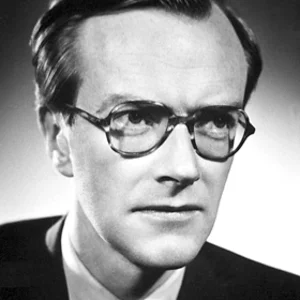

British biophysicist of New Zealand origin. His X-ray diffraction work on DNA contributed to the discovery of the double-helix structure, which earned him the Nobel Prize in Medicine in 1962 alongside James Watson and Francis Crick.
Maurice Wilkins(1916 — 2004)
Maurice Wilkins
Royaume-Uni, Nouvelle-Zélande
6 min read
Frequently asked questions
Key Facts
- Born on 15 December 1916 in Pongaroa (New Zealand), died on 5 October 2004 in London
- Took part in the Manhattan Project during the Second World War (isotopic separation of uranium)
- Produced the first X-ray diffraction images of DNA at King's College London from 1950 onwards
- Received the Nobel Prize in Physiology or Medicine in 1962 with Watson and Crick for the structure of DNA
- Published his autobiography 'The Third Man of the Double Helix' in 2003
Works & Achievements
Wilkins and his team obtained ordered DNA fibres that produced sharp diffraction images, the experimental basis for the discovery of the double helix.
One of three papers published simultaneously in Nature in April 1953; in it Wilkins presents the experimental evidence supporting the double-helix model.
During the war he contributed to research on separating uranium isotopes, an experience that later steered him away from nuclear physics.
After 1953, Wilkins continued his work to verify and refine the double-helix model, strengthening the proof that it was correct.
As president of the British Society for Social Responsibility in Science, he campaigned for an ethical and peaceful use of scientific discoveries.
An account of his life and his role in the discovery of DNA, in which he reflects on his relationships with Franklin, Watson and Crick.
Anecdotes
During the Second World War, Maurice Wilkins worked on the Manhattan Project, at Berkeley, separating the uranium isotopes destined for the atomic bomb. Devastated by Hiroshima and Nagasaki, he abandoned nuclear physics and turned to biology, later becoming a committed anti-nuclear activist.
It was while reading physicist Erwin Schrödinger's little book, “What Is Life?”, that Wilkins had the idea of applying physics to the study of living things. The book suggested that a single molecule could contain the “code” of heredity, an insight that steered his entire career toward DNA.
In January 1953, Wilkins showed James Watson the famous “Photo 51,” an X-ray diffraction image of DNA produced in his laboratory by Rosalind Franklin and Raymond Gosling. This picture, which revealed a cross-shaped pattern characteristic of a helix, was a decisive spark for Watson and Crick.
Wilkins and Rosalind Franklin, who worked in the same laboratory at King's College, had a tense and difficult working relationship: a misunderstanding about their respective roles set them at odds for years. In his 2003 autobiography, Wilkins expressed his regrets about this failed collaboration.
In 1962, Wilkins received the Nobel Prize in Medicine alongside Watson and Crick. Rosalind Franklin, who had died of cancer in 1958 at only 37, could not be honoured because the Nobel is not awarded posthumously — an absence that still fuels much debate today.
Primary Sources
While the biological properties of deoxypentose nucleic acid suggest a molecular structure containing great complexity, X-ray diffraction studies described here show the basic molecular configuration has great simplicity.
We have also been stimulated by a knowledge of the general nature of the unpublished experimental results and ideas of Dr. M. H. F. Wilkins, Dr. R. E. Franklin and their co-workers at King's College, London.
The discovery of the structure of DNA has been made possible by the work of many people, and I should like to express my gratitude for the contributions of my colleagues at King's College.
I have tried to give a balanced account of the discovery of the structure of DNA, and of my own part in it, including the difficult relationship with Rosalind Franklin.
Key Places
Rural village where Maurice Wilkins was born in 1916. His family lived there before leaving for England.
Wilkins studied physics here at St John's College and earned his degree in 1938.
Within the Medical Research Council's biophysics unit, Wilkins carried out his X-ray diffraction research on DNA. It was here that Photo 51 was produced.
During the war, Wilkins worked here on the Manhattan Project, on the separation of uranium isotopes.
Wilkins prepared his doctorate on luminescence here under the supervision of John Randall, before the war.
City where Wilkins spent much of his professional life and where he died in 2004.
Liens externes & ressources
Références
Œuvres
Clichés de diffraction des rayons X de l'ADN
1950-1952
Article « Molecular Structure of Deoxypentose Nucleic Acids » (Nature)
1953
Travaux sur la séparation des isotopes (projet Manhattan)
1944-1945
Confirmation expérimentale de la structure de l'ADN
années 1950
Engagement pour la responsabilité sociale de la science
1969 et après
« The Third Man of the Double Helix » (autobiographie)
2003