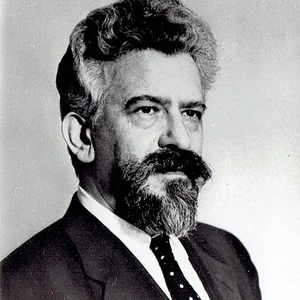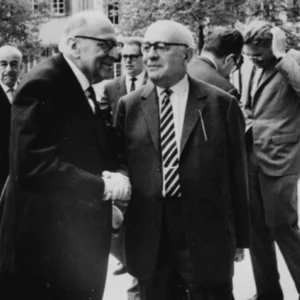

German philosopher and sociologist, a major figure of the Frankfurt School, whose Institute for Social Research he directed. Together with Adorno, he founded Critical Theory, a Marxist and Freudian analysis of modern societies.
Max Horkheimer(1895 — 1973)
Max Horkheimer
États-Unis, Allemagne
6 min read
Frequently asked questions
Key Facts
- Born in 1895 in Stuttgart into a well-off Jewish family, died in 1973 in Nuremberg.
- Became director of the Institute for Social Research in Frankfurt in 1930, the birthplace of the Frankfurt School.
- Went into exile in the United States after Hitler came to power in 1933, with the Institute relocated to New York (Columbia University).
- Published 'Dialectic of Enlightenment' (Dialektik der Aufklärung) with Theodor W. Adorno in 1947.
- Returned to Frankfurt after the war and re-established the Institute there, contributing to Germany's intellectual reconstruction.
Works & Achievements
A collection of critical aphorisms on German society, published under a pseudonym. It reveals his commitment against capitalism and the rising tide of fascism.
A foundational article that defines “Critical Theory” as engaged thought, distinct from neutral science. The programmatic text of the Frankfurt School.
A major work that asks how the reason of the Enlightenment could turn into barbarism. One of the most influential works of twentieth-century philosophy.
An essay written in English that denounces the reduction of reason to a mere tool of calculation and domination (“instrumental reason”).
Under his leadership, the Institute became the world's hub of Critical Theory and survived exile. He gave its research a lasting direction.
A collective study directed by Horkheimer, blending sociology, psychoanalysis, and Marxism to understand obedience and authoritarianism.
His return to Germany to re-establish critical thought in the postwar university. There he trained a new generation of researchers.
Anecdotes
When the Nazis came to power in 1933, Horkheimer — Jewish and Marxist — was doubly under threat. As early as 1931, he had had the foresight to transfer part of the funds of the Institute for Social Research abroad, which made it possible to save the institution and reopen it in Geneva, then in New York.
In exile in the United States, the Institute was welcomed by Columbia University in New York. Horkheimer continued his research there before settling in California, where he reunited with other German exiles such as Thomas Mann and Bertolt Brecht.
During the war, together with his friend Theodor Adorno, Horkheimer wrote the *Dialectic of Enlightenment*, a book penned by both men that asks why humanity, instead of progressing, sank into Nazi barbarism despite the Enlightenment and science.
After the war, Horkheimer made a choice rare among the exiles: he returned to Germany in 1949 to rebuild the Institute in Frankfurt. He even became rector of the University of Frankfurt in 1951, helping to revive critical thought in a country that had to be rebuilt.
Horkheimer is regarded as the theorist who coined the expression “Critical Theory” in 1937, in an article that contrasts engaged thought with “traditional theory,” deemed too neutral and subservient to the existing order.
Primary Sources
The critical theory of society has as its object human beings as producers of the totality of their historical forms of life.
From time immemorial, humanity, in the progress of the Enlightenment, has set out to dispel fear and to establish itself as master. But the wholly enlightened earth now radiates under the sign of a triumphant calamity.
Reason has become completely harnessed to the social process. Its operational value, its role in the domination of human beings and nature, has become its sole criterion.
Whoever is not willing to talk about capitalism should also keep quiet about fascism.
Key Places
City in Germany where Max Horkheimer was born in 1895 into a Jewish family of textile industrialists.
Headquarters of the Institute he directed and of the university where he became rector. Birthplace of the Frankfurt School, before and after exile.
Home of the Institute in exile from 1934 onward, which allowed Critical Theory to survive far from Nazi Germany.
Region where Horkheimer settled in the early 1940s and, together with Adorno, wrote the “Dialectic of Enlightenment.”
First stop of the Institute's exile in 1933, before its definitive move to the United States.
City near which Horkheimer died in 1973, after his return to Germany.
Typical Objects

Scholarly journal directed by Horkheimer, the main vehicle for spreading Critical Theory. It first appeared in 1932 and continued in exile.

An everyday tool of the 20th-century intellectual, on which Horkheimer and Adorno produced clean copies of articles and manuscripts. Essential to writing essays in exile.

An instrument of the Institute's major empirical studies, such as 'The Authoritarian Personality'. It was used to measure attitudes and prejudices within the population.

An emblematic object of the 'mass culture' analyzed by the Frankfurt School. Horkheimer saw in it an instrument for standardizing minds.

A collection of books on philosophy, economics and sociology, patiently rebuilt after each relocation of the Institute in exile. The material heart of its research.

Vital documents for Jewish intellectuals fleeing Nazi Germany. They determined survival and admission to the United States.
School Curriculum
Vocabulary & Tags
Key Vocabulary
Tags
Daily Life
Morning
As an academic and institute director, Horkheimer devotes his mornings to reading, scholarly correspondence, and preparing his lectures and articles. He exchanges many letters with his colleagues, especially **Adorno**.
Afternoon
His afternoons are shaped by Institute meetings, leading collective studies, and philosophical discussions with his team. He oversees the journal and coordinates research in sociology.
Evening
In the evening, during his Californian exile, he continues his writing work, sometimes composing in several voices together with **Adorno**. Evenings are also an opportunity for German émigré intellectuals to gather.
Food
Coming from a middle-class family and later living in the United States, he has the diet of a well-off city dweller of the 20th century. In California, he discovers the American way of life, quite different from German habits.
Clothing
Horkheimer wears the sober suit of the academic of his time: jacket, shirt, and tie. This formal attire reflects his status as a professor and the director of an institution.
Housing
His life is marked by the successive moves of exile: apartments in **New York**, then a house in **California**, before the return to **Frankfurt**. Each new settling-in involves transferring the Institute's archives and library.
Historical Timeline
Period Vocabulary
Liens externes & ressources
Références
Œuvres
Crépuscule (Dämmerung)
1934
Théorie traditionnelle et théorie critique
1937
La Dialectique de la Raison (avec Adorno)
1947
Éclipse de la raison (Eclipse of Reason)
1947
Direction de l'Institut de recherche sociale
1930-1958
Études sur l'autorité et la famille
1936
Reconstruction de l'Institut et rectorat de Francfort
1949-1953