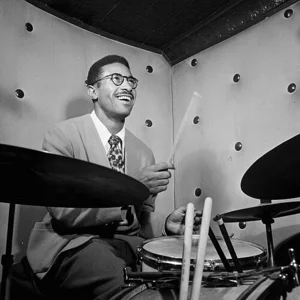

Maxwell Lemuel Roach (1924-2007) was an American jazz drummer, percussionist, and composer. A pioneer of bebop alongside Charlie Parker and Dizzy Gillespie, he was also a committed activist for civil rights.
Max Roach(1924 — 2007)
Max Roach
États-Unis
6 min read
Frequently asked questions
Famous Quotes
« Jazz is a very democratic musical form. It comes out of a communal experience.»
Key Facts
- Born on January 10, 1924, in North Carolina, he established himself as early as the 1940s as one of the founding drummers of bebop.
- In the mid-1940s, he played alongside Charlie Parker and Dizzy Gillespie, revolutionizing the rhythmic role of the drums.
- In 1954, he co-founded the celebrated Brown-Roach Quintet with trumpeter Clifford Brown.
- In 1960, he composed 'We Insist! Freedom Now Suite', a major work dedicated to the civil rights struggle.
- In 1988, he became the first jazz musician to receive the MacArthur Fellowship; he died on August 16, 2007, in New York.
Works & Achievements
Roach laid the rhythmic foundations of bebop, including the famous “Ko-Ko,” at a tempo and precision never heard before.
One of the most acclaimed and accomplished hard bop quintets in jazz history, cut short by the death of Clifford Brown.
An album where his drumming on “St. Thomas” showcases his art of driving and supporting a soloist.
A major work of protest, linking slavery, the American civil rights movement, and the anti-apartheid struggle.
A bold trio bringing Roach together with Duke Ellington on piano and Charles Mingus on double bass.
An album spotlighting drum solos, including “The Drum Also Waltzes,” which assert the drums as an instrument in their own right.
An ensemble made up entirely of percussionists, exploring timbres and rhythms from all around the world.
Anecdotes
As a teenager, Max Roach stepped in at the last minute for the drummer in Duke Ellington's orchestra for a few performances at a New York theater. Before long, he joined the jam sessions at Minton's Playhouse in Harlem, the club where bebop was being invented alongside Charlie Parker, Dizzy Gillespie, and Thelonious Monk.
Roach transformed the way the drums were played. Rather than keeping the tempo on the bass drum, he shifted the pulse to the ride cymbal and reserved the bass drum and snare for surprise accents, a technique nicknamed “dropping bombs.” His drumming became melodic, like a voice in dialogue with the soloists.
In 1960, he recorded “We Insist! Freedom Now Suite,” an album devoted entirely to the struggle for civil rights. Its cover shows three Black men seated at a restaurant counter, echoing the Greensboro sit-ins, where Black students demanded to be served on equal terms with white customers.
The quintet he co-led with the young trumpet prodigy Clifford Brown was one of the most brilliant of its time. But the adventure came to an abrupt end in 1956: Brown died at 25 in a car accident on the highway. Roach, devastated, would take years to overcome the loss.
In 1988, Max Roach became the first jazz musician to receive the MacArthur Fellowship, nicknamed the “genius grant.” He was teaching music at the University of Massachusetts at the time, proof that jazz was finally recognized as a major art form worthy of university study.
Primary Sources
The suite moves through “Driva' Man,” “Freedom Day,” “Triptych: Prayer / Protest / Peace” and “Tears for Johannesburg,” linking American slavery to the anti-apartheid struggle in South Africa.
Interviewed by drummer Arthur Taylor, Roach argues that jazz is a full-fledged African American art form and demands for its creators the respect and recognition granted to other art forms.
On this founding bebop session, Max Roach is on drums alongside Charlie Parker and Dizzy Gillespie, at a dizzying tempo that heralds a new kind of music.
Roach backs Sonny Rollins on the famous “St. Thomas,” showing how drums can support and spur on a soloist while remaining a partner in dialogue.
Key Places
Rural region of the southern United States where Max Roach was born in 1924, before his family moved to New York.
Neighborhood where Roach grew up and learned the drums, notably at church and at school.
Legendary club where, during jam sessions, the young Roach took part in the invention of bebop.
Street lined with jazz clubs where Roach performed regularly throughout the 1940s and 1950s.
Institution where Roach taught music from 1972 onward, helping to gain academic recognition for jazz.
City where Max Roach died in 2007 after a long career.
Typical Objects

His instrument, which he transforms into a melodic voice able to converse with the soloists rather than merely keeping time.

Roach shifts the tune's main pulse onto it, freeing the bass drum for accents: a revolution in bebop drumming.

He uses it for accents and short motifs, giving his drumming a phrasing close to speech.

A drummer's basic tool; Roach also mastered brushes for softer, more nuanced textures.

A photograph of three Black men at a restaurant counter, a direct reference to the civil rights sit-ins.

The medium on which his albums appear; the long format lets Roach develop entire suites such as the Freedom Now Suite.
School Curriculum
Vocabulary & Tags
Key Vocabulary
Tags
Daily Life
Morning
Like many musicians who play late into the night, Roach got up late. His mornings blended rest, reading, and work on *rudiments*—those basic exercises that drummers practice tirelessly to keep their speed and precision.
Afternoon
Afternoons were devoted to rehearsals, composition, and writing arrangements. From the 1970s on, he added teaching and discussions with his students at the university.
Evening
Evenings were the heart of his profession: club concerts, studio recordings, or long tours. A single night might string together several sets in front of an attentive audience.
Food
His life followed the irregular rhythm of touring musicians: meals eaten late, often backstage or at restaurants open through the night, between trips from city to city.
Clothing
On stage, bebop musicians took pride in a polished elegance: a well-cut suit, shirt, tie, and sometimes glasses—a way of commanding respect for their art.
Housing
Roach spent most of his life in New York, first in Brooklyn during his youth, then in Manhattan, at the heart of the jazz scene.