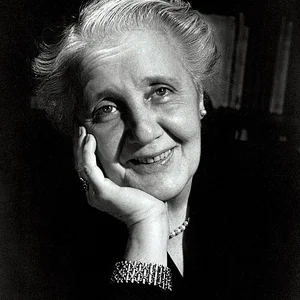

British psychoanalyst of Austrian origin (1882–1960), pioneer of child psychoanalysis. She developed object relations theory and was one of the first to analyze very young children through play. Her work profoundly influenced child psychiatry and psychoanalytic thought.
Melanie Klein(1882 — 1960)
Melanie Klein
Royaume-Uni, Royaume-Uni de Grande-Bretagne et d'Irlande
9 min read
Frequently asked questions
Key Facts
- 1882: Born in Vienna into an Austro-Hungarian Jewish family
- 1919: First papers on child analysis presented to the Hungarian Psychoanalytic Society
- 1926: Permanent move to London and membership in the British Psycho-Analytical Society
- 1932: Publication of The Psycho-Analysis of Children, a major theoretical work
- 1946: Development of the theory of the paranoid-schizoid and depressive positions
- 1960: Death in London, leaving behind an international Kleinian school
Works & Achievements
Klein's first published article, based on the observation of her own son. It lays the groundwork for her play technique and inaugurates the idea that psychoanalysis can be applied to very young children.
Klein's foundational work, which formalizes the play technique and develops her theory of early psychic development. This book establishes child psychoanalysis as a discipline in its own right, distinct from pedagogy.
A major article in which Klein introduces the concept of the ‘depressive position’, a normal stage of infant development linked to the recognition of affective ambivalence toward the mother. A founding text of object relations theory.
Klein demonstrates that the work of mourning in adults reactivates the infantile depressive position. Written after the death of her son, this text is one of her most personal essays and among the most cited in the analytic literature.
Klein formalizes the ‘paranoid-schizoid position’, the first stage of psychic development, characterized by splitting and projection. This concept profoundly shapes the analytic understanding of psychotic states.
Klein distinguishes primary envy — destructive, directed against the maternal breast from birth — from jealousy and greed. One of her most controversial texts, it extends and radicalizes Freud’s theory of the death drive.
Published posthumously, this book traces session by session the analysis of a ten-year-old boy (“Richard”) conducted in Scotland in 1941. A unique clinical document in the history of psychoanalysis, it offers an exceptional window into her method in action.
Anecdotes
Melanie Klein was one of the first psychoanalysts to analyze very young children, sometimes from the age of two. To work around the barriers posed by language, she invented the 'play technique': she observed and interpreted the way children manipulated small toys laid out on a low table, seeing in this the equivalent of free association in adults. This method, revolutionary for its time, is still used in child psychiatry today.
In her early clinical work, Klein analyzed her own children under pseudonyms. Her son Erich appears in her writings under the name 'Fritz': he was the subject of her first published article in 1921. This practice, now considered professionally unethical, was already drawing criticism from her contemporaries, yet it also speaks to the boldness with which Klein explored entirely new analytical territory.
From 1941, the British Psychoanalytic Society became the arena for a passionate debate known as the 'Controversial Discussions'. On one side stood Melanie Klein and her supporters; on the other, Anna Freud, daughter of Sigmund Freud, who had fled to London following the Anschluss. The two women held opposing views on child psychoanalysis, and their exchanges left lasting scars within the British analytic community.
Melanie Klein's own daughter, Melitta Schmideberg, became a psychoanalyst and joined Anna Freud's camp during the 'Controversial Discussions', publicly attacking her mother's theories at official meetings. This familial and intellectual rupture, which Klein experienced with great pain, illustrates the extreme tensions running through the psychoanalytic world of the time.
Melanie Klein continued to practice and write until the end of her life. She died in London in September 1960, at the age of 78, shortly after completing *Narrative of a Child Analysis*, published posthumously. This work traces session by session the analysis of a ten-year-old boy nicknamed 'Richard', conducted in Scotland in 1941: a unique clinical document in the entire history of psychoanalysis.
Primary Sources
The child brings to his play the same fundamental processes that the adult expresses through speech during analysis; play thus constitutes his natural language and his mode of symbolic expression.
The play technique is, in the child, the equivalent of the free association technique in the adult. Through toys and play, the child symbolically represents his fantasies, wishes, and anxieties.
I propose to call the “depressive position” the stage of development in which the child recognizes that the loved mother and the frustrating mother are one and the same object, giving rise to a foundational mourning and guilt.
I propose that normal mourning, just as pathological manic-depressive states, is closely bound up with the infantile depressive position and constitutes, in every bereaved adult, a reactivation of it.
Envy is the angry feeling that another person possesses and enjoys something desirable — the envious impulse being to take it away or to spoil it.
Key Places
Melanie Klein's birthplace and the cradle of the psychoanalytic movement founded by Freud. It was in this intellectually vibrant environment of the late nineteenth century that she grew up and developed her scientific sensibility.
It was in Budapest that Klein began her personal analysis with Ferenczi and started working with young children. She presented her first papers to the Hungarian Psychoanalytic Society in 1919, marking the beginning of her career.
Klein lived and worked in Berlin from 1921 to 1926, where she was analysed by Karl Abraham and developed her play technique with Berlin children. Abraham's death in 1925 left her without an anchor in Germany and drew her toward London.
The city where Klein settled permanently in 1926 and produced the bulk of her work. The British Psychoanalytical Society, of which she was a central and controversial figure, became the arena for her major theoretical advances until her death in 1960.
It was in this part of Scotland that Klein took refuge during the London Blitz in 1941, conducting the analysis of a ten-year-old boy nicknamed “Richard”, recorded in her posthumous work *Narrative of a Child Analysis*.
Typical Objects

Klein arranged small standardized objects on a low table that the child could freely handle during sessions. These toys became the symbolic medium for the child's anxieties and unconscious fantasies, serving as the raw material for analytic interpretation.

In her consulting room, a small child-height table defined the therapeutic space. This specific arrangement was central to her technique: each child had their own locked drawer, ensuring the confidentiality of their materials between sessions.

Klein meticulously recorded her observations session by session. Her detailed notes on the case of the child "Richard" form the basis of her posthumous work *Narrative of a Child Analysis*, an exceptional clinical document.

Inherited from Freudian practice, the couch was used with her adult patients. It symbolizes the continuity between classical psychoanalysis and the Kleinian approach, which radicalizes and extends its theoretical foundations.

Klein drew extensively on Freud's writings, particularly his texts on the death drive (*Beyond the Pleasure Principle*, 1920) and the Oedipus complex, whose theses she both extended and at times contradicted in her own work.

The psychoanalytic world of the twentieth century operated largely through epistolary exchanges and internal memos. The archives of the "Controversial Discussions" bear witness to the intensity of the theoretical debates Klein conducted in writing as much as in plenary sessions.
School Curriculum
Vocabulary & Tags
Key Vocabulary
Tags
Daily Life
Morning
Melanie Klein began her days early, receiving her first adult patients in the morning at her London consulting room. She placed paramount importance on the regularity of sessions, convinced that the stability of the therapeutic framework was itself a healing factor.
Afternoon
Afternoons were often devoted to sessions with children, for whom a separate playroom had been arranged. Klein also supervised analysts in training, passing on her method to a generation of practitioners who would go on to spread her ideas throughout the world.
Evening
Evenings were dedicated to writing her papers and books — a task she kept up into old age — as well as attending the theoretical meetings and seminars of the British Psychoanalytical Society, whose lively debates shaped the intellectual life of the London analytic community.
Food
A Viennese woman living in London, Klein shared the dietary habits of the Central European intellectual bourgeoisie transplanted to England: structured meals and Central European cuisine. The Viennese café culture in which she had forged her earliest intellectual friendships still coloured the social gatherings of her generation of émigrés.
Clothing
Klein dressed with the elegant restraint typical of the woman of letters and science of her era: dark suits, a strict and dignified appearance in keeping with the image of the medical practitioner, particularly during her many lectures. Her dress reflected the authority and seriousness she intended to embody in a professional world largely dominated by men.
Housing
Klein lived in a comfortable London flat in neighbourhoods frequented by the intellectual bourgeoisie. Her home incorporated a consulting room separate from the family living space, with the specially equipped playroom for her young patients — its small furniture and toy drawers kept locked — in accordance with the requirements of her analytic framework.
Historical Timeline
Period Vocabulary
Liens externes & ressources
Références
Œuvres
Le développement d'un enfant
1921
La psychanalyse des enfants
1932
Contribution à l'étude de la psychogenèse des états maniaco-dépressifs
1935
Le deuil et ses rapports avec les états maniaco-dépressifs
1940
Notes sur quelques mécanismes schizoïdes
1946
Envie et gratitude
1957
Récit d'une analyse d'enfant
1961