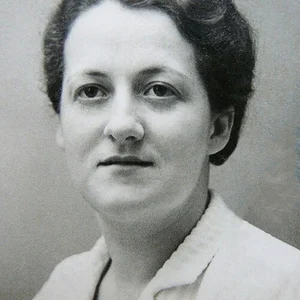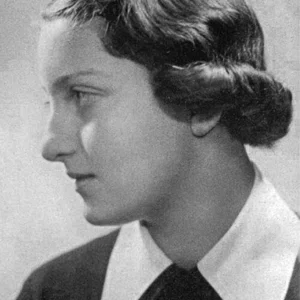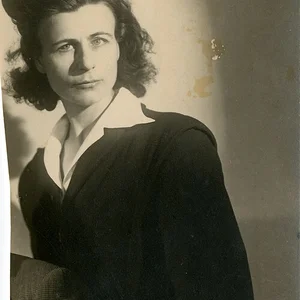

An Armenian resistance fighter who took refuge in France, she married Missak Manouchian, leader of the FTP-MOI network. After her husband's execution by the Nazis in February 1944 (the Red Poster affair), she dedicated her life to keeping alive the memory of the foreign resistance fighters who died for France.
Mélinée Manouchian(1913 — 1989)
Mélinée Manouchian
France, Empire ottoman, République socialiste soviétique d'Arménie
8 min read
Frequently asked questions
Key Facts
- 1913: born in Constantinople into an Armenian family
- 1915: survives the Armenian Genocide as a child
- 1930s: arrives in France as a political refugee
- 1942: marries Missak Manouchian, leader of the FTP-MOI network
- 21 February 1944: execution of Missak and 22 comrades by the Nazis — the Red Poster affair
- 1974: publishes Missak's letters and writings to preserve their memory
- 1989: dies in Paris
Works & Achievements
Mélinée's principal work, published by Éditeurs français réunis. She brings together letters, archival documents, and testimonies to reconstruct the life and struggle of her husband, providing the first comprehensive historical source on the Manouchian group.
Mélinée preserved and brought to public attention the letter written by Missak on the morning of his execution. By entrusting it to historians, publishers, and institutions, she turned it into one of the most widely reproduced and studied documents of the French Resistance.
For forty-five years, Mélinée spoke at commemorations, schools, and associations to bear witness to the sacrifice of foreign Resistance fighters. Her efforts contributed to the official recognition of immigrants' place in the French Resistance.
Mélinée provided testimonies and documents to several historians and authors working on the Main-d'Œuvre Immigrée (Immigrant Labour) in the Resistance, notably for the research of Stéphane Courtois and Adam Rayski on the PCF and Jewish Resistance.
Anecdotes
On February 21, 1944, a few hours before being shot at Fort Mont-Valérien, Missak Manouchian wrote Mélinée a farewell letter of rare beauty. He asked her “not to be unhappy” and concluded: “I die without hatred for the German people.” This letter is today one of the most moving documents of the French Resistance.
In February 1944, Mélinée discovered her husband's face on the Red Poster (Affiche rouge), a Nazi propaganda poster plastered across the walls of Paris to present foreign resistance fighters as “criminals” and “terrorists.” Far from achieving its goal, the poster had the opposite effect: many Parisians quietly laid flowers at the base of the display boards as a sign of respect.
After the Liberation, Mélinée refused to sink into silent mourning. She devoted the forty-five years remaining to her to winning recognition for the sacrifice of the foreign resistance fighters who had died for France, giving lectures, meeting secondary school students, and tirelessly passing on the memory of the Manouchian group across Europe.
In 1974, Mélinée published a biography of Missak, bringing together letters, testimonies, and archival documents. This meticulous work of remembrance allowed generations of historians and students to better understand the journey of the immigrants who had chosen to give their lives for their adopted country.
On February 21, 2024, exactly eighty years after Missak's execution, the ashes of Mélinée and Missak Manouchian were transferred to the Panthéon. Mélinée had died in 1989, but this joint enshrinement honored their shared commitment: two Armenian refugees became national symbols of the French Republic.
Primary Sources
My dear Mélinée, my little beloved orphan, in a few hours I will no longer be of this world. We are going to be shot this afternoon at 3 o'clock. […] I die with no hatred for the German people or for any people. At the moment of dying, I declare that I bear no grudge against the German people.
Liberators? Liberation by the army of crime. A poster presenting ten members of the Manouchian group described as "terrorists" and "bandits," with their names, origins, and alleged crimes.
This book is above all a testimony. I wanted those who read these pages to be able to hear Missak's voice, understand his thinking, feel his heart beating. He did not only fight for France; he fought for human dignity.
You had your portraits on the walls of our cities / Dark with beard and night, unkempt and threatening / The poster that looked like a bloodstain / Because your names are difficult to pronounce.
Key Places
City in present-day Turkey where Arpiné Assadourian (the future Mélinée) was born in 1913. Her Armenian family fled Ottoman persecution during the First World War, beginning a life of exile that would eventually bring Mélinée to France.
The place where Mélinée and Missak Manouchian lived, organized, and went underground. They were active in Armenian communist circles and the FTP-MOI, until Missak was arrested and Mélinée was forced into hiding.
The site where Missak Manouchian and twenty-one of his comrades were executed by firing squad on 21 February 1944. Today it is France's largest national memorial to the Occupation, where commemorative ceremonies are regularly held.
Missak Manouchian was buried here after his execution. Mélinée also rested here until both spouses were transferred to the Panthéon in 2024, reflecting her dedication to preserving the collective memory of the group.
In February 2024, eighty years after Missak's execution, the remains of both spouses were transferred here. Mélinée and Missak Manouchian thus became the first foreign Resistance fighters to be enshrined in the Panthéon.
Typical Objects

A falsified document allowing clandestine resistance fighters to move around under an assumed identity. For Mélinée and Missak, whose names and faces were known to the police, these forged papers were a matter of daily survival.

A sheet printed clandestinely, distributed at night or slipped under doors, calling for resistance against the Nazi occupier. The FTP-MOI network used these leaflets to inform and mobilize the immigrant working-class population of Paris.

A Nazi propaganda poster plastered on the walls of Paris in February 1944, presenting ten members of the Manouchian group as "foreign criminals." Intended to terrorize the population, this document paradoxically became a symbol of the sacrifice made by immigrants who died for France.

A farewell letter written by Missak to Mélinée on the morning of his execution, 21 February 1944. This intimate document, preserved and published by Mélinée, has become one of the most moving pieces in the archives of the French Resistance.

An indispensable tool for the clandestine production of resistance newspapers and leaflets. FTP-MOI militants used these machines, often hidden in back rooms or borrowed apartments, to type up bulletins and calls to action.

A small notebook in which resistance fighters recorded their contacts under pseudonyms or codes, to avoid compromising the network in the event of arrest. Missak was known by several different pseudonyms within the network.
School Curriculum
Vocabulary & Tags
Key Vocabulary
Tags
Daily Life
Morning
During the clandestine period (1943–1944), Mélinée wakes up early in a makeshift apartment, often lent by comrades. She listens to Radio London in secret and checks that nothing compromising is visible before going out.
Afternoon
She moves around Paris under a false identity, passing messages or printed materials between resistance cells. Each journey is carefully planned to avoid police checkpoints and the raids that regularly sweep through working-class neighborhoods.
Evening
The evening is devoted to clandestine meetings held in back rooms or private apartments. They prepare upcoming actions, share news of recent arrests, and reassure comrades whose loved ones have disappeared.
Food
Like all Parisians under the Occupation, Mélinée lives on ration tickets that severely restrict access to meat, bread, and sugar. Community meals in Armenian activist circles sometimes allow for the sharing of traditional dishes such as manti or borek, prepared with whatever scarce resources are available.
Clothing
Mélinée wears plain, inconspicuous clothes typical of Parisian working women, so as to blend in during her movements. No bright colors or noticeable accessories — the goal is absolute neutrality, to avoid drawing the attention of the special brigade's agents.
Housing
After Missak's arrest in November 1943, Mélinée regularly changes address to avoid being tracked down. She lives in borrowed lodgings, small and barely comfortable, carrying with her only the essentials and a few precious letters from Missak.
Historical Timeline
Period Vocabulary
Liens externes & ressources
Références
Œuvres
Missak Manouchian (biographie)
1974
Transmission de la lettre d'adieu de Missak
À partir de 1945
Engagement mémoriel auprès des associations de résistants
1944–1989
Contribution à l'ouvrage collectif sur le FTP-MOI
Années 1970-1980