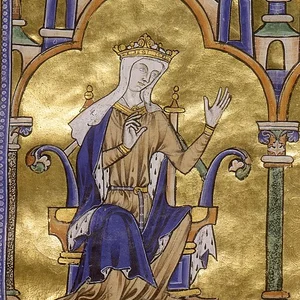

Queen of Jerusalem from 1131 to 1153, Melisende was one of the most powerful rulers of the Crusader States. She governed with authority, resisting attempts by her son Baldwin III to remove her from power.
Melisende of Jerusalem(1105 — 1161)
Melisende of Jerusalem
Royaume de Jérusalem
8 min read
Frequently asked questions
Key Facts
- Born in 1105, daughter of King Baldwin II of Jerusalem and an Armenian princess, Morphia of Edessa
- Married Fulk V of Anjou in 1129 and became co-queen of Jerusalem in 1131
- Ruled alone as regent upon Fulk's death in 1143, during Baldwin III's minority
- Resisted Baldwin III's attempt to remove her in 1152 and retained political influence until her death in 1161
- A patron of the arts, she commissioned the famous Melisende Psalter, a masterpiece of Crusader manuscript illumination
Works & Achievements
A masterpiece of Crusader illumination, commissioned by the queen and held at the British Library. Its 24 miniatures blending Byzantine and Romanesque styles, together with its carved ivory cover, make it a unique testament to the culture of the Latin States.
Melisende funded and oversaw the unification and enlargement of the Church of the Holy Sepulchre in Jerusalem, bringing all the shrines associated with the Passion of Christ under a single roof.
The queen endowed this convent generously to establish her sister Ioveta as abbess, making it a religious and educational center for women in the Latin Kingdom of the East.
Melisende had a covered market street built in Jerusalem, a testament to her urban planning initiatives and her determination to develop the economic prosperity of the capital.
Melisende signed numerous official acts granting privileges to religious and military orders, helping to give the Kingdom of Jerusalem a solid legal and institutional framework.
Anecdotes
In 1134, King Fulk I attempted to sideline Mélisende from government by associating her, without solid evidence, with the rebellion of Count Hugh II of Jaffa. Far from stepping aside, Mélisende rallied her supporters among the kingdom's barons and clergy. Fulk was forced to reconcile with her and to recognize her fully as co-ruler in her own right. This episode reveals the breadth of her alliance network and her determination to exercise power.
In 1143, Fulk died in an accident, thrown from his horse during a hunting party near Acre. Mélisende then assumed sole regency of the kingdom on behalf of her son **Baldwin III**, who was thirteen years old. She governed with such skill that even after Baldwin came of age, she refused to relinquish power. In 1152, the conflict escalated into armed confrontation, and Mélisende was ultimately forced to withdraw to her domain of Nablus.
Mélisende commissioned one of the most precious illuminated manuscripts of the Middle Ages: the **Melisende Psalter**, produced in Jerusalem between 1131 and 1143. This prayer book brilliantly blends Byzantine and Western Romanesque art, reflecting the unique cultural synthesis of the Crusader states. It is today held at the British Library in London and remains the masterpiece of Crusader illumination.
Mélisende funded and oversaw the reconstruction and enlargement of the Church of the Holy Sepulchre in Jerusalem, consecrated in 1149. She also had the convent of Bethany rebuilt, installing her younger sister Ioveta there as abbess. These two major religious building projects bear witness to her sincere piety and her desire to leave a lasting mark on the sacred landscape of the kingdom.
The daughter of an Armenian princess, Morphia of Melitene, Mélisende was equally at home in Eastern Christian traditions and Western feudal customs. She spoke several languages and skillfully negotiated with local princes, Byzantine envoys, and crusaders freshly arrived from Europe. This dual cultural heritage gave her a considerable diplomatic advantage in a kingdom that stood at the crossroads of civilizations.
Primary Sources
Melisende, a wise and prudent woman, worthy of remembrance by future generations, governed the kingdom with an energy and wisdom that far exceeded what was expected of a woman; she held the reins of government with remarkable firmness.
An illuminated manuscript commissioned by Queen Melisende, containing 24 full-page miniatures depicting biblical scenes, produced in Jerusalem by artists blending Byzantine and Western traditions, with a carved ivory cover.
Ego Melesindis, Dei gratia Hierusalem regina... — I, Melisende, by the grace of God Queen of Jerusalem, confirm the privileges granted to the brothers of the Hospital of Saint John for the salvation of my soul and my ancestors.
The covered market street, built at the queen's initiative, teems with merchants from every nation; it bears witness to the prosperity and wisdom of she who governs this holy city.
Key Places
Capital of the Latin Kingdom and the heart of Melisende's power. She lived there her entire life, governing from the royal palace near the Tower of David and funding the reconstruction of the Church of the Holy Sepulchre.
Melisende's personal domain, inherited from her mother. After her forced political retirement in 1152, she resided there and continued to exercise local influence until her death in 1161.
Melisende had this convent rebuilt and richly endowed in order to install her sister Ioveta as abbess. Located a few kilometres from Jerusalem, it became an important female spiritual and intellectual centre.
The Latin Kingdom's main port, where Fulk died in an accident in 1143. A city of trade and diplomatic exchange, it was one of the keys to the kingdom's economic power.
Melisende's burial place, in the Benedictine abbey beside the Tomb of the Virgin Mary. This choice of resting place, at the heart of the Holy Sites, speaks to her deep piety.
Liens externes & ressources
Références
Œuvres
Psautier de Mélisende
v. 1131-1143
Reconstruction de l'église du Saint-Sépulcre
Consacrée en 1149
Reconstruction du couvent de Béthanie
v. 1138
Marché couvert de Jérusalem (Rue de la Reine)
v. 1140
Chartes royales et actes de gouvernement
1131-1152