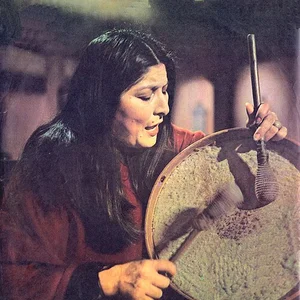

Nicknamed “La Negra,” Mercedes Sosa (1935–2009) was one of the greatest voices in Latin America. An iconic figure of the Nueva Canción movement, she channeled through her music the struggle for social justice and the dignity of oppressed peoples.
Mercedes Sosa(1935 — 2009)
Mercedes Sosa
Argentine
8 min read
Frequently asked questions
Famous Quotes
« I don’t sing for the love of singing, or because I have a beautiful voice. I sing because the guitar has sense and reason.»
« Cambio, todo cambia.»
Key Facts
- Born on July 9, 1935, in San Miguel de Tucumán, Argentina
- Co-founder of the Nueva Canción movement, committed to the cause from the 1960s onward
- Forced into exile in 1979 under the Argentine military dictatorship
- Triumphant return to Argentina in 1982, with memorable concerts at the Teatro Ópera in Buenos Aires
- Died on October 4, 2009, in Buenos Aires, mourned across all of Latin America
Works & Achievements
Mercedes Sosa's first major album, establishing her as an essential voice in Argentine folklore with works by Atahualpa Yupanqui. It laid the foundation for her politically committed repertoire.
A poetic album set to texts by Félix Luna and music by Ariel Ramírez, paying tribute to the women who shaped Argentina's history. A pioneering work of Argentine cultural feminism.
An album dedicated to the great Chilean singer Violeta Parra, whose "Gracias a la vida" would become one of Mercedes Sosa's most celebrated and iconic interpretations.
A live album recorded during her return-from-exile concerts at the Teatro Opera in Buenos Aires. A historic document of rare collective emotion, considered her most important work.
An album of democratic reconquest, recorded after Argentina's return to democracy. The title expresses hope for a continent freed from military dictatorships.
A double album of duets with artists from various generations (Shakira, Caetano Veloso, Joan Manuel Serrat, Gustavo Cerati…). Mercedes Sosa's artistic testament, released just weeks before her death.
Anecdotes
In 1979, during a concert in La Plata, military police stormed the stage and arrested Mercedes Sosa along with the entire audience — roughly two hundred people — on charges of subversive activities. After several hours in detention, they were released, but this traumatic episode convinced the singer to go into exile. She settled first in Paris, then in Madrid, continuing to sing for Latin American communities in Europe.
In October 1982, after three years in exile, Mercedes Sosa returned to Argentina and gave a series of concerts at the Teatro Opera in Buenos Aires. Tickets sold out within hours and thousands of people queued for days. On the first night, many in the audience wept: the voice of their resistance had finally come home.
Born into a working-class family in San Miguel de Tucumán, Mercedes Sosa got her start by winning a radio singing contest at the age of fifteen in 1950, under the pseudonym “Gladys Osorio” — she was too young to enter officially. This first prize opened the doors of local radio stations and launched a career that would span more than half a century.
In 2009, just a few months before her death, she recorded “Cantora,” a double album of duets with artists as diverse as Shakira, Caetano Veloso, Fito Páez, Joan Manuel Serrat, and Gustavo Cerati. The album became her artistic testament and proved that her voice, undiminished despite illness, continued to bring together generations and musical genres around a shared ideal.
When Mercedes Sosa died on October 4, 2009, the Argentine government declared three days of national mourning. Thousands of people filed past her body for hours as it lay in state at the National Congress in Buenos Aires — a rare honor typically reserved for heads of state, here granted to a popular artist who had risen from nothing.
Primary Sources
"Coming back is also a form of struggle. This concert belongs to all those who stayed and to all those who had to leave."
"Exile did not kill me, but it taught me that the homeland is not just the soil — it is above all the people one carries within."
"I sing because singing has meaning when there are people who need it. Art is not a luxury: it is a necessity of the collective soul."
"I do not consider myself a political singer. I am an artist who sings the reality of her people, and that reality, in our América, has always been harsh."
Key Places
Mercedes Sosa's birthplace, in the northwest of Argentina. It was here that she grew up in a working-class family and discovered her calling by winning a radio contest at the age of 15.
The capital where Mercedes Sosa settled to build her national and international career. She spent most of her adult life there, between periods of intense work and years of forced exile.
The legendary venue where Mercedes Sosa gave her comeback concerts in 1982 after returning from exile — events that became historic in Argentine cultural memory, recorded on the album *Mercedes Sosa en Argentina*.
The city where, in 1979, Mercedes Sosa was arrested mid-concert by the military dictatorship's police. This event forced her into exile and marked a turning point in her political commitment.
The first stop of her exile from 1979 onward. In Paris, she found a supportive Latin American community and continued to perform, bearing witness to the atrocities of the Argentine dictatorship.
Her second city of exile, where she lived for several years and recorded albums. Madrid became a meeting point for Latin American artists driven out by the region's military dictatorships.
Typical Objects
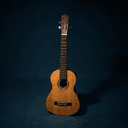
The classical acoustic guitar is the inseparable instrument of Mercedes Sosa at her concerts. Even when accompanied by orchestras, the guitarra criolla remained the symbol of her connection to Argentina's popular musical traditions.

This large drum made of wood and goat skin, typical of northwestern Argentina, often accompanied her concerts and evoked the Andean and folk roots of her music.
📷 CC BY-SA 4.0 · Wikimedia Commons ↗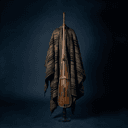
Mercedes Sosa regularly wore ponchos with Andean patterns on stage, asserting her mixed cultural identity and her solidarity with the indigenous peoples of South America.

During her exile, bootleg cassettes of her concerts circulated secretly throughout Argentina, becoming precious objects of cultural resistance for those who remained under the dictatorship.

This traditional Argentine drink prepared in a gourd was a daily ritual for Mercedes Sosa — a symbol of her Tucumán roots and her bond with popular culture.

The central tool of her art, the microphone was for her as much a political instrument as an artistic one: she held that every concert was an act of resistance and communion with her people.
School Curriculum
Vocabulary & Tags
Key Vocabulary
Tags
Daily Life
Morning
Mercedes Sosa began her days with a traditional mate prepared according to the customs of Tucumán, reading the press or listening to music. Her mornings were devoted to correspondence and vocal exercises, often alongside a guitarist who had accompanied her for years.
Afternoon
Afternoons were given over to intensive rehearsals, interviews with journalists and activists, and studio recording sessions. She was known for her musical exacting standards and would meticulously re-read song lyrics, always searching for the depth of the words before interpreting them.
Evening
On concert nights, she arrived backstage at least two hours early, withdrawing to prepare herself vocally and mentally. When there was no concert, evenings often became late-night gatherings with fellow artists and intellectuals, gathered around an asado, discussing politics and culture into the small hours.
Food
Mercedes Sosa's diet followed the traditional cuisine of Tucumán and of the working people: oven-baked empanadas, locro (a corn and meat stew), and Sunday asado with friends. Mate was a constant presence from morning to night, brewed bitter in the style of northern Argentina.
Clothing
On stage, she often wore flowing dresses in vivid colors or embroidered Andean ponchos, asserting her mixed-heritage identity. In everyday life, she preferred simple, comfortable clothes with no particular concern for elegance, staying true to her modest origins.
Housing
For many years she lived in an apartment in the Palermo neighborhood of Buenos Aires, simply furnished but filled with books, instruments, and records. During exile, she stayed in apartments lent by friends in Paris and Madrid, living modestly thanks to the solidarity of the international artistic community.