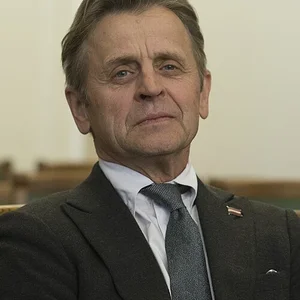

Dancer and choreographer of Latvian origin, considered one of the greatest classical dancers of the 20th century. Trained at the Vaganova school in Leningrad, he defected to the West in 1974 and became a major figure in American ballet, before turning to contemporary dance, theater, and film.
Mikhail Baryshnikov(1948 — ?)
Mikhail Baryshnikov
États-Unis, Lettonie, Union soviétique
6 min read
Frequently asked questions
Famous Quotes
« I do not try to dance better than anyone else. I only try to dance better than myself.»
Key Facts
- Born in 1948 in Riga, in Soviet Latvia, he trained at the prestigious Vaganova school in Leningrad
- Became a principal dancer at the Kirov Theatre (Mariinsky) in the early 1970s
- Defected to the West during a tour in Canada in June 1974
- Danced for and then led the American Ballet Theatre (artistic director from 1980 to 1989)
- Nominated for an Oscar for his role in the film The Turning Point (1977)
Works & Achievements
A classical interpretation that reveals his flawless technique and deep emotion; one of his signature roles at American Ballet Theatre.
A virtuoso role in which his spectacular leaps dazzle audiences; he also makes a very famous filmed version of it.
A film that earns him an Academy Award nomination and introduces him to the wider American public.
A widely broadcast television recording that introduces classical ballet to millions of viewers.
A contemporary dance company co-founded with Mark Morris, marking his move from classical ballet to modern creation.
A television appearance that extends his acting career and confirms his place in popular culture.
A major achievement off the stage: a New York venue dedicated to artistic creation and support for artists.
Anecdotes
In June 1974, during a Bolshoi tour in Canada, Baryshnikov gave his Soviet minders the slip as he left a performance in Toronto. He ran across the parking lot, jumped into a waiting car and requested political asylum: at 26, he had just left the USSR for good.
His small stature (about 1.70 m / 5'7") could have kept him out of classical ballet, but his extraordinary elevation let him leap so high and so far that he seemed to hang in the air. Critics spoke of a dancer who defied gravity.
In 1977, he earned an Academy Award nomination for his role in the film *The Turning Point*, in which he plays a seductive dancer: a rare Hollywood recognition for an artist who came from the world of ballet.
In the 1980s, he became an icon of American popular culture by playing the Russian painter Aleksandr in the television series *Sex and the City*, proving he could move from the classical stage to mainstream screens.
Born in Riga, in what was then Soviet Latvia, Baryshnikov was never able to return there while the USSR still existed. Marked by his own exile, he long supported causes promoting artistic freedom and human rights.
Primary Sources
“I wanted to dance what I wanted to dance, the way I wanted to.” Baryshnikov explains that his departure was first and foremost about the freedom to create and to explore new repertoires.
A collection in which Baryshnikov comments on his classical roles and his understanding of a dancer's craft, presenting his interpretations of *Giselle*, *Swan Lake* and *Don Quixote*.
Here Baryshnikov describes his desire, together with Mark Morris, to found a company devoted to American contemporary dance rather than to classical ballet alone.
Key Places
Baryshnikov's birthplace, then the capital of the Latvian Soviet Socialist Republic. He spent his childhood here before leaving to study dance.
The famous school that trains dancers in the Russian tradition. Baryshnikov learned there the rigorous technique that would make his name.
The great stage where Baryshnikov began his professional career with the Kirov Ballet before his defection.
The city where, in 1974, Baryshnikov slipped away from his Soviet minders to seek asylum in the West during a tour.
The company he joined as a principal dancer in 1974, then directed from 1980 to 1989. The heart of his American career.
The arts creation center he founded in 2005 in Manhattan to support dancers and performing artists.
Typical Objects

Soft leather or canvas shoes that let the dancer feel the floor while gliding and jumping. The basic tool of the male classical dancer.

A close-fitting outfit that hugs the body to reveal the line and movement of the muscles. It lets the audience see every bit of precision in the dancer's gestures.

A long horizontal bar fixed to the wall that dancers lean on for their daily warm-up exercises. A symbol of the discipline of ballet.

A white powder that dancers rub under their shoes to keep from slipping on stage. A small, invisible but essential gesture before stepping into the spotlight.

A stage costume from the great Romantic ballets, like that of Prince Albrecht in Giselle, one of Baryshnikov's signature roles.

Documents at the heart of his life: his 1974 defection left him a man without a Soviet passport, who obtained asylum and then American citizenship in 1986.
School Curriculum
Vocabulary & Tags
Key Vocabulary
Tags
Daily Life
Morning
An elite dancer's day begins early with a long warm-up and a technique class at the barre, repeated every morning without exception. The body must be loosened up muscle by muscle before any exertion.
Afternoon
The afternoon is devoted to rehearsing the ballets: the same passages are run through dozens of times to achieve perfection. Baryshnikov, demanding as he was, also worked on new roles with choreographers and partners.
Evening
In the evening comes the performance before the audience, sometimes followed by receptions or meetings with other artists. Recovery for the exhausted body is essential before the next day.
Food
A dancer watches their diet to stay light and have stamina: balanced meals, rich in energy but without excess. Hydration and quick snacks between rehearsals are indispensable.
Clothing
In training, he wears tights, a leotard and soft slippers; on stage, costumes that are sometimes lavish depending on the ballet. Around town, in the New York of the 1970s and 80s, he adopts a relaxed elegance.
Housing
After his defection, he lives in New York, the world capital of performing arts, in homes close to the great theaters. His private life remains discreet despite his international fame.
Historical Timeline
Period Vocabulary
Liens externes & ressources
Références
Œuvres
Giselle (rôle d'Albrecht)
années 1970
Casse-Noisette (version filmée)
1977
White Oak Dance Project
1990
Rôle d'Aleksandr Petrovsky dans Sex and the City
2003-2004
Baryshnikov Arts Center
2005