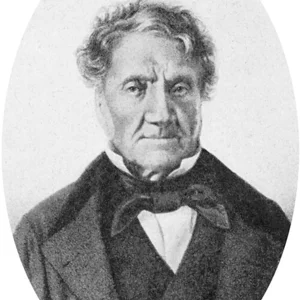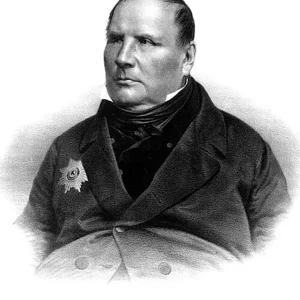

Russian mathematician and physicist (of Ukrainian origin), a major figure of the Saint Petersburg mathematical school. He is known for his work in mathematical analysis, mechanics, and mathematical physics, notably the divergence theorem.
Mikhail Ostrogradsky(1801 — 1862)
Mikhail Ostrogradsky
Empire russe
5 min read
Frequently asked questions
Key Facts
- Born in 1801 in Pashenna (Russian Empire, present-day Ukraine)
- Studies in Paris in the 1820s, where he mixes with Cauchy, Laplace, Fourier, and Poisson
- Formulates the divergence theorem (Ostrogradsky-Gauss theorem) in 1826, linking volume integrals and surface integrals
- Elected to the Saint Petersburg Academy of Sciences in 1830
- Died in 1862 in Poltava
Works & Achievements
A fundamental result linking the integral of the divergence of a field within a volume to the flux through the surface that encloses it; a cornerstone of vector calculus and mathematical physics.
A work in which he established and applied his formula for transforming integrals, building on Fourier's research.
An extension of the calculus of variations to multiple integrals, carrying forward the methods of Euler and Lagrange.
Contributions to rational mechanics, including the Ostrogradsky–Hamilton principle and formula connected to the principle of least action.
An algebraic method for isolating the rational part of the integral of a rational function, still taught today.
The organization and modernization of training in mathematics and mechanics at the engineering and artillery schools of the Russian Empire.
Anecdotes
As a young boy, Ostrogradski dreamed of becoming a military officer and had little interest in his studies. It was only after his father enrolled him at the University of Kharkiv that he discovered his passion for mathematics, to the point of devoting his entire life to it.
In 1822, he left to study in Paris, then the world capital of mathematics, where he attended the lectures of giants such as Cauchy, Laplace, Fourier and Poisson. Cauchy himself took notice of him and cited his work, which was an immense honour for a young foreigner.
Ostrogradski refused to sit a compulsory theology examination at Kharkiv, which led to his degree being denied. He then left Russia for Paris without the university qualification he nonetheless deserved.
In Saint Petersburg, he became a genuine scientific celebrity: it is said that one mother, wanting to motivate her lazy son, would threaten him by saying “You will never be like Ostrogradski!” His name had become synonymous with mathematical genius in Russia.
The famous writer Leo Tolstoy, then a student, attended some of his lessons. Ostrogradski was a renowned professor who trained a whole generation of Russian mathematicians and military engineers.
Primary Sources
The memoir establishes, by transforming a volume integral into a surface integral, a fundamental relationship between the flux of a field through a closed surface and its divergence within the volume that the surface bounds.
In it, Ostrogradsky generalizes the methods of the calculus of variations to multiple integrals, extending the work of Euler and Lagrange.
The lectures set out the principles of rational mechanics applied to the training of the Empire's military engineers.
Key Places
Village in Ukraine where Ostrogradski was born in 1801, into a family of minor landed gentry.
Institution where he completed his first higher studies and discovered his mathematical calling.
World capital of mathematics, where he studied under Cauchy, Laplace, Fourier and Poisson from 1822 to 1828.
Imperial capital where he served as an academician and professor, training generations of Russian engineers and mathematicians.
City in Ukraine where he died in 1862, near the region of his birth.
Typical Objects

Essential writing instrument for composing proofs, papers and scientific correspondence in the 19th century.

The central teaching tool of his lectures in Saint Petersburg, where he worked out equations and theorems in front of his students.

Reference works, notably those of Lagrange, that fed his research and his teaching of mathematical physics.

The format for publishing discoveries in the proceedings of the Imperial Academy of Sciences in Saint Petersburg.

The official dress he wore as a teacher in the engineering and artillery schools of the Russian imperial army.

Geometry tools used for diagrams, technical drawings and teaching mechanics to future engineers.
School Curriculum
Vocabulary & Tags
Key Vocabulary
Daily Life
Morning
An academician and professor, Ostrogradsky often began his day by preparing his lectures and writing up his research. Mornings were devoted to intellectual work, pen in hand, in the calm of his Saint Petersburg study.
Afternoon
In the afternoon, he gave his lessons at the military and engineering schools of Saint Petersburg, before lecture halls full of students. Renowned for his lively teaching, he worked out theorems and proofs at the blackboard.
Evening
In the evening, he took part in the sessions of the Imperial Academy of Sciences or exchanged ideas with his fellow scholars. He also kept up his correspondence with European mathematicians, staying connected to the scientific debates of Paris and beyond.
Food
His diet was that of the nineteenth-century Russian urban middle class: soups such as borscht and shchi, rye bread, kasha (a porridge of grains), fish and meats. Tea, served from the samovar, set the rhythm of the day.
Clothing
He wore the dark coat and frock coat of the scientists and professors of his time, as well as the official uniform of teachers at the imperial military institutions when carrying out his duties.
Housing
He lived in Saint Petersburg, an imperial capital of broad avenues and neoclassical buildings, in the home of an educated city dweller near the academic and military institutions where he taught.
Historical Timeline
Period Vocabulary
Liens externes & ressources
Références
Œuvres
Théorème de la divergence (théorème d'Ostrogradski-Gauss)
1826
Mémoire sur la propagation de la chaleur
1826
Mémoire sur le calcul des variations des intégrales multiples
1834
Travaux sur la mécanique analytique et la dynamique
années 1830-1850
Recherches sur l'intégration des fonctions rationnelles (méthode d'Ostrogradski)
1845
Réforme de l'enseignement mathématique militaire
1840-1860