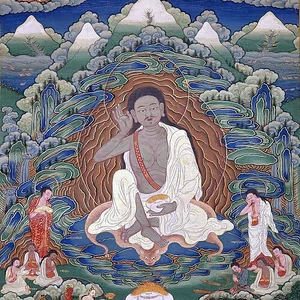

Milarepa was a Tibetan yogi, hermit, and poet of the 11th–12th centuries, a major figure of the Kagyu school of Tibetan Buddhism. After a youth marked by black magic and revenge, he became the disciple of the master Marpa and attained enlightenment through asceticism and meditation. His spiritual songs (the “Hundred Thousand Songs”) remain famous.
Milarepa(1040 — 1123)
Milarepa
http://www.wikidata.org/.well-known/genid/af748ec857bc9b294c2231cd8f6186fa
6 min read
Frequently asked questions
Key Facts
- Born around 1052 in the province of Gungthang, in Tibet, into a family ruined after the death of his father
- First practiced black magic to avenge his despoiled family, before turning to Buddhism
- Became the disciple of the translator Marpa, who put him through harsh trials before passing on his teachings
- Led the life of an ascetic hermit in the caves of the Himalayas, famous for having fed himself on nettles
- Died around 1135, regarded as one of the spiritual founders of the Kagyu school
Works & Achievements
A collection of improvised spiritual songs, jewels of Tibetan poetry, that convey Buddhist teaching in a living and accessible form.
Milarepa passed on to Gampopa the teachings he had received from Marpa, ensuring the continuity of one of the great schools of Tibetan Buddhism.
A yogic practice for generating bodily heat through meditation, of which Milarepa became the legendary model by surviving naked in the snow.
Transmission of the advanced meditation techniques inherited from India through Marpa, at the heart of Kagyü practice.
Through his journey, Milarepa embodies the idea that even a great sinner can attain enlightenment within a single lifetime through effort and devotion.
Anecdotes
In his youth, after his father's death, Milarepa and his mother were stripped of their inheritance by a greedy uncle and aunt. To take revenge, his mother sent him to learn sorcery: it is said that he triggered the collapse of a house, killing many guests at a wedding, then a hailstorm that devastated the crops.
Tormented by remorse for having killed through black magic, Milarepa sought out a master to purify himself. His master Marpa subjected him to ordeals of extreme harshness: he ordered him to build several stone towers alone and with his bare hands, then to demolish them and start all over again, until his back was covered in sores.
To meditate, Milarepa withdrew for years into the freezing caves of the Himalayas, feeding only on nettles. Tradition tells that his skin took on a greenish tint from this diet, and that he survived almost naked despite the cold thanks to the *tummo* (inner heat) mastered through meditation.
Milarepa taught through song rather than through lengthy treatises. His spontaneous poems, improvised in answer to his disciples' questions, were gathered under the title of the “Hundred Thousand Songs” and remain among the best-loved texts of Tibetan Buddhism.
According to tradition, Milarepa died poisoned by a scholar jealous of his renown. On learning of the deed, the yogi is said to have forgiven his murderer and accepted his fate with serenity, turning his death into a final teaching on compassion.
Primary Sources
An account of his youth, his practice of black magic, the ordeals imposed on him by Marpa, and his awakening through asceticism, written in the 15th century from oral traditions.
A collection of the spiritual songs improvised by Milarepa to instruct his disciples, blending teaching, narrative, and poetry.
“My home is the cave of the deserted mountains, my clothing is a simple cotton cloth, my food is the nettles of solitude: thus I attain awakening.”
Key Places
Village on the highlands of western Tibet, near the Nepalese border, where Milarepa is said to have been born and to have spent his childhood.
A place in southern Tibet where Marpa the Translator lived, and where Milarepa underwent the trials of his spiritual training.
A stone tower that Milarepa was made to build for Marpa; today a shrine and place of pilgrimage in the Lhodrak valley.
High, snow-covered hermitages on the border of Tibet and Nepal, among the sites where Milarepa meditated in seclusion for years.
A famous hermitage where Milarepa undertook long retreats, living on nettles; a major Kagyü pilgrimage site.
According to tradition, the place of his final years and death, in the border region of southern Tibet.
Typical Objects

A simple piece of cotton worn even high in the mountains, whose name “repa” (cotton-clad) is the origin of Milarepa's nickname. It symbolizes renunciation and the mastery of inner heat (tummo).

A wild plant that made up almost his only food during his retreats in caves. Tradition holds that this diet tinged his skin green.

A rocky shelter in the high Himalayan valleys where Milarepa practised retreats lasting several years. It embodies the solitude conducive to awakening.

A characteristic gesture of Milarepa, depicted with his right hand raised near his ear to listen or to intone his spiritual songs.

A multi-storey tower that Marpa ordered Milarepa to build and tear down several times in order to purify his karma. The building has become a place of pilgrimage.

The wandering yogi's modest gear: a walking staff and a bowl for food, signs of his itinerant and stripped-down life.
School Curriculum
Vocabulary & Tags
Key Vocabulary
Daily Life
Morning
Before dawn, Milarepa would sit in meditation in the cold of his cave, practicing *tummo* to warm his body. He devoted the first hours to concentration and inner recitation.
Afternoon
The day was spent in prolonged meditation, broken up by gathering nettles and a little water. He sometimes received disciples or villagers who came to hear him sing.
Evening
In the evening, Milarepa would improvise his spiritual songs to answer his students' questions or to express his realizations. Then he would return to meditation until late into the night.
Food
His diet was extremely frugal: essentially a soup of boiled nettles, without salt or fat, during his long retreats. Tradition holds that this regimen gave his skin a greenish color.
Clothing
He wore only a simple white cotton robe, the *repa*, even high in the snowy mountains, thanks to the inner heat he had mastered.
Housing
He lived in bare, isolated caves in the high Himalayan ranges, without furniture or comfort, choosing the harshest solitude to foster meditation.
Historical Timeline
Period Vocabulary
Liens externes & ressources
Références
Œuvres
Les Cent mille chants (Gourboum)
XIe-XIIe siècle (compilé au XVe)
Transmission de la lignée Kagyü
vers 1110
Maîtrise du toumo (chaleur intérieure)
vers 1080-1110
Enseignement du Mahamoudra et des Six Yogas de Naropa
XIe-XIIe siècle
Modèle de l'éveil en une seule vie
XIe-XIIe siècle