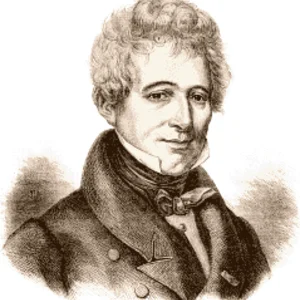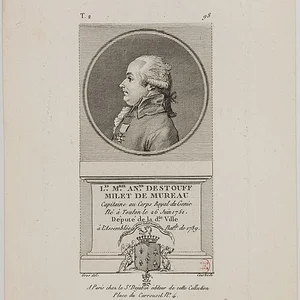

Milet-Mureau (1750-1825) was a French general and writer, best known for editing and publishing the account of Lapérouse's voyage after the explorer's disappearance. His editorial work preserved the geographical legacy of the expedition for posterity.
Milet-Mureau
Louis-Marie Despéroux, known as Milet-Mureau
8 min read
Frequently asked questions
Key Facts
- Born in 1750, Milet-Mureau served as a divisional general and member of the legislative body during the Revolution
- In 1797, he published the 'Voyage de Lapérouse autour du monde' in 4 volumes, compiling the journals and notes of the expedition that disappeared in 1788
- His edition of Lapérouse's voyage remains the primary source on the expedition, whose ships sank near Vanikoro
- The work includes atlases of maps and naturalist plates, the fruit of the expedition's scientific labor
- His editorial achievement was praised by the scholarly community and enhanced the reputation of French geography
Works & Achievements
A monumental four-volume editorial work accompanied by an atlas, published by the Imprimerie de la République based on the expedition's journals and notes. Quickly translated into several languages, this work stands as Milet-Mureau's chief contribution to geographical science and to French collective memory.
Over several years, Milet-Mureau gathered, cross-referenced, and organized the letters, logbooks, and scientific observations sent by Lapérouse from various ports of call — a considerable work of philological and documentary scholarship aimed at reconstructing a coherent narrative from scattered fragments.
Anecdotes
When news of Lapérouse's disappearance spread through France, his logbooks and scientific letters had fortunately been dispatched from several ports before the shipwreck. The National Convention then entrusted Milet-Mureau with the weighty task of gathering these scattered documents so that the explorer's work would not be lost forever. This painstaking labor took several years before culminating in the 1797 publication.
Milet-Mureau faced an unprecedented editorial challenge: reconstructing a coherent narrative from logbooks written by several different officers, letters sent from stopovers scattered to the four corners of the globe, and incomplete scientific observations. The result, published in four volumes accompanied by an atlas of maps and engraved plates, was immediately hailed as a monument of French geography.
A trained artillery officer, Milet-Mureau had never sailed the Pacific nor taken part in an expedition of exploration. Yet it was he — a man of the study and the pen as much as of the sword — whom the Republic chose to pass on Lapérouse's legacy to posterity, proving that military rigor and philological care could go hand in hand.
The account published by Milet-Mureau was swiftly translated into English, German, and several other languages, ensuring the expedition's discoveries reached an international audience. Valuable information about the coasts of the North Pacific, Japan, and Oceania thus became accessible to the global scientific community, making this officer-editor a bridge of knowledge between two centuries.
Primary Sources
Compiled and published by order of the National Assembly, the four-volume work presents the nautical, geographical, and ethnographic observations of the expedition. In his preface, Milet-Mureau explains that he gathered the journals sent from Kamchatka and Botany Bay, and paid tribute to the officers who perished.
The editor describes the difficulties encountered in reconstructing the narrative from incomplete and sometimes redundant documents, and explains the editorial choices made to remain faithful to the original authors' accounts while offering an accessible read.
The National Assembly officially ordered the publication of the Lapérouse expedition's documents, recognizing their scientific and national value. This decree forms the legal foundation for Milet-Mureau's editorial work.
A collection of cartographic plates and engraved illustrations accompanying the four volumes of the narrative, depicting the coastlines explored, the peoples encountered, and the species observed. Milet-Mureau oversaw the production of this atlas, which allowed the geographers of the era to visualize the expedition's discoveries.
Key Places
The city where Milet-Mureau spent years editing the journals of Lapérouse and pursued his military and administrative career throughout the Revolution. He died there in 1825.
Milet-Mureau's birthplace (1750), a major Mediterranean naval port where he was born and introduced from childhood to the realities of the French navy and army.
The Breton port from which Lapérouse's two frigates set sail on 1 August 1785. This symbolic starting point of the expedition is intimately bound up with the work Milet-Mureau was entrusted to publish and preserve.
A South Pacific island where Lapérouse's ships were wrecked, discovered in 1827. This site forms the tragic epilogue to the expedition whose account Milet-Mureau had published, revealing the fate of the men whose memory he had worked to preserve.
Typical Objects

Notebooks kept by the officers of the Lapérouse expedition, which Milet-Mureau received, organized, and edited over several years. Filled with nautical and scientific observations, these documents were the essential raw material for his editorial work.

A collection of maps and engraved plates depicting the coastlines explored by Lapérouse, overseen by Milet-Mureau to accompany the four volumes of the narrative. It allowed European geographers to visualize and build upon the expedition's discoveries.

The everyday tools of any man of letters at the end of the 18th century. Milet-Mureau used them to write his annotations, his preface, and the voluminous administrative correspondence tied to the publication.

Although he never sailed himself, Milet-Mureau had to understand and describe these astronomical measuring instruments in order to faithfully convey the observations of Lapérouse's officers — the very heart of the scientific narrative.

Printed sheets that Milet-Mureau proofread and corrected before the definitive 1797 publication, bearing witness to the care lavished on the final presentation of a work intended for posterity.

The regulation military dress coat — blue with red facings and embroidery — that Milet-Mureau wore as a general officer, a reminder that this gifted editor was first and foremost a career soldier trained under the *Ancien Régime*.
School Curriculum
Vocabulary & Tags
Key Vocabulary
Tags
Daily Life
Morning
Milet-Mureau began his day early, true to the military discipline he had acquired in the royal artillery. During the years he spent editing Lapérouse's journals, his mornings were devoted to reading and sorting manuscripts, comparing different versions of documents sent by the expedition's officers from their distant ports of call.
Afternoon
His afternoons were often divided between administrative meetings required by his military post and working sessions with the cartographers and engravers tasked with preparing the atlas. Under the Directory, Parisian life was gradually returning to activity, and learned circles such as the Société de géographie were beginning to stir around the great questions of exploration.
Evening
In the evening, by candlelight, Milet-Mureau wrote his annotations and refined his preface, choosing each word carefully to do justice to the men who had perished. The Parisian salons of the late eighteenth century were also places of exchange where geographical news circulated and the great expeditions of the age were debated.
Food
Like the officers and men of letters of his rank, Milet-Mureau ate according to the bourgeois habits of the late eighteenth century: thick soups, brown or white bread depending on availability, seasonal vegetables, roasted meats, and provincial wines. The Revolution had sometimes made these meals more frugal, but senior officers still maintained a respectable table.
Clothing
As a general, Milet-Mureau wore the regulation military uniform: a blue coat with red facings and gold embroidery under the Revolution, then the more imposing dress of a Napoleonic imperial general, with bicorne hat, gold epaulettes, and decorations. During his editorial work, he likely wore more comfortable civilian attire.
Housing
Milet-Mureau lived in Paris in an apartment or townhouse befitting a senior officer and high-ranking official. His study, cluttered with manuscripts, unfolded maps, and volumes of geography, reflected his dual role as a military man and man of letters in the service of national memory.
Historical Timeline
Period Vocabulary
Liens externes & ressources
Références
Œuvres
Voyage de La Pérouse autour du monde (édition et publication)
1797
Travaux d'édition, d'annotation et de classement des documents de l'expédition Lapérouse
1794-1797