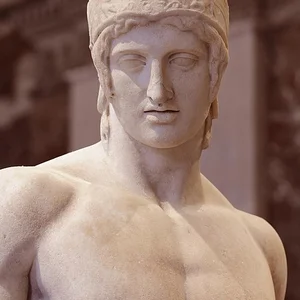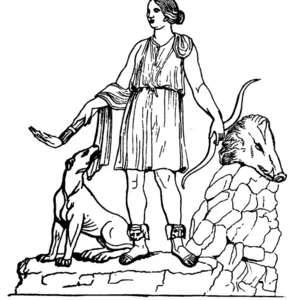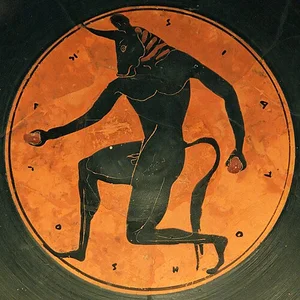

A monstrous creature of Greek mythology, half-man and half-bull, born from the unnatural union of Pasiphae and a bull sent by Poseidon. Imprisoned in the Labyrinth of Crete by King Minos, he was ultimately slain by the hero Theseus.
Minotaur
Minotaur
8 min read
Frequently asked questions
Key Facts
- Born from the union of Pasiphae, wife of King Minos of Crete, and a white bull sent by Poseidon
- Imprisoned in the Labyrinth designed by Daedalus on Minos's orders to keep him hidden
- Fed each year (or every nine years) seven young men and seven young women sent as tribute by Athens
- Slain by the Athenian hero Theseus, who escaped the Labyrinth using Ariadne's thread
- His true name was said to be Asterius or Asterion; 'Minotaur' means 'bull of Minos'
Works & Achievements
The most complete Greek mythographic account of the birth and death of the Minotaur, and the primary reference source for the entire Cretan myth cycle.
A Latin poetic narrative describing Daedalus's construction of the Labyrinth and the episode of Theseus and Ariadne, linked to the flight of Daedalus and Icarus.
A mytho-historical biography of the hero Theseus, describing in detail the Athenian tribute, Ariadne's role, and the death of the Minotaur in the Labyrinth.
A series of etchings in which Picasso uses the Minotaur as his alter ego, exploring violence, sensuality, and the duality of human nature through this mythological figure.
A short story retelling the myth from the Minotaur's own perspective, presenting him as a solitary, misunderstood creature awaiting his liberator. Widely studied in secondary school curricula.
Anecdotes
The name "Minotaur" comes from the Greek Minotauros, literally meaning "bull of Minos." His true name, according to some mythographers such as Apollodorus, was Asterion, meaning "the starry one." This duality of names reflects the creature's dual nature: at once the illegitimate son of a king and a monster condemned to exist without a true identity.
To allow Pasiphae to mate with the white bull sent by Poseidon, the craftsman Daedalus built a hollow wooden cow covered in real cowhide. This episode, recounted by Apollodorus and Ovid, illustrates how divine wrath could compel mortals to unnatural acts — indirectly punishing King Minos, who had refused to sacrifice the animal.
Athens was required to send — every nine years in some versions, every year in others — a tribute of seven young men and seven young women to be devoured by the Minotaur. This humiliating tribute was a constant reminder to the Athenians of their military defeat at the hands of King Minos, who had demanded this reparation following the death of his son Androgeos in Athens.
It was thanks to Ariadne, daughter of King Minos, that Theseus managed to defeat the Minotaur. Smitten with the Athenian hero, she gave him a ball of thread, which he unrolled at the entrance to the Labyrinth. After slaying the Minotaur, Theseus was able to find his way out by following this thread — since known as "Ariadne's thread," an expression still used today to describe whatever guides us through a complex situation.
The discovery in 1900 by British archaeologist Arthur Evans of the Palace of Knossos in Crete renewed scholarly interest in the myth. This vast palace, with its labyrinthine corridors and frescoes depicting bulls and bull-leaping acrobatics, convinced many historians that it lay at the origin of the myth of the Labyrinth and the Minotaur.
Primary Sources
Pasiphae fell in love with the bull and asked Daedalus to help her. He built a hollow wooden cow [...] Pasiphae climbed inside, and the bull coupled with her. She gave birth to Asterius, who is called the Minotaur, who had the head of a bull and the body of a man.
Theseus volunteered to join the young people destined for the tribute [...] Ariadne, having fallen in love with him, gave him a thread which he tied at the entrance to the Labyrinth and unwound as he advanced. Having found the Minotaur at the heart of the Labyrinth, he slew it with his bare hands.
There, in this palace of darkness and shame, Minos resolved to conceal this disgrace and to shut the two-formed monster away within a blind and impenetrable edifice. Daedalus, a craftsman of great renown, designed and built the Labyrinth, confounding the senses with countless winding passages.
There too [Hephaestus] depicted the broad dancing floor of renowned Knossos, the one that Daedalus once built for Ariadne of the lovely tresses.
Minos had Daedalus build a Labyrinth similar to that of Egypt [...] He imprisoned the Minotaur within it and sent there the young people that Athens delivered to him as tribute, until Theseus slew the beast and put an end to this terrible levy.
Key Places
A real Minoan palace whose complex corridors are associated with the mythical Labyrinth. Excavated by Arthur Evans from 1900 onward, it yielded frescoes depicting bulls and bull-leaping rituals.
The city-state forced to pay a human tribute to Minos, destined for the Minotaur. It was from here that Theseus set sail to put an end to this humiliating tribute and free his city.
A Cycladic island where Theseus abandoned Ariadne on his return voyage after slaying the Minotaur. This place symbolizes the betrayal that can follow a heroic victory.
The sea crossed by Theseus on his way to Crete, whose name is said to be linked to the tragic death of King Aegeus, who threw himself into its waters upon believing his son had died in battle.
Typical Objects

A ball of thread given by Ariadne to Theseus so he could find his way out of the Labyrinth after slaying the Minotaur. A universal symbol of guidance through darkness and complexity.

An impenetrable structure designed by Daedalus on the orders of Minos to imprison the Minotaur. A true architectural prison from which no one could escape alone.

The heroic weapon with which Theseus is said to have slain the Minotaur. According to some versions of the myth, the hero fought barehanded, which further emphasizes the exceptional feat of physical strength.

A hollow mechanical wooden contraption built by the inventor Daedalus to allow Pasiphae to approach the divine bull. A testament to the technical genius attributed to Daedalus in Greek mythology.

A sacred animal of extraordinary beauty sent by the god of the sea to Minos to be sacrificed. Minos's refusal to carry out this sacrifice is the direct cause of the Minotaur's birth.

The iconic attribute of the Minotaur, symbolizing raw power and uncontrollable animal nature. In Minoan art, the horns of consecration are a major religious symbol found throughout Knossos.
School Curriculum
Vocabulary & Tags
Key Vocabulary
Tags
Daily Life
Morning
Alone in the darkness of his Labyrinth, the Minotaur wanders the stone corridors with no natural light or sense of time. He has no "morning" in any real sense — time in the Labyrinth is cyclical, marked only by hunger and the rare intrusion of the outside world.
Afternoon
According to ancient mythographers, the creature endlessly roams the dead-end corridors of his vast architectural prison. His intelligence is limited and bestial; he has no tools, no occupation, condemned to a purely animal existence despite his partially human form.
Evening
When the Athenian tribute is sent, the Minotaur hunts the young people delivered into the Labyrinth. These moments are the only events that break the monotony of his eternal confinement, making him at once a victim of divine will and an instrument of Minos's reign of terror.
Food
According to myth, the Minotaur fed on human flesh — the young men and women of the Athenian tribute. This cannibalistic diet is a symbol of his monstrous nature and his complete break from the human, civilized order.
Clothing
The creature wears no clothing, in keeping with its traditional iconographic depiction. Devoid of human culture despite its half-human body, it embodies raw bestiality in direct opposition to the civilization represented by Theseus.
Housing
The Labyrinth of Crete, built by Daedalus beneath the palace of Knossos according to myth, is his one and only dwelling. This underground structure of countless winding, dead-end corridors was specifically designed so that none could escape it, making the Minotaur at once the prisoner and the guardian of his own domain.
Historical Timeline
Period Vocabulary
Visual Style
Fusion entre l'art minoen de Knossos et la céramique grecque antique à figures noires, dans une atmosphère sombre et labyrinthique aux tons ocres et terracotta.
Sound Ambience
Sons caverneux et oppressants du Labyrinthe souterrain crétois : gouttes d'eau, mugissements lointains et silence lourd de menace.
Liens externes & ressources
Références
Œuvres
Apollodore, Bibliothèque (III, 1)
IIe siècle apr. J.-C.
Ovide, Métamorphoses (Livre VIII)
8 apr. J.-C.
Plutarque, Vie de Thésée
Ier-IIe siècle apr. J.-C.
Pablo Picasso, Suite Vollard — Séquence du Minotaure
1933-1937
Jorge Luis Borges, La Maison d'Astérion
1947