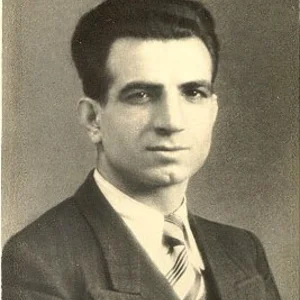

Armenian poet and Communist resistance fighter, Missak Manouchian led the FTP-MOI group in Paris during the Occupation. Arrested by the Gestapo, he was featured on the Affiche rouge by Nazi propaganda before being shot at Mont-Valérien on February 21, 1944.
Missak Manouchian(1906 — 1944)
Missak Manouchian
Empire ottoman
7 min read
Frequently asked questions
Famous Quotes
« At the moment of dying, I proclaim that I have no hatred toward the German people.»
Key Facts
- Born in 1906 in Ottoman Armenia, a survivor of the Armenian genocide
- Arrived in France in 1925, joined the French Communist Party
- Took command of the FTP-MOI group (Francs-Tireurs et Partisans — Main-d'Œuvre Immigrée) in Paris in 1943
- Arrested in November 1943, displayed on the Affiche rouge by the Nazis to stigmatize the Resistance as 'foreign'
- Shot at Mont-Valérien on February 21, 1944; inducted into the Panthéon in February 2024
Works & Achievements
A collection of lyrical poems written in Armenian, bearing witness to the grief of a lost homeland and the hope for a more just world. They were gathered and translated after the war, revealing a poet of great sensitivity.
A deeply moving letter written just a few hours before his execution, which became one of the most poignant documents of the French Resistance. It bears witness to his dignity, his love, and his faith in the allies' final victory.
In-depth articles and poems published in the Armenian immigrant press in France, weaving together communist political demands and a steadfast attachment to Armenian culture threatened with oblivion.
Under his command, the FTP-MOI group carried out more than a hundred armed actions in just a few months: attacks against German generals, industrial sabotage, and weapons seizures. An unprecedented urban military campaign within the Parisian Resistance.
Anecdotes
Orphaned by the 1915 Armenian Genocide, Missak Manouchian witnessed his parents being massacred when he was just nine years old. Taken in by an orphanage, he learned to read and write in Armenian before setting out alone for France in 1925, at the age of nineteen, without speaking a word of French.
Although a wanted Resistance fighter, Manouchian continued to write poems in Armenian right up until his arrest. He published in the Armenian press of Paris under his real name, convinced that culture was as much a form of resistance as weapons.
The *Affiche rouge* (Red Poster), plastered across Paris in February 1944 by Nazi propaganda to brand the group's members as 'foreign terrorists', had the opposite effect to the one intended: many French people saw in it patriots who had died for France, and Louis Aragon's poem *L'Affiche rouge* became an anthem of the Resistance.
In his final letter to his wife Mélinée, written on the very morning of his execution on 21 February 1944, Manouchian wrote: 'I am certain that the French people and all the fighters for Liberty will know how to honor our memory with dignity.' These prophetic words came true eighty years later when he entered the Panthéon.
In less than a year, the FTP-MOI group led by Manouchian carried out more than a hundred armed actions against the Nazi occupier in Paris: attacks on German officers, acts of sabotage, and executions of collaborators. The occupier nicknamed them 'the Army of Crime', a title sarcastically reclaimed by the Resistance as a badge of honor.
Primary Sources
My dear Mélinée, my beloved little orphan, in a few hours I will no longer be of this world. We are to be shot this afternoon at 3 PM. This happens to me like an accident in my life, I do not believe it, yet I know I will never see you again.
Liberators? Liberation by the army of crime. Manouchian Group — Gang leader — Armenian, Jew — 56 attacks — 150 dead — 600 wounded.
Autumn comes from afar, from the depths of dark times, it carries in its arms the leaves and the fruits, the hopes and the mournings of vanished peoples.
We fought for France as for our own homeland. We are not ashamed of what we did.
Key Places
Birthplace of Missak Manouchian, in the Ottoman Empire, where he was born in 1906 and witnessed the horror of the Armenian Genocide of 1915, which claimed the lives of his parents.
Working-class districts of Paris where Manouchian lived and organized, at the heart of the Armenian immigrant and labor community. It was here that he led the operations of the FTP-MOI group.
Large prison in the southern suburbs of Paris where Manouchian and his comrades were held after their arrest in November 1943, prior to their summary trial and execution.
The main execution site in the Paris region during the Occupation; Manouchian and twenty-two of his comrades were shot there on February 21, 1944. A national memorial stands on the site today.
Republican temple where the great men and women of the French Nation are laid to rest. Missak and Mélinée Manouchian were inducted into the Panthéon on February 21, 2024, 80 years after their execution.
Typical Objects

Underground resistance fighters used forged identity cards to move around without being stopped at German or Vichy police checkpoints. Manouchian regularly changed his aliases to cover his tracks.

A handgun used by FTP-MOI groups in armed operations against the occupying forces. Resistance fighters obtained their weapons from Allied airdrops or by seizing them from the enemy.

Mimeographed sheets distributed in secret to inform the population about Resistance activities and counter Nazi propaganda. Printing and distributing them was punishable by death.

Manouchian wrote his poems in Armenian in notebooks he kept with great care — a testament to his attachment to his native culture despite exile and life underground.

A large-format Nazi propaganda poster plastered across Paris in February 1944, combining photographs with accusations to portray the fighters of the Manouchian group as foreign criminals.

A newspaper of the Armenian community in France in which Manouchian published his poems and activist articles. This kind of community press served as the vital link between Armenian exiles living in France.
School Curriculum
Vocabulary & Tags
Key Vocabulary
Tags
Daily Life
Morning
During his time underground, Manouchian never slept in the same place two nights in a row. Each morning, he would check for any surveillance around his hideout, sometimes alter his appearance, and collect forged papers from his contacts before making his way to a meeting point arranged the day before.
Afternoon
Afternoons were devoted to organizing armed operations: meetings in discreet cafés or back rooms, passing instructions to his lieutenants, scouting potential targets. All contact was made through secure networks to avoid compromising the cell in the event of an arrest.
Evening
In the evenings, Manouchian would sometimes find shelter with sympathizers or in transit safe houses. He made use of rare moments of respite to write poems in Armenian, read the underground press, or correspond with his wife Mélinée using agreed-upon codes.
Food
Like the rest of the Parisian population, Manouchian lived under the ration-card system, which drastically limited access to meat, bread, and fats. Life underground made obtaining food even harder, and resistance fighters often depended on the solidarity of their supporters to get by.
Clothing
Manouchian wore ordinary workers' clothes — a work jacket, a flat cap — to blend into the crowd and avoid drawing attention while moving around Paris. His dress had to be unremarkable, neither too worn nor too neat, so as not to attract police scrutiny.
Housing
Manouchian lived in a state of constant movement, regularly changing hideouts to escape Gestapo raids and tails. Before going fully underground, he shared a modest apartment with his wife Mélinée in a working-class building in the 10th arrondissement of Paris, typical of the housing occupied by immigrant workers of the era.
Historical Timeline
Period Vocabulary
Liens externes & ressources
Références
Œuvres
Poèmes en arménien (recueil posthume)
1930-1943
Dernière lettre à Mélinée
21 février 1944
Articles dans le journal Zangou
1934-1939
Direction des opérations du groupe FTP-MOI de Paris
1943