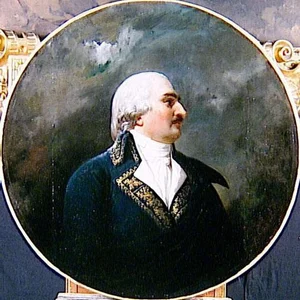
Sultan of Morocco from 1822 to 1859, Moulay Abd er-Rahman had to navigate between French and Spanish colonial pressures while maintaining Moroccan sovereignty. After supporting Abdelkader against France, he was defeated at the Battle of Isly in 1844.
Moulay Abd er-Rahman
Moulay Abd er-Rahman ibn Hicham
8 min read
Frequently asked questions
Key Facts
- Sultan of Morocco from 1822 to 1859, of the Alaouite dynasty
- Supported Emir Abdelkader in his resistance against the French conquest of Algeria
- Defeated by the French army at the Battle of Isly (14 August 1844)
- Signed the Treaty of Lalla Maghnia (1845) establishing the Algerian-Moroccan border
- Attempted to modernize the Moroccan army in the face of European threats
Works & Achievements
Agreement signed following the defeat at Isly, by which Morocco committed to ceasing all support for Abd el-Kader. This treaty marked the first major Moroccan concession under French colonial pressure and signaled the end of official backing for Algerian resistance.
Treaty establishing, under duress, the border between Morocco and French Algeria. This artificial frontier, which ignored local tribal realities, generated lasting tensions in the region and remained disputed well beyond the nineteenth century.
An attempt to create a regular infantry trained along European lines with the help of foreign instructors. The first outline of military modernization in modern Moroccan history, it foreshadowed the reforms that his successors would continue to pursue.
Trade agreement granting customs advantages to British merchants in Morocco. Signed under diplomatic pressure, it illustrates the economic concessions the sultan was compelled to make in order to preserve an increasingly fragile political independence.
A body of letters and negotiations with France, Spain, Great Britain, and the Ottoman Empire, preserved in Moroccan and European archives. These documents attest to an active diplomacy aimed at maintaining Sharifian sovereignty in the face of colonial ambitions.
Anecdotes
In 1832, the French painter Eugène Delacroix accompanied a French diplomatic mission to Morocco. Moulay Abd er-Rahman received him in solemn audience at Meknes, surrounded by his mounted Black Guard. This encounter inspired the famous painting *The Sultan of Morocco and His Entourage*, exhibited at the Salon of 1845, which revealed the splendor of the Sharifian court to European audiences.
On August 14, 1844, the Moroccan army was crushed by the French forces of Marshal Bugeaud on the banks of the Isly River, near Oujda. Despite the numerical superiority of his cavalry, the sultan was overwhelmed by devastating modern artillery. This humiliating defeat forced him to sign a peace treaty and officially abandon all support for Abd el-Kader.
Before the Battle of Isly, the fleet of the Prince of Joinville bombarded Tangier (August 6, 1844) and then Mogador — present-day Essaouira — from the sea. These naval bombardments, to which Morocco had no answer for lack of a war fleet, laid bare the military gulf between the Sharifian empire and Europe's industrial powers.
Aware of the technical lag in his armies, Moulay Abd er-Rahman attempted to introduce a European-style regular infantry known as the *Nizam*. Foreign instructors were recruited to train these new units, but internal resistance and a lack of resources hampered this ambitious reform, which remained unfinished until his death in 1859.
After the defeat at Isly and Abd el-Kader's surrender to the French in 1847, the sultan was compelled to accept an Algerian-Moroccan border imposed by the Treaty of Lalla Maghnia (1845). This border, drawn without regard for the nomadic tribes who freely crossed it, would remain a source of tension between Morocco and Algeria well beyond the nineteenth century.
Primary Sources
His Majesty the Emperor of Morocco undertakes to expel Abd el-Kader from Moroccan territory and to pursue him as a common enemy should he persist in resisting French authority and disturbing the peace between the two States.
The two governments acknowledge that the nomadic tribes inhabiting the east and west of the demarcation line cannot be subjected to strict territorial delimitation, given their particular way of life.
The Sultan rode out from his palace on horseback, surrounded by his guard and his officers. His dress was simple yet his bearing commanded great majesty; he scarcely glanced at the crowd, with that air of confidence that comes from a lifetime of absolute command.
We have always wished to maintain relations of sincere friendship with France; the disputes that have arisen cannot alter our shared will for peace and trade, founded on the mutual respect of our sovereignties.
Key Places
The spiritual and administrative capital of Morocco, seat of the Makhzen where Moulay Abd er-Rahman held his court and issued his dahirs. The royal palace of Fès concentrated the machinery of the central Sharifian government.
An imperial city where the sultan received in solemn audience the French diplomatic mission accompanied by Delacroix in 1832. His palace, a legacy of Moulay Ismail, impressed European visitors with its splendour.
The site of the battle of 14 August 1844, where the Moroccan army was defeated by the French forces of Marshal Bugeaud. This river in eastern Morocco gave its name to one of the most significant defeats in 19th-century Sharifian history.
A strategic port facing Gibraltar where European consuls resided, bombarded by the French fleet in August 1844. The principal site of diplomatic negotiations, the city was also the scene of the signing of the Franco-Moroccan peace treaty on 10 September 1844.
The southern capital of Morocco, where the sultan regularly stayed to consolidate his authority over the tribes of the south. A symbolic city of Alaouite legitimacy, it complemented Fès and Meknès as part of the network of imperial capitals.
Typical Objects

Curved-blade saber characteristic of 19th-century Morocco, with a guard adorned with carved ivory or horn. An honorary attribute of the sultan and his officers, it symbolizes military authority and Sharifian royal legitimacy.

A voluminous hooded white wool cloak worn by the sultan during public audiences, described by Delacroix as the garment of his great majesty. The whiteness symbolizes the spiritual purity associated with the title of Commander of the Faithful.

A metal stamp engraved with the sultan's Arabic titles, affixed to dahirs (royal decrees) and diplomatic correspondence. Its impression authenticates international treaties and gives binding force to the orders of the Makhzen.

A bronze artillery piece used by the Moroccan army at the Battle of Isly. Less accurate and less mobile than French rifled cannons, it illustrates the military technological gap that cost the sultan his defeat in 1844.

A miquelet-type flintlock musket, the standard weapon of the Moroccan cavalry, often inlaid with mother-of-pearl and silver for officers. Its ignition mechanism, less reliable than French percussion rifles, contributed to Morocco's military difficulties.

A richly decorated Quranic manuscript featuring calligraphy and gilded interlacing patterns, kept in the palace library. As Commander of the Faithful, the sultan derived from this text the religious legitimacy of his authority over the kingdom.
School Curriculum
Vocabulary & Tags
Key Vocabulary
Daily Life
Morning
The sultan rose at dawn for the fajr prayer in the company of the court's ulamas. He then received reports from his vizirs on the state of the kingdom and held an audience (mouna) where governors, caids, and notables came to present their requests or disputes.
Afternoon
The afternoon was devoted to affairs of state: drafting dahirs (royal decrees), receiving foreign ambassadors and consuls in the throne room, or inspecting the garrison troops. On market days, the sultan might ride out to show himself to the people, escorted by his Black Guard (Abid al-Bukhari).
Evening
The evening brought the sultan together with his close family, scholars, and musicians in the palace's private apartments. Reading the Quran and religious texts marked the end of the day, before the isha prayer and the evening meal served in the strictest privacy.
Food
The sultan's table offered refined dishes: couscous with seven vegetables, meat and prune tajines, and flaky bastilla with pigeon drizzled with honey and almonds. Mint tea accompanied long diplomatic audiences, while rose water perfumed desserts and table water.
Clothing
In public, the sultan wore a fine white wool burnous over a gold-embroidered djellaba, and yellow babouches reserved for members of the royal family. For military audiences, he wore more sober attire with a white turban and a belt bearing his ceremonial nimcha.
Housing
Moulay Abd er-Rahman resided in the imperial palaces of Fez, Meknes, and Marrakesh — vast complexes of inner courtyards adorned with zellige tilework and carved stucco, gardens irrigated by seguias, and libraries housing precious manuscripts. The harem, royal stables, arsenals, and Makhzen storehouses formed a truly self-sufficient microcosm.
Historical Timeline
Period Vocabulary
Liens externes & ressources
Références
Œuvres
Traité de paix de Tanger avec la France
10 septembre 1844
Convention de délimitation de Lalla-Maghnia
18 mars 1845
Réforme militaire du Nizam
Années 1840-1850
Traité de commerce avec la Grande-Bretagne
1856
Correspondance diplomatique avec les puissances européennes
1822-1859