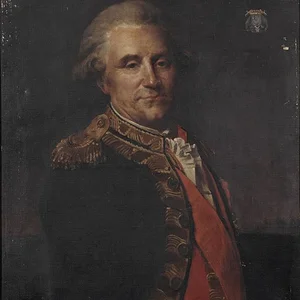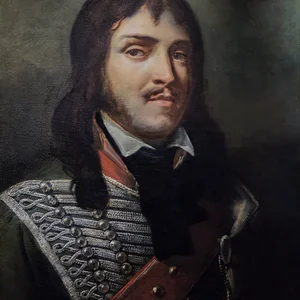

French general of the Revolution (1756–1793), he took command of the Army of the North after Dumouriez's betrayal and was killed in action during the siege of Condé-sur-l'Escaut. Pantheonized in 1793, his remains were removed during the Restoration.
Auguste Marie Henri Picot de Dampierre(1756 — 1793)
Auguste Marie Henri Picot de Dampierre
France
7 min read
Frequently asked questions
Key Facts
- Born in 1756 into the nobility, he embraced the revolutionary cause
- Took command of the Army of the North in April 1793 following Dumouriez's defection
- Killed in action on 8 Thermidor (27 May 1793) during the siege of Condé-sur-l'Escaut
- His remains were transferred to the Panthéon in August 1793 by decree of the National Convention
- Removed from the Panthéon in 1814 during the monarchical Restoration
Works & Achievements
Dampierre took command of the Army of the North in the midst of a total crisis following Dumouriez's betrayal. He stabilized the front and maintained the cohesion of the republican troops against the Austro-Prussian coalition.
A thorough effort to restore discipline and supply lines to a demoralized army, carried out in constant coordination with the Committee of Public Safety. This near-impossible mission, accomplished in just a few weeks, earned the admiration of the Convention.
Offensive attempts to loosen the coalition's grip on the northern fortified towns. Conducted under difficult conditions, these actions slowed the Austrian advance and bought the Republic precious time.
The Convention voted to transfer his remains to the Panthéon, enshrining his sacrifice as an example of republican devotion. This honor, revoked under the Restoration, illustrates the political dimension of the posthumous legacy of revolutionary heroes.
Anecdotes
When Dumouriez betrayed the Republic by defecting to the Austrians on April 5, 1793, the Convention suddenly had no commander for the Army of the North. Dampierre, until then a little-known lieutenant general, was urgently appointed to take command. He inherited a demoralized army, short on ammunition and threatened on its right flank — an immense challenge he faced with a composure that his contemporaries remarked upon.
On May 8, 1793, during the siege of Condé-sur-l'Escaut, Dampierre was inspecting his lines on horseback when an Austrian cannonball struck him fatally. According to accounts from his aides-de-camp, he refused to take cover, believing that the commander-in-chief had a duty to remain visible to his troops in order to keep their spirits up.
In July 1793, the National Convention voted to pantheonize Dampierre, placing him among the great servants of the nation alongside Voltaire and Mirabeau. History's irony: during the monarchical Restoration, his remains were removed from the Panthéon — his name, associated with the revolutionary armies, had become politically undesirable to the Bourbons who had returned to power.
Dampierre belonged to the nobility of the Ancien Régime and had served in the royal army before the Revolution. Unlike many of his peers who emigrated, he chose to remain in France and serve the Republic, illustrating the deep divide within the French military nobility in the face of the events of 1789.
Primary Sources
The National Convention, considering the necessity of filling the command-in-chief of the Army of the North following the defection of General Dumouriez, decrees that General Dampierre is appointed commander-in-chief of said army.
The army is in a state of disorganization that I cannot conceal from you. The soldiers lack shoes, supplies are insufficient, and the enemy is pressing on our left flank. I will do everything humanly possible to hold our positions.
The representative of the people Delacroix announces to the Convention that General Dampierre, commander-in-chief of the Army of the North, has died from wounds sustained before Condé-sur-l'Escaut. The Convention decrees that the fatherland is well indebted to him.
The National Convention decrees that the remains of Auguste Marie Henri Picot de Dampierre shall be transferred to the Panthéon, in recognition of his services rendered to the fatherland and his sacrifice in defense of the Republic.
Key Places
A fortified town in northern France where Dampierre died on May 8, 1793, struck by an Austrian cannonball while inspecting his troops. This place stands as a symbol of his sacrifice in defense of the Republic.
The Parisian monument where Dampierre's ashes were transferred in 1793 to honor his sacrifice, before being removed during the Restoration — a reflection of the era's turbulent political upheavals.
A major northern stronghold and headquarters of the Army of the North, which Dampierre took command of following Dumouriez's betrayal. It was from this city that he attempted to reorganize the republican forces.
The place where the Convention appointed Dampierre commander-in-chief and where the political decisions governing his military operations were made. The Salle du Manège, and later the Tuileries, served as the center of republican power.
Typical Objects

Standard-issue weapon worn at the belt by republican generals, with a slightly curved blade and gilded guard. It embodied both rank and the capacity for close combat when necessary.

A sash in the blue, white, and red colors worn across the chest by generals to be identified on the battlefield. A symbol of republican authority, it replaced the marks of honor of the Ancien Régime.

A detailed military map of the Army of the North's theater of operations, covering the Belgian-French border and fortified towns such as Condé, Valenciennes, and Mons. An indispensable tool for planning troop movements.

Flintlock pistols carried in the saddle holsters, serving as the mounted general's personal sidearms. In the event of close combat or ambush, they were the last resort before the saber.

An official document issued by the National Convention granting Dampierre supreme command of the Army of the North. This commission, sealed with the Republic's stamp, symbolized the break with the royal appointments of the old order.

A brass and leather telescope allowing the general to observe enemy positions from a safe distance. On the battlefield, it was the commander's eye.
School Curriculum
Vocabulary & Tags
Key Vocabulary
Daily Life
Morning
General Dampierre rose before dawn to receive his officers' night reports and study the staff maps. The day began with a quick review of the front-line situation, followed by dispatching communiqués to the Committee of Public Safety in Paris.
Afternoon
Afternoons were devoted to mounted troop inspections, war councils with his divisional generals, and overseeing supplies — an exhausting task for a chronically under-equipped army. Strategic decisions were often made under direct pressure from the representatives on mission sent by the Convention.
Evening
In the evenings, Dampierre dictated his march orders for the following day and drafted his official dispatches, reporting to Paris on the military situation with a frankness his superiors did not always appreciate. He slept little, in makeshift billets, sometimes sharing the same conditions as his men.
Food
Like his troops, the general ate plainly: soup, hardtack, boiled meat when the quartermaster could provide it. Coffee, an increasingly scarce commodity under the blockade, was the essential stimulant during his working nights.
Clothing
Dampierre wore the blue coat with red lapels of Republican generals, a tricolour sash across his chest, and the cockaded hat. He had abandoned the embroidery and powdered wigs of the *Ancien Régime* for a more sober dress, a symbol of Republican regeneration.
Housing
A campaign general's itinerant headquarters amounted to a requisitioned house in a village near the front, furnished with a table spread with maps, makeshift chairs, and a camp bed. No comfort was possible in the northern war zone.
Historical Timeline
Period Vocabulary
Liens externes & ressources
Références
Œuvres
Commandement de l'armée du Nord (avril-mai 1793)
5 avril – 8 mai 1793
Réorganisation des troupes après la défection de Dumouriez
Avril 1793
Opérations militaires autour de Condé-sur-l'Escaut et Valenciennes
Avril-mai 1793
Panthéonisation posthume
Juillet 1793